On November 2 the newspaper San Diego Union-Tribune hosted a free event that attracted a 50+ crowd interested in subjects related to aging. Main speakers were Patricia Schultz (author of 1000 Places to See Before You Die) and Captain Dale Dye, USMC retired (author, filmmaker) focused on veterans and others.
November 2, 2019
Most of the activity at the San Diego Convention Center was at booths. Among the participants offering information were AARP, Leading Age, healthcare service providers, a cancer awareness initiative group, estate planners, Medicare Advantage Plan insurers such as Humana and SCAN, retirement counselors, senior movers, senior living placement consultants, a sleep therapy advisor, and others.
The highlight for me, related to some of my work as a senior placement consultant for Mexico, was to meet up with Miguel Angel Torres and Marisa Molina of Serena Senior Care in Baja California. I toured their Rosarito assisted living home last year and am eager to return to see their latest developments. I appreciate their dedication, enthusiasm, and focus on quality care. See www.serenacare.net plus links to videos found on their web site.
As an aside, Serena offers residents and visitors to Baja a Full Assistance Card for $99/year ($198 per couple). The Full Assistance Card offers ambulance services, roadside assistance, a 24-hour bi-lingual call center, discounts, and access to online medical records. Have not seen this service in action so am not in a position to comment on it. Information on this is at the web site listed above.
Miguel Angel Torres, one of his supporters, and Wendy Jane Carrel Assisted Living Consultant for Mexico at Serena Care booth
Corey Avala of www.RetireBaja55.com was also present to encourage folks to retire early and “affordably” to one of three developments he is involved with. Have not seen them.
Jane Garcia, a realtor from Dream Home Mexico was also there to espouse the benefits of retiring to Mexico.
One of the advantages of Baja California for assisted living and retirement, aside from the lower cost of living, is its close proximity to San Diego for health care through the Veteran’s Administration, and U.S. healthcare for American ex-pats who wish to return in case of need.
Many thanks for the warm reception by the San Diego Union-Tribune sponsor team! Many thanks to the San Diego Union-Tribune for producing the San DiegoEldercare Directory 2020 available in print at the expo, and also available on-line at http://www.sandiegoeldercare.com. The directory includes listings of independent living and long-term care throughout San Diego County.
This is an exciting fall month for educational events.
Other than shepherding families to appropriate, compatible Mexican assisted living and ”nursing” care for their loved ones, pastoral care visits to sweet older adults at Lake Chapala (always a pleasure), and coordinating the production of health books (one a translation to Spanish), there are seminars to attend and blog about, plus informational talks I have prepared for ex-pats.
Here’s a partial calendar….
October 3 Future of Medical Cannabis conference on-line. Medical cannabis is not yet legal in Mexico, lots of challenges related to its release, but all is possible. Am keeping informed of movements in the U.S. and Canada. Some U.S. doctors are titrating down opioid prescriptions and other pain meds for their patients- slowly, by introducing medical cannabis at the same time.
Oct 16 Beautiful Dying in Mexico Power Point presentation at Lake Chapala Society. In honor of Mexico’s Day of the Dead, Dia de los Muertos, an overview of dying in Mexico – family and religious traditions, rituals, their origins and meaning, and why many Mexicans seem so comfortable with death. Told through stories I’ve been witness to volunteering at a palliative care hospital/hospice and/or as a friend on a village street in Ajijic, Mexico.
Oct 19 Medical Cannabis in Mexico Conference all day in Guadalajara
Oct 22 Preparing for Medical Emergencies at Lake Chapala Power Point presentation at Presbyterian Church
Oct 24-26 4th International Palliative Care Congress at UTEG in Guadalajara produced by www.JuntosContraelDolor.com, the palliative care hospital and service I volunteer with
Oct 30 Focus on Mexico Power Point presentation about Senior Care in Mexico, members only
One of the biggest pleasures for those of us dedicated to healthcare (for me senior care and palliative care from a social, spiritual, and administrative perspective) is to attend a conference where one can network and learn from thought leaders focused on a similar mission – best practices for quality care.
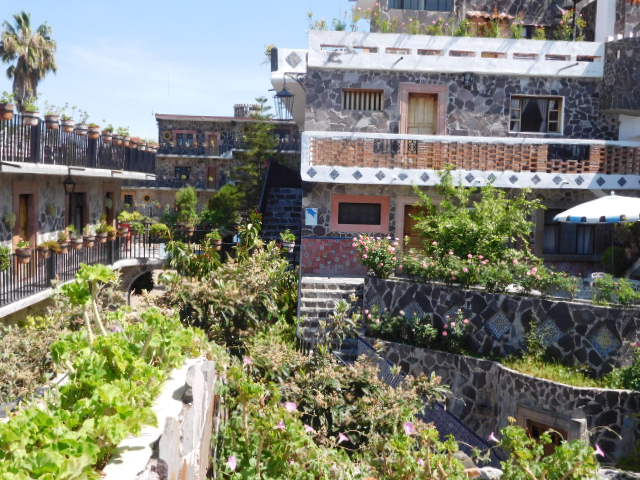
The 2nd PACE Pan American Forum for Emergency Care and Global Health held at Hotel Real de Minas in San Miguel de Allende, Mexico last month, was a gift for all attendees. (Below is a photo of Hotel Posada de las Monjas in SMA, a former monastery, where the PACEforum.org offices are located).
PaceForum.org headquarters in San Miguel de Allende at Hotel Posada de las Monjas, a former monastery
The three-day conferencefocused on innovative ways to offer medical training to communities in lower-resource, culturally challenging settings through technology (tele-mentoring, digital health monitoring), and one-on-one communication and care skills.
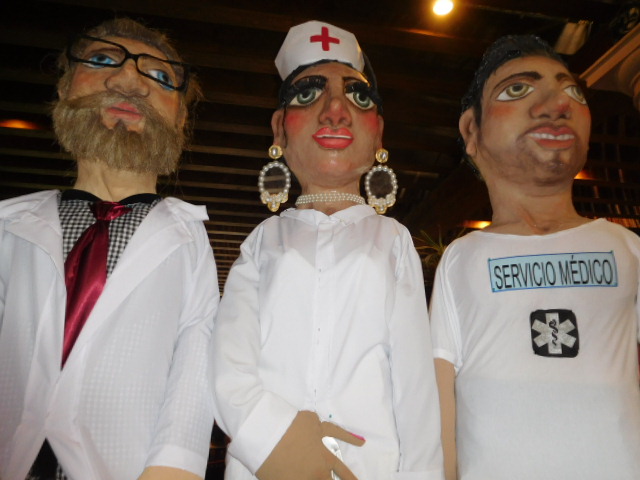
PaceForum.org 2019 Hotel de Real Minas lobby mascots
Public health leaders in Emergency Medicine shared years of accumulated knowledge from state, national, and international levels. Tracks included general emergency medicine, disaster management, obstetrics, pediatrics, the ECHO tele-mentoring program, rural and wilderness medicine, palliative care, and many more. Attendees received CME credits.
Each track was of the utmost importance.
The most meaningful tracks forme were physicians teaching palliative care to emergency resident physicians, a demonstration of a clinically proven mental health protocol for first responders and physicians to keep themselves and others calm through Breath-Body-Mind (trade-marked), and the presentation by internationally renowned social entrepreneur, university professor, and conference founder Dr. Haywood Hall who focused on the formidable impact the PACE program has had in Mexico, plus a current international concern, health and mental health issues at the US-Mexico border.
Thanks to the international work of Dr. Angel Braña-Lopez, and New York integrative psychiatrists Drs. Richard Brown and Patricia Gerbarg of www.Breath-Body-Mind.com who teach innovative programs to help people recover from trauma and mass disasters, I was able to travel to San Miguel de Allende. Many thanks also to Dr. Haywood Hall!! It was a privilege to attend.
Other attendees were medical school professors from Latin America (mostly Mexico) and the U.S., specialists, generalists, nurses, mid-wives, paramedics, community health workers and others.
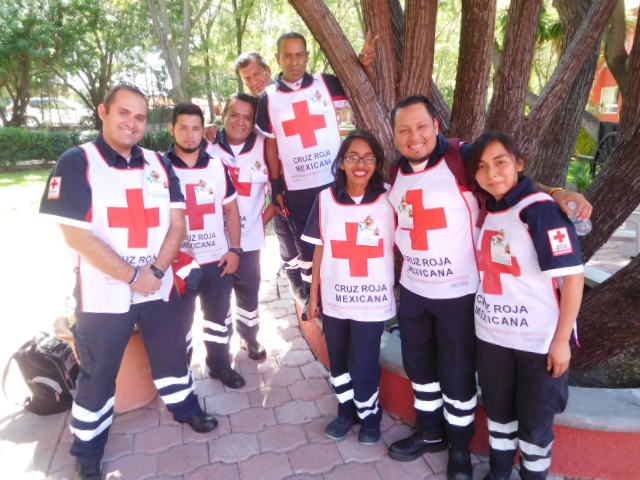
Cruz Roja (Red Cross) paradmedics at PaceForum.org 2019
More about PACE Global Health
PACE Global Health (aka Groupo PACE) is an off-shoot of the award-winning social impact program PACE MD, founded over 20 years ago “to improve emergency and general medical care in Latin America through community-based training in skills, knowledge and ability as well as to improve medical care in the US and Latino populations through MedSpanish’s language and cultural literacy training (offering CME and GME credits).”
PACE MD founder Haywood Hall is an Emergency Medicine Specialist, Telemedicine Physician, and Professor at the University of New Mexico and the University of North Carolina. He is an American fluent in Spanish language and culture, and is an Ashoka Change Maker Fellow who works with Duke University’s Innovations in Healthcare. His PACE program has trained and certified over 41,000 healthcare providers and 6,000 lay people in systems-based emergency care.
For his achievements in positively affecting the chain of survival through emergency care skills Dr. Hall has won the International Federation of Emergency Medicine Humanitarian Award as well as the College of Emergency Physician’s Hero of Emergency Medicine Award, LATAM’s Top 10 Social Impact Enterprise in Latin American and the Caribbean Award, the American Heart Association’s Silver Award, as well as 2nd place for Social Innovation from Mohammad Yunus Creative Labs.
PaceForum.org breakfast meeting with Ms. Karen, Dr. Angel Brana-Lopez, Elena Lopez of Hola Hospice, Wendy Jane Carrel of Wellness Shepherd and Book Ambassador,, and Dr. Haywood Hall, founder of PACEMD, Pace Forum, and MedSpanish
“The future of emergency medicine is here and it’s up to us to pave the way,” states Dr. Hall. “As front line healthcare providers we are in a unique position to be agents of change. We know the exact problems that plague our societies.”
If you are interested in learning more about Latin culture and how you can use healthcare technology to reach low resource areas you may wish to attend the next Pan-American Forum for Emergency Care and Global Health (date not yet set), or contact PACE via the information below:
Another take away: What many people may not realize is the enormous effort and energy required to create innovative, sustainable public health programs, especially related to emergency medicine, which is often a 24/7 profession. Most participants, and PACE founder Dr. Hall, usually depend on their teaching income to fund their outreach passions and programs.
Note: PACE International is not to be confused with another PACE, a US federal Program of All Inclusive Care for the Elderly. The objectives are similar, however – to treat all with dignity, compassion, and quality care.
I always look forward to addressing folks from Canada, Europe and the U.S. at Focus on Mexico one-week seminars, currently held every two to three months at the Real de Chapala Hotel, Lake Chapala, Mexico.
Most attendees are considering a move to Mexico for a variety of reasons – adventure, climate, housing costs, more affordable healthcare, retirement, and more!
Placard in front of modest assisted living home, Jocotopec, Lake Chapala
The newbies will see my Power Point presentation Thursday morning, August 8, outlining various models of senior living and senior care in Mexico – government, non-profit, and for profit independent living, assisted living, memory care, and Life Plan Communities/CCRC’s. My photos of senior living options are from various states in Mexico from Baja California to Merida in the Yucatan, all ex-pat havens.
To date, Lake Chapala attracts the fastest growing and largest community of ex-pats in Mexico.
I am a Spanish-speaking senior care specialist for Mexico, serving Americans, Canadians, and Europeans who are discovering they may not be in a position to retire, or, may outlive their savings. They are looking for more affordable aging options at home or abroad.
Where are these retirees choosing to move if going abroad?
Mexico … for the most part, because of its proximity to Canada and the U.S., milder weather, opportunities for new life adventures, and most of all, access to medical and senior care at one-third to one-half less than at home – a major concern, just in case, even for those who are super fit and who follow a healthy lifestyle.
This boom is no surprise to developers from Canada, Mexico, Spain, and the U.S. who have anticipated the rise in the number of retirees from Canada and the U.Sfor over 10 years – to Baja California, Mazatlan, Oaxaca, Puerto Vallarta, San Miguel Allende, and the Quintana Roo/Yucatan states where Merida and Cancun reign. Large numbers of ex-pats continue to arrive.
Many new retirees – boomers, boomers bringing parents, and some Gen-Xers – love technology, travel, and learning. They like to drive, to explore. Some will continue to work on-line. More than anything they enjoy their independence. They seek ways to live more economically, and, use Mexico as a home base for more travel.
They have unique interpretations of what independent living means. Generally, the vision is of a person 50 or older, usually but not always retired. The overriding lifestyle goal is AGING IN PLACE either within a community where one is self-sufficient, or in a community providing services such as meals, laundry, cleaning, and transportation.
Mexico is preparing to offer a variety of such choices in beach environments or the colonial highlands.
However, unlike the U.S., retirees must not expect choices as diverse as an all Hindu, laughing yoga, retired postal worker, artist, Japanese, or Presbyterian senior community, nor any development as large as a Sun City.
The most aggressive housing expansion has been at Lake Chapala, one hour south of Guadalajara, Mexico’s second largest city, which also boasts an international airport.
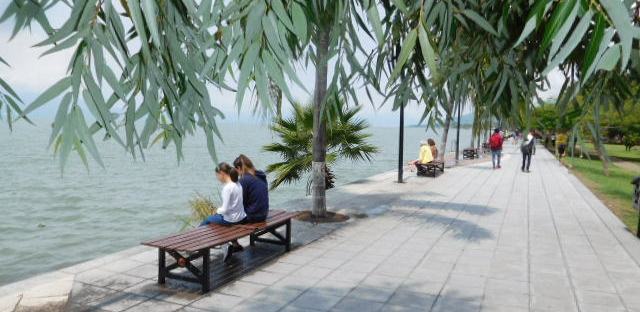
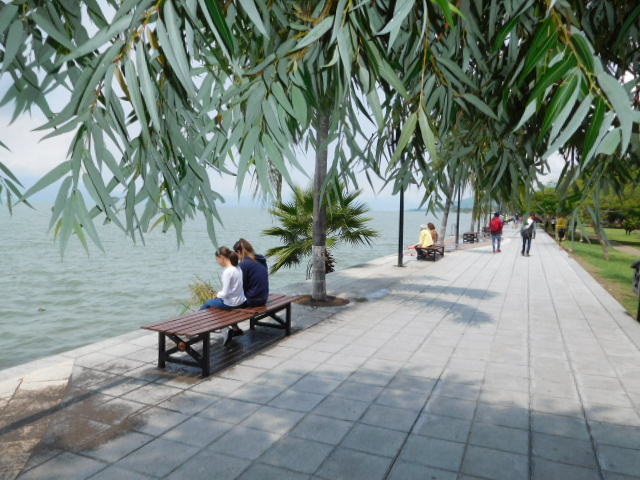
Ajijic malecon, Lake Chapala, Mexico
What kind of housing are retirees finding at the lake?
If not stand-alone private homes, most retirees are on the look-out for living akin to 55+ communities near golf courses, shopping, gyms, spas, and the company of other ex-pats.
What’s in the offing at Lake Chapala?
Three large construction projects – two Life Plan Communities with independent living (with moves to assisted living or nursing care as part of a long-term plan), and one “luxury” development of condos and casitas not unlike already existing communities known as El Dorado, El Parque, or The Raquet Club replete with tennis courts, pools, a club house, gym equipment, and gardens. The new projects may open by 2021.
The two newest additions for independent living at Lake Chapala are:
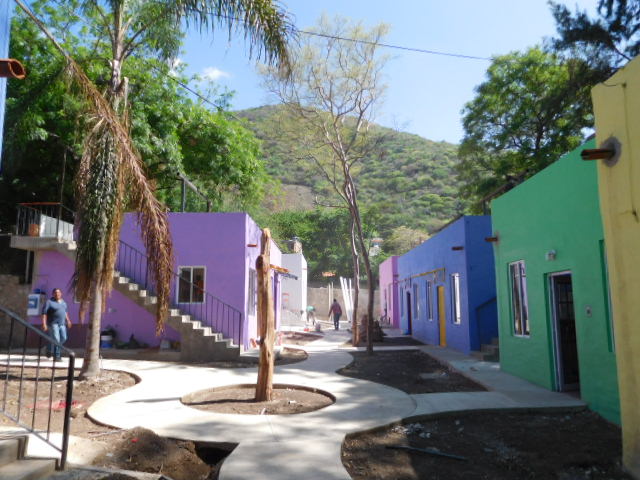
Namaste Lake Chapala Community tiny houses, a co-housing enclave in the village of Ajijic. Its founder is American James F. Twyman, a body/mind/spirit author and musician who travels the globe as a “peace troubadour.” The Namaste community opens its doors to the public for morning meetings to discuss or review A Course in Miracles.
Namaste Community Patio, Lake Chapala
Namaste offers 12 brightly painted homes providing 300 SF to 600 SF of living space, each with kitchen, bath, and living areas. The Namaste concept is to age in place affordably, bringing healthcare in should it be needed. Meals are communal, or taken to your residence if you wish silence.
Namaste Co-Housing Community, Lake Chapala, Mexico
Namaste Co-Housing Communty, Lake Chapala, Mexico
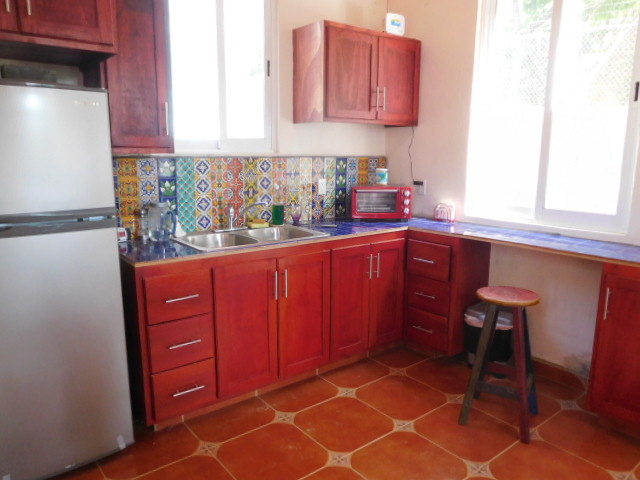
First Completed Namaste Tiny House Kitchen
As of this writing, all but one of the homes have been purchased and/or rented. For more information see www.NamasteLakeChapala.com or call Kerri Moon, Head of Sales, at (510)250-3002, a U.S. phone number.
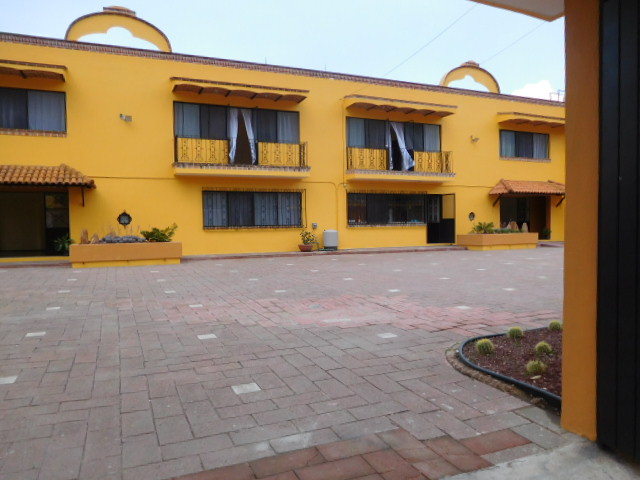
Ohana Independent Living in San JuanCosala, 20 minutes west of Ajijic, is the other newbie. The owners are bi-lingual geriatric nurses. Even though there is no assisted living or nursing care at their two story independent living home on the lake, folks with walkers who can take care of themselves are welcome. An elevator is currently being installed.
Ohana Independent Living main gate entrance, Lake Chapala
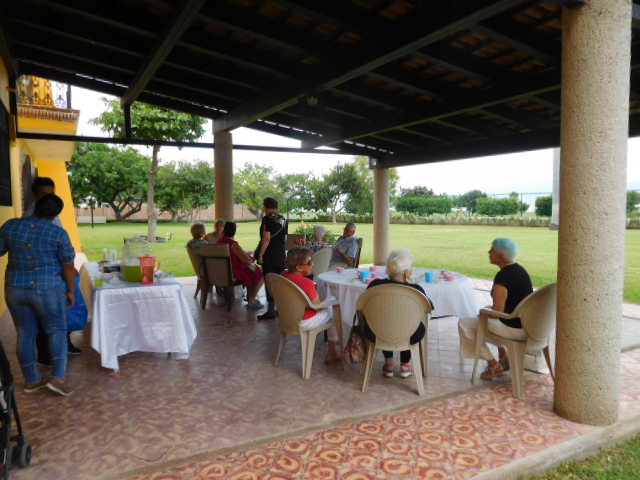
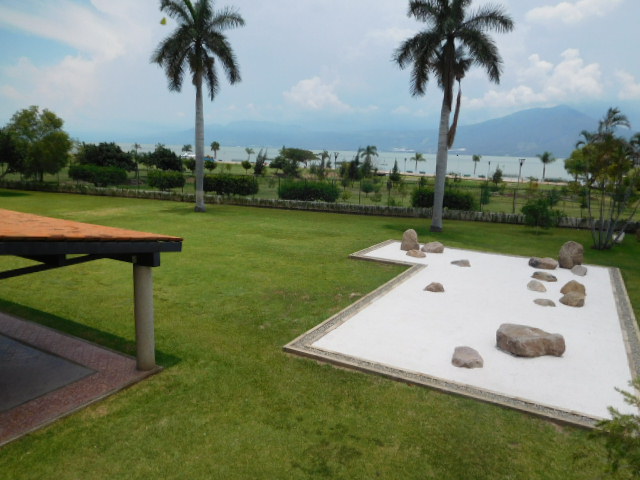
Ohana Independent Living is located on a large lakefront estate with sprawling lawns, close to nature. There are 12 rooms. Each residence has mountain or lake views. There is a balcony on the second floor facing the lake. Rooms are partially furnished or decorated to one’s preferences. Dogs are welcome. Meals are included, as well as laundry, maid service, and parking. There is no web site. For more information call Alonzo Garcia at 52 331 495-6167.
Alonzo, Ana, and Adam bi-lingual owners of Ohana
Patio at Ohana Independent Living, Lake Chapala
Cloudy day view of Lake Chapala from Ohana Independent Living
Dining room, newly opened Ohana Independent Living, Lake Chapala, Mexico
Summation:
There are currently three independent living residences with meals, laundry, maid service, and parking for your car at Lake Chapala. There is a fourth residence, owned by a physician, with no parking. If you became seriously infirm at any of these places, you would be required to move somewhere else. Monthly fees range from $1200 to $1800/month USD, the average cost of Mexican assisted living with no frills.
There are another four communities designed as individual apartments for older adults. Stretching the interpretation, there are about seven more that have a community feel but are exclusively rentals; the renters happen to be older adults. There are also four hotel apartments, some with kitchens, rented long-term by older adult ex-pats.
There are two intentional co-housing communities. Other than Namaste there is Rancho La Salud Village in West Ajijic. It consists of a group of larger homes created for aging in place and green, sustainable living. There are no communal meals, each resident is on his or her own. RLSV was founded in 2010 by Jaime Navarro and his wife Sara Villalobos, together with “green” architect Rick Cowlishaw. See www.ranchollasaludvillage.com
As of this writing, other “independent living” and/or senior living projects for ex-pat retirees are in the works throughout Mexico awaiting, for the most part, American and Canadian boomers.
Wendy Jane Carrel, MA, is a Spanish-speaking senior care specialist and consultant from California. Over a period of several years she has traveled state to state in Mexico researching health systems, senior care options, end-of-life care, and disposition of remains. She volunteers at the only 24/7 palliative care hospital/hospice in Jalisco that also has a community outreach service. http://www.WellnessShepherd.com or contact her at wellnessshepherd@aol.com.
You have permission to re-post the entire article when you include author’s name, biography, and contact information as above.
In February 2019, El Ojo del Lago (The Eye of the Lake), an English-language publication at Lake Chapala, Mexico catering to 20,000 high season retirees from north-of-the-border, dedicated a section of its magazine to articles on End-of-Life.
Each contributor has worked in Senior Care and End-of-Life care for over 20 years. A piece I wrote was included. See the link (looks good there) or, you may read the copy below the link on this page.
ODE TO LOVE AND CAREGIVING AT A CHAPALA, MEXICO ART INSTALLATION
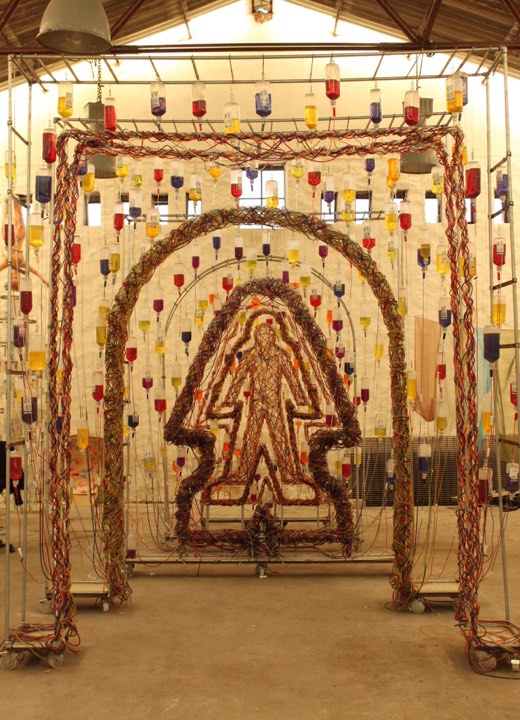
It is a notable synchronicity that “Transcendence – A Celebration of Those with Perseverance”, a medical art installation created by LK Gubelman (Leslie Katherine aka Kate), is located in El Sacrificio (the Sacrifice), Jalisco, Mexico.
Gubelman, an architect by profession, was caregiver to her retired and ill parents (mom Canadian, dad American) over the course of eight years at Lake Chapala, Mexico. Her creation is based on what she witnessed as she put her life aside to assist and honor her father and mother. The installation is also, she might share with you, how she has been meeting her irrevocable losses and sadness. The art has been her therapy.
The Transcendence exhibit in El Sacrificio is located inside “Los Conos”, cone-shaped granaries that continue to serve as art studio. Once you enter the big cone you cannot help but notice what is before you – six large scale works that required several years to complete (2015-2018) with the assistance of six men.
What will you see?
Depending on your own interpretation, the exhibit offers a way to reflect on life and death, from the point of view of the caregiver and Kate’s parents.
The largest of the pieces – THRESHOLDS – UMBRALES – is what you notice first. From the entrance, it resembles a beautiful stained glass window. Up close you see a symbolic body surrounded and connected by IV bottles filled with bright-colored water through plastic tubing. According to the artist, this piece is about time passing; each frame telling a tale of care given and the will to persevere. Every bottle was actually used at home.
Thresholds by Kate Gubelman
ENTANGLEMENT – ENREDO is a lattice work of medications, pills and pill boxes hung from the ceiling in suspended form, dazzling with crystal and beads linking one to another like Christmas decorations. Standing under it you cannot help but notice enormity of drugs consumed and what was required by caregiver Kate for medical management. All medication boxes and packets were used by Kate’s parents.
TRANSPARENCY – TRANSPARENCIA is a corridor of x-ray images, CT scans, MRIs mounted on translucent multi-colored panels described best by the publicist as “a tunnel of muted light and color…and a tale of medical machinery (cold steel) and the toll on all involved.” The names of Kate’s parents, Allison and Oscar, are on the panels.
Artist and caregiver Kate concludes, “there was no choice but to create the installation. It was a necessity, it helped my healing.”
Aside from honoring the wishes of her parents, and their lives, Gubelman bears witness to medical choices involved to keep her parents alive. Somehow, she felt compelled during the caregiving years, to collect and keep pill packages, intravenous bottles, medical records, x-rays, and other mementos.
Little did she know at the time they would become the basis of her installation.
What might you discover or experience?
You may instantly relate to Kate Gubelman’s art pieces, or not. According to Gubelman there are a variety of responses. Many visitors, both gringo and Mexican have felt either saddened or amazed. Many find deep meaning, especially recent widows and widowers who have been caregivers themselves.
Visitors have called the installation captivating, thought-provoking, emotional, and loving.
At minimum, you may feel sacrifice and perseverance were involved not only for Gubelman, but for her parents. An act of love? A comment on modern medicine? No matter your read, it is an immersive art experience.
Who might wish to see the exhibit Transcendence?
Caregivers, healthcare workers, perhaps those mourning the loss of loved ones, and, the general public
For more information or to schedule a private studio tour, please contact Bethany Anne Putnam
I am grateful to Focus on Mexico, where I address the ever-changing topics in Mexico (and elsewhere) of independent living, assisted living, nursing care, Life Plan Communities (CCRC’s – there is only one so far with others being developed).
The next talk to the Focus on Mexico attendees is March 21 at 11:15 a.m. at a hotel in Ajijic, Mexico. See https://www.focusonmexico.com/focus-6-day-program/ Focus on Mexico offers seminars to folks interested in how to move to and/or live in Mexico. All presenters at Focus on Mexico are volunteers.
On Friday, March 29, I will be speaking at a FREE community event (open to the public) at the Lake Chapala Society Sala in Ajijic at Lake Chapala, Mexico at 2:00 p.m. on Why End-of-Life Planning is a Good Idea for Ex-Pats in Mexico.
Veladoras for Guadalupe and those we’ve lost, Mexico City Cathedral
Here below are links to articles I have written on the above-referenced subjects:
Wendy Jane Carrel, M.A., a Spanish-speaking senior care specialist, has spent over seven years traveling province to province in Chile, Ecuador, and Mexico researching senior living options. She acts as an advisor or liaison for those who wish assistance negotiating health systems, senior care options, end-of-life care, and disposition of remains.
In January of 2018 Loretta Downs, M.A. gerontology, and I co-founded Death Café Ajijic aka Café Mortality Ajijic at Lake Chapala, Mexico.
Launched the following month, the first café aimed to help the retirement community navigate end-of-life planning. By providing a dedicated space to discuss feelings and final wishes, the initiative sought to alleviate the emotional and logistical burden on loved ones and local neighbors while fostering greater overall well-being.
Because we travel a lot, we invited other health professionals in the community to join as volunteer hosts. We have been fortunate. There is now a rotating team to handle responsibilities for the all-volunteer events starting in 2019. We continue to do our best to improve the experience for attendees.
For those of you unfamiliar with Death Cafes, the were created with this name in 2011 by British web developer Jon Underwood of East London and his mother Sue Barskey Reid. The cafes are now in 63 countries around the world. See www.DeathCafe.com for a café near you. (Underwood was inspired to continue the work of Swiss sociologist Bernard Crettaz and his cafés mortel created in 2004).
One of the best ways for me to learn more has been and continues to be experiencing other Death Cafes.
I was recently in Santa Barbara, CA, originally a Spanish mission post, to attend the Santa Barbara Death Café.
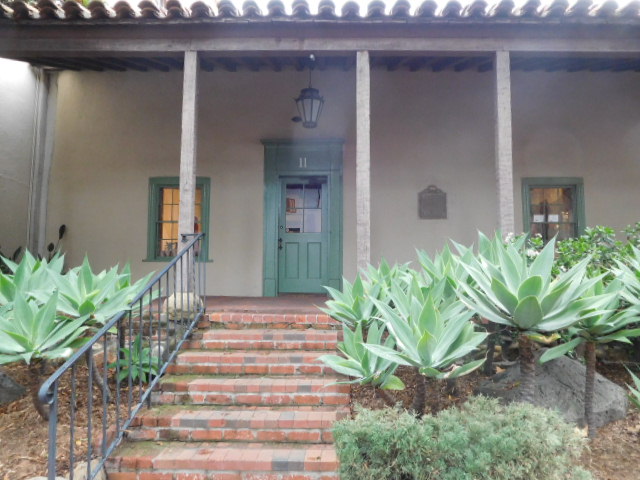
It was a pleasure to enter the donated venue at 11 E. Carrillo Street, the Hill-Carrillo Adobe. Beautiful place built in 1825. It is on the National Registry of Historic Places.
Hill-Carrillo Adobe, circ 1825, Santa Barbara, CAHill-Carrillo Abode, Santa Barbara, CA
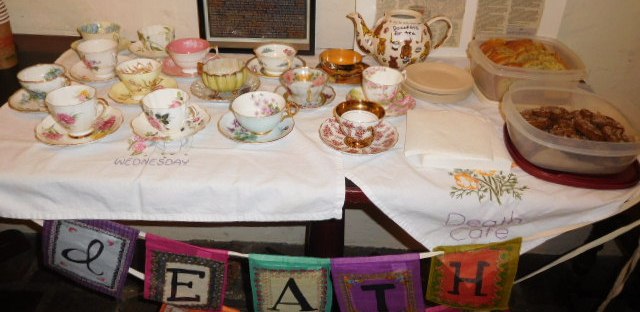
There are three dedicated hostesses in Santa Barbara. One of them provides her grandmother’s tea cups and linen. Others bring cake or cookies. Attendees offer donations to defray expenses.
Death Cafe Santa Barbara tea table
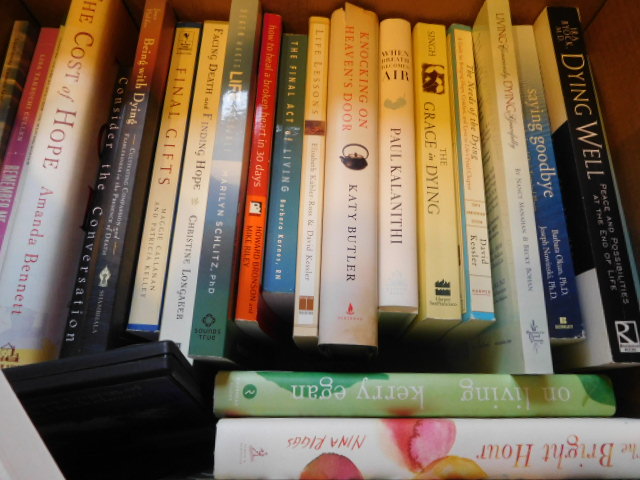
One of the surprises was that Santa Barbara Death Cafe provides a mobile library. They bring books in a large carton each month for participants to check out!! I love this idea!!
Death Cafe Santa Barbara lending library
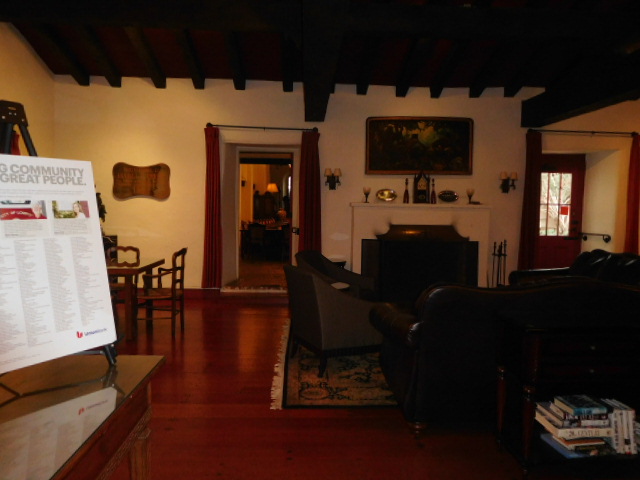
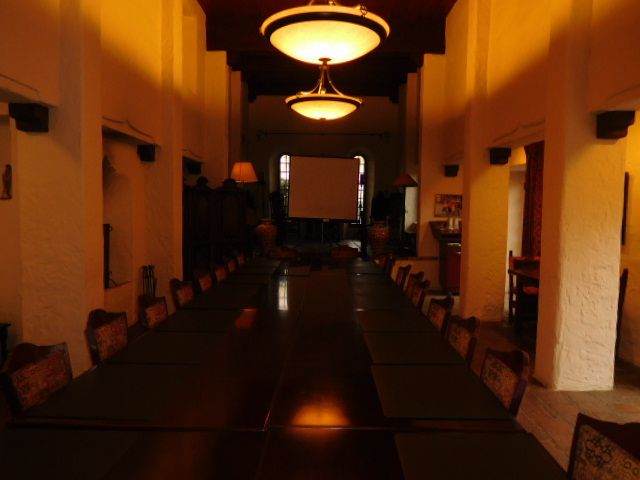
Participants in Santa Barbara are all adults, mostly older adults. In a group of about 20, there were two men, one a recent widower. We introduced ourselves to each other at a long, rectangular table, one by one, sharing briefly what brought us to the café.
Conference table at Hill-Carrillo Adobe, Santa Barbara, CA
We dispersed after the introductions to talk in groups of three, four, or more. It was organic, and attendees were encouraged to move to another group if they so desired. I see how attendees return over and over again. The hostesses and environment feel cozy and safe.
Thank you Death Café Santa Barbara and Center for Successful Aging for your hospitality!!!
I also attended an intimate Death Café in Santa Monica a few days prior to the Santa Barbara Café. It was hosted by a lovely woman at her office space. She is a psychologist, grief counselor. death doula, and drama therapist from Pasadena. There were five of us. The counselor led by asking why each came, and the other three participants, each in their 30’s, were off and running, lively and engaged from the start. Time went by quickly. This multi-talented Death Cafe host also offers a Death Goes to the Movies night. Recently she screened a documentary about a psychiatrist/musician preparing for his green burial.
Both cafes in Santa Barbara and Santa Monica were unique, rewarding experiences. You will find the next dates for these Death Cafes or others near you at http://www.DeathCafe.com. If you do not find one, perhaps you may have a desire to start one.
Please see the following links for articles about two of the cafes in Ajijic if you are interested – how we organized, and how attendees shared experiences at the end.
Wendy Jane Carrel, MA, is a Spanish-speaking senior care advocate from California. She has travelled Mexico for several years researching health systems, senior care, and end-of-life care to connect Americans, Canadians, and Europeans with healing options for loved ones. She is a compassionate companion and palliative care liaison, legacy writer, co-founder of Café Mortality Ajijic/now Death Café Ajijic and a speaker and published author on subjects related to senior well-being. Wendy’s web site is https://www.WellnessShepherd.com
For the last few years I have had the good fortune to visit palliative care and hospice entities in California as well as in six states of Mexico with the objective of learning more about what works, what’s missing, and what might work in Mexico for years to come. There are challenges based on cultural differences, but all is possible.
I am comparing various models – hospitals and facilities (medical), in-home community outreach (medical and/or volunteer), all volunteer, government, non-profit, and for profit.
Hospice of San Luis Obispo County (HSLO) has been on my radar for some time because it is a successful, locally based non-profit volunteer hospice that has sustained itself for 41 years!! For those of you who are familiar with the operations of non-profits, this is an extraordinary achievement.
Aside from serving the public, HSLO educates and trains locals and others as end-of-life doulas (companions). They host Death Cafes and much more.
The sustainability is based on more than dedication and love – mainly inventive ways to engage the public, an especially hard task in a difficult economy.
Hospice of San Luis Obispo County, California office
I am so pleased I was finally able to visit HSLO. I am indebted to the Executive Director and the Director of Volunteers, the few paid staff, for a warm, meaningful, memorable exchange.
HSLO is one of six hospice services in a county with a population of around 284,000. It is the only volunteer in-home hospice supported by the generous energy of over 200 volunteers. They serve approximately 5,000 persons per year.
Any county resident with life-limiting illness is served through “in-home respite care, emotional, spiritual, practical and non-medical support, and grief counseling support (group and individual).”
Other services are education about dying and death for professionals, caregivers and the community, doula programs, Death Cafes, Threshold Choirs, and Pet Peace of Mind groups.
From my perspective their outreach and activities place HSLO in the vanguard of the “death care and the death positive” movement that is sweeping North America and beyond. It is exhausting but rewarding work.
Additional treat: I was blessed to attend HSLO’s annual Light Up A Lifecandlelight vigil held at the San LuisObispo Mission on a nippy, rainy evening. Names of those who have passed were read out loud during the hour service that included a choir. Later we carried candles outside for readings and prayers.
Light Up A Life Candlelight Vigirl, San Luis Obispo Mission, California
Anyone may pay a fee (fundraising) to have the name or names of loved ones read at Light Up A Life. This lovely event is repeated during one week in December in different cities of the county.
HSLO was created in 1977 and has an excellent reputation through word-of-mouth.
Services are provided without charge; no insurance company is billed.
HSLO relies on community donations, fundraising events, grants, doula training fees, and the time of its over 200 volunteers.
Hospice of San Luis Obispo County is a remarkable operation. So much goodwill!! A great gift to the community.
The home which serves as office was bequeathed to HSLO by Dorothy D. Rupe; it bears her name.
1304 Pacific Street, San Luis Obispo,CA 93401 tel. (805)544-2266
While conducting research on health care and end-of-life options for older adults in Mexico, and volunteering at a Guadalajara palliative care hospital and “hospice” (not a term often used in Mexico, and not a term used by the hospital), I have witnessed both expected and unexpected deaths of Americans, Canadians, other foreigners, and Mexicans. In the case of Mexicans, the procedure following death is almost seamless, with rare exception.
Chapala Municipal Cemetery, Lake Chapala, Mexico
The question is, how will you prepare for such a situation if you are not Mexican?
Here is some of what I’ve learned in expat havens from Alamos to Ajijic, Mazatlan to Merida, and Tijuana to Oaxaca:
If you wish to save your family, other loved ones, and your neighbors considerable grief and time, it is important to understand what is involved when a foreigner dies in Mexico, and, to have a plan in place.
This goes for 18-year olds, 40-year olds, and especially for all persons over age 60.
Even though the subject is one many of us prefer to avoid, family and friends back home, as well as your local neighbors, will be grateful if you plan ahead. Planning ahead might even give you peace of mind!
WHAT TO BE AWARE OF
The system of law is different. If you are from Canada, England, or the U.S., you are accustomed to common law, not civil law based on Napoleonic code. The rules governing disposition of human remains in Mexico are not the same as at home. The time and bureaucratic requirements required to negotiate the Mexican system, post-death, can be daunting.
Laws governing end-of-life options and protocol are not federal. Laws vary from state to state regarding advance healthcare directives and the right to choose not to receive medical treatment if it is clear you are dying.
Mexico is a country with predominantly Catholic traditions. These traditions influence choices. If you are Catholic, the system may seem familiar, such as burial over cremation. If you had chosen to live in Buddhist or Hindu Asia, cremation would be a relatively easy matter involving fewer steps as cremation is common practice. Or, you could have opted for a Tibetan sky burial!
The Mexican culture, language, and way of thinking are unique. Most of all, procedures may be unfamiliar and complex.
PREPARING AHEAD FOR YOUR DEMISE & DISPOSITION OF REMAINS IN MEXICO
Legal Documents
The one key Mexican legal document you need to acquire for best outcomes is a “declaración jurada ” (more or less the equivalent of a living will) stating your dying wishes for comfort, how you wish to die, how you wish your body handled, your burial, cremation, and other desires. This document must be created before your demise. The declaración jurada will almost always insure your plan is followed. It is prepared by notaries (notarios), attorneys who are notarios, or attorneys who create the document and send you to a notario. The document is apostilled with the notario according to the Hague Convention which establishes a legal framework to resolve cross-border legal issues in family law and civil matters.
Current costs for the federal apostille are around 2200 MX pesos, 755 MX pesos for the legalization, 100 to 400 MX pesos per page for translation (many offices that assist foreigners write the documents in Spanish on one side, English on the other), about 30 pesos per page for official government certification, and between 1000 and 5000 Mexican pesos for the Poder Notorial (Power of Attorney) fee. Amounts may vary office to office. Refer to your local attorney or notary for exact amounts and details. Amounts may increase each year.
Note: Powers of Attorney (equally important for pre-death and health care complications), and wills regarding your property (usually a Testamento Publico Abierto) and fidelcomisos (for those owning property near the coastline or a border) are separate documents. Please consult with attorneys and notaries for specific advice. Once a year, older adults can receive a 50% discount in the month of September for wills relating to property (home, car, jewelry, and other assets).
Most notaries create and offer you two or three apostilled original copies of your declaración jurada. One copy stays with the notario. Carefully file your copies and if possible, create one photocopy for your glove compartment if you drive, place another in a binder or file at home, and scan and send a copy for cloud storage.
Note: Some funeral homes offer notarized Letters of Intention for cremation or burial. This, in addition to your declaración jurada, is a somewhat reliable back-up. These funeral homes will give you a card to carry on your person at all times; the card contains your name and other details plus their contact information. Not all funeral homes offer this service.
Your Advance Health Care Directive or Five Wishes from home is not valid in Mexico even if notarized, apostilled and translated into Spanish unless you get lucky.
You are best off incorporating preferences from your Advance Health Care Directive or Five Wishes (https://fivewishes.org/) into your Mexican legal document or declaración jurada. Several expats in Jalisco have chosen to do this with their attorney/notarios or attorneys and notarios.
As mentioned, many living wills/declaración juradas for foreigners, unless you live in a rural area, are written in Spanish on one half of the page, and English on the other. This is the most important document you can obtain relating to your end-of-life wishes.
Note: there is no guarantee your healthcare requests will be honored by doctors, hospitals, and ambulance services, just as in your home country. Your cremation request will be honored if it is in writing and your papers are presented.
Another helpful legal document exists if you are diagnosed with a terminal illness, the “voluntad anticipada” or “directriz”.
As of this writing, if you live in one of the Mexican states that have the Ley de VoluntadAnticipada (Advance Healthcare Directive law) you may refuse life-sustaining medical treatment. This document is created by a notario or your healthcare institution.
You may also incorporate your wish to refuse life-sustaining medical treatment in your living will/declaración jurada.
The states which have created and implemented the law of Voluntad Anticipada to date are Aguascalientes, Chiapas, Chihuahua, Coahuila, Colima, Guanajuato, Guerrero, Hidalgo, Jalisco, Michoacan, Nayarit, Mexico City, Mexico state, Oaxaca, Puebla, San Luis Potosi, Sonora, Tlaxcala, Veracruz, Yucatan, and Zacatecas.
Burial in Mexico
Burial in Mexico could be easier than shipping a casket home and less expensive, with one exception. Many cemeteries offer plots for purchase for a set period of time (usually six years) with the understanding that remains will be removed and buried elsewhere at the end of that period. Arrangements must be made in advance for relocation of remains or they may be removed to a communal grave.
There is now the option of green burial in the state of Guanajuato through the Elizabeth Kubler-Ross Foundation in San Miguel de Allende. At the time of this writing there is no other known green burial option in Mexico.
There are “natural” burials (linen shrouds, light wood caskets) in Jewish cemeteries at Lake Chapala, and in Mexico City, and Puerto Vallarta.
Note: There is less room at cemeteries in heavily populated areas. According to some city Pantheon (cemetery) directors, families with plots are burying loved ones 10 persons deep.
The population from Chapala to Jocotopec (north Lake Chapala) just south of Guadalajara, for example, is around 100,000, including 20,000 full-time ex-pats (numbers not exact). There are approximately 100+ deaths per year among the ex-pat community according to Chapala’s Registro Civil, Civil Registry office.
Ajijic Cemetery along Lake Chapala serves a population of 10,000-12,000. It is full unless a family sells you a plot there.
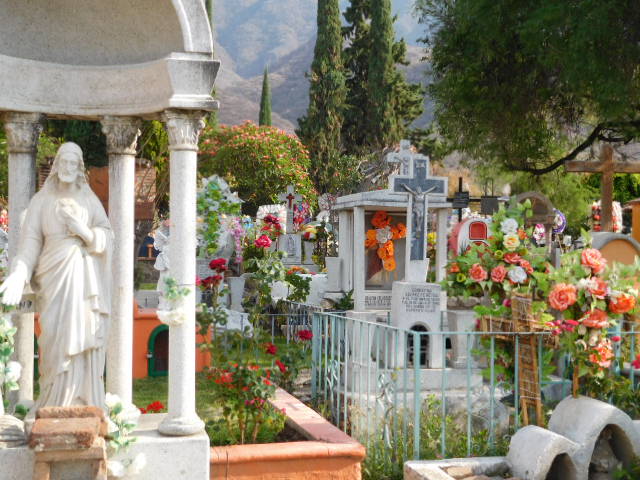
Ajijic Cemetery, Lake Chapala, Mexico
Cremation in Mexico
When death occurs in Mexico, local practices will govern how quickly a cremation can take place. In the state of Jalisco burial or cremation must be within 48 hours, or the body must be embalmed. There is one exception – a body can lie up to 30 days in refrigeration (if refrigeration is available and with permission) awaiting family members from out of country to view the remains. Then cremation or interment will take place. Cost for cremation in Jalisco, for example, is approximately 10,000 -15,000 Mexican pesos; costs for embalming, around 5,000 Mexican pesos. The prices escalate every year.
In Mexico your legal next-of-kin may request cremation or interment if you do not have a notarized living will with end-of-life wishes. It is unwise, however, to depend on good luck or miracles in this situation – again, best to have a Mexican living will, your declaración jurada.
Some churches in Mexico offer space for cremated remains in an urn or box in a mini-mausoleum setting. Here again, you are usually paying for a specified number of years.
Note: According to a U.S. Consulate web site, “if the deceased is to be transported between states in Mexico for cremation, the body must be embalmed. If the body is to be transported over 100 km a special transit permit is also required.”
Crematories
By law, a body is to be identified ahead of time. In Guadalajara, for example, no toe tags are used. Photos are taken of faces before the procedure. The name of the person is also written on a ticket. That ticket, serving as I.D., is inserted into a slot space outside the crematory machine.
Crematory Center, Guadalajara Municipal Cemetery, Mezquitan Country
Shipment of Remains Outside of Mexico
If you are American and wish your ashes or remains sent home, there is another step for a loved one or trusted advocate to complete after all Mexican death-related documents are obtained. (If you are Canadian, see the links in the Resources section below. Canadian procedures are not the same as American procedures). If your body has been cremated, a cremation certificate from the funeral home, an affidavit from the funeral director, and an original copy of the death certificate must be delivered to the nearest Embassy or Consulate. (See U.S. Government 7 FAM 258 DOCUMENTS TO ACCOMPANY REMAINS). If you die in a small city or rural area and cremation is your preference, understand the expense, effort, and permissions needed to fulfill this requirement.
According to the U.S. government, a consular officer will prepare a consular mortuary certificate to ensure “orderly shipment of remains and facilitate U.S. Customs clearance.” The certificate will be delivered to you in English and it will contain the essential information including cause of death.
As for shipment of remains in a casket, a U.S. consular officer will work to ensure that the Mexican funeral director and American funeral director are in communication to guarantee preparation of remains complies with local, U.S. Department of State, and federal requirements. All corpses going to the U.S. must be embalmed. The shipping time is approximately seven days.
Also note: DHL, Federal Express, and embassy diplomatic pouches cannot be used to ship cremated remains out of the country. There is no customs fee to ship remains to the U.S. Note: Shipment of embalmed remains in a casket outside of Mexico involves not only high cost, but red tape. Consider buying repatriation of remains insurance.
Other Details to Consider for Smoother Disposition of Remains in Mexico:
Someone to Act on Your Behalf
Are you a solo ager? Or a millenial digital nomad? Even if not, do you have at least three friends or neighbors in your community who will follow through with your wishes and instructions if you die in Mexico? Note: Do not depend on legal next-of-kin (spouse) or significant other to represent you. What if you both die in a car accident or other tragedy? It is best to delegate additional persons or a trusted attorney to take charge.
A Physician
Do you have a working relationship with a medical doctor who can be called immediately by the designated person or persons to declare cause of death and write the death certificate so an autopsy can be avoided? If you live in Jalisco do not call 911,an ambulance (Cruz Roja or Cruz Verde), the fire department (bomberos), or the police. Call the doctor, obtain the death certificate (Certificado de Defunción – delivered with three copies), then call the funeral home. The copies of the certificate are then delivered to the local Civil Registry (Registro Civil), the Ministry of Public Health, and INEGI (the National Statistics Office).
In places with several expatriates, funeral homes sometimes have doctors who can appear if your doctor is on vacation, but most doctors prefer a relationship with you before they will appear and sign a death certificate. Note: If foul play is suspected, an autopsy will be required and the police and fiscalia (the district attorney’s forensics department) will be involved.
Funeral company
Have you selected a funeral service or transporter to collect your body and handle your remains? Using a funeral service is necessary in most of Mexico, unless you are in a remote, rural village where you may be buried in a local cemetery.
Guadalajara Municipal Cemetery, Mezquitlan Country
Organ donation
Do you want your organs donated? Then your wishes must be written in your living will/declaración jurada or indicated on your Mexican driver’s license. Organ donations are handled by CETOT, the State Council of Organ Transplants.
Do you wish to donate your corpse for scientific study? If you die in Mexico City, your body may be welcome at UNAM’s Programa de Donacion de Cuerpo. Note: Many universities now use the TAQ Sistemas Medicos with synthetic human body parts for surgical instruction. The system comes complete with imaging equipment, computer interface, and surgical equipment.
Where to Place Remains. Do you wish your remains to stay in country or shipped home?
Chapala Municipal Cemetery, Lake Chapala, Mexico
Someone to Act on Your Behalf, Part 2
Again, designate at least three people to oversee your affairs in Mexico in the immediate aftermath of your death. This is recommended based on witnessing situations in Ecuador and Mexico over a period of 15 years and accompanying distressed family members. Your ex-pat friends may travel quite a bit or may not be present at the time. Always plan for back-up.
Do your designees know which funeral service or transporter will collect your body? Do they know where your legal documents (passport, INM immigration green card, living will/declaración jurada – specific for cremation or burial, contact info) are and how to pay the funeral home if not pre-paid? Do they know where to locate your bankcard, cash, and/or documents 24/7? Do they have a set of your keys? Plan on leaving about 20,000 – 30,000 Mexican pesos or more for the certifying doctor, transportation, the funeral company, Civil Registry fees, and cremation so your friends are not left to raise funds.
Copies of Documents.
Your survivors will need several copies of critical documents – passport, residence card, living will/declaración jurada , death certificate, mortuary certificate, affidavit of Mexican funeral director, transit permit, et altri. The person(s) in charge must be told not to offer an original document to transit people, most bureaucrats, etc. – in most instances these entities receive copies. Place your documents in an easy to locate binder, scan them, and send them to cloud storage for retrieval. (You will have organized your passwords ahead of time and given them to your trusted designees).
Death Certificate (Acta de Defunción)
Who will obtain the Mexican government declaration of death with the appropriate stamps from the Civil Registry and the Ministry of Public Health? This is not only a death certificate but an authorization for burial or cremation. Some Mexican funeral homes have experience assisting with these matters, others not. Will your designees need to do it? Best to find out how to obtain the certificate in the state or province where you live so you can leave instructions. (See Resources section with links to information about death certificates in Mexico).
Register Death with Your Country’s Embassy or Consulate
Who will obtain the proper documents from the U.S. Embassy or Consulate, the Canadian Embassy or Consulate, or other foreign government representative in Mexico not only to register the death, but for remains transported home? Some funeral homes are accustomed to offering this service, others not. The embassy or consulate will prepare a Report of Death from the death certificate. Your family member or representative will use this document along with the Mexican documents if or when remains are transported out of Mexico. At the U.S. Consulate you are entitled to 10 to 20 original copies in English.
Spanish language skills are imperative
Depending on Spanish-speaking friends or Mexican friends during this process requires a Plan B. What if they are not available when needed? Have more than one person at the ready who can negotiate procedures in Spanish. There are a number of facilitators, translators, and attorneys who speak English or other languages, best to keep their information handy for your back-up group.
What happens if you die in Mexico, have no spouse, no next-of-kin, no legal documents stating your wishes, and no legal representatives?
Your body will probably be transported to a morgue, usually a SEMEFO (Servicio Médico Forense – Medical Forensic Service) building with refrigeration. Not all SEMEFO buildings have refrigeration or space, even if they have refrigeration. See video links at end of article with tours of SEMEFO in Guadalajara, Mexico City, Sinaloa and the Yucatan.
Your country’s representatives will be called. Each country has different procedures for handling such situations. Your body will probably be autopsied. Often, if no one claims your body, your remains will be placed in a communal grave in Mexico. Each state of Mexico and each rural area has different traditions and procedures.
Few people know where they will die or when. If you spend time in Mexico, or any Latin American country with deeply Catholic traditions, where family ties and support reign (i.e. you will be rescued and your loved ones will know what to do), as well as strict codes and preferences that may not be yours, please choose to prepare yourself.
Preparation hint: register your whereabouts and family contact information with your embassy or consulate The U.S. government, for example, has an excellent system for Americans at https://step.state.gov/. It is the Smart Traveler Enrollment Program and advises you of security risks in the place where you are living and assists with connecting family and others to you in case of emergency. Other places to register your emergency information are located in expat communities around the country. The registries are usually announced in local directories, magazines, English-language newspapers, or found by word-of-mouth. Some non-profit expat organizations provide registries as do churches and synagogues with English-speaking congregations.
End-of-Life Planning is critical for expats.
Create peace of mind for yourself, your loved ones, and your neighbors.
Note: Preparing medical directives for healthcare emergencies, and preparing wills, are subjects worthy of their own long articles and are not included above.
Note two: Physicians, hospital administrators, funeral directors, cemetery directors, city and province officials (including a district attorney forensics office), three attorneys, one notary, and a consulate were consulted with or interviewed in Mexico for this article.
Note three: If you are alone with no spouse, no children, and no one to rescue you, it is suggested you carry a copy of the funeral home card with contact information on you, plus a copy of key contacts including the notary public. When traveling, also carry a copy of your declaración jurada. If you have a car, it is recommended you keep a copy of your declaración jurada in the glove compartment.
Wendy Jane Carrel, MA, is a trusted older adult advocate and consultant who has hands-on experience with healthcare systems, senior care residences, and end-of-life care in Mexico, Ecuador, and other nations. She is a healthcare liaison providing informed, thoughtful guidance and curated, compatible care options for families and their loved ones. She is a speaker and published author on subjects related to senior well-being. She is trauma-informed end-0f-life doula. Wendy’s web site is http://www.WellnessShepherd.com.
You have permission to re-post the entire article or quote from the article when you include author’s name, biography, and contact information as above, and the copyright indicated below.
https://wdef.com/2018/09/19/morgue-director-fired-over-stench-of-157-corpses-in-truck/ September 2018 article reporting on two tractor trailers filled with unidentified corpses as there is not enough refrigerated space at the morgue in Guadalajara. A report by the English-language Guadalajara Reporter stated that corpses of two unrelated Americans, who died of natural causes, were stored in the tractor trailers, an indication that some stored corpses were identified first, not that it makes being stored in a tractor trailer palpable.
https://www.youtube.com/watch?v=kWNr53cWfxk Sinaloa SEMEFO, a report in Spanish about abandoned corpses and no refrigeration 2016, “muerte indigna.” Apparently a new building has been constructed since with refrigeration. Note: in places of extreme humidity and heat with no refrigeration, imagine the stench.
https://www.youtube.com/watch?v=5fNXN6XycPA According to the video, “drug dealer” tombs in Sinaloa represent the opposite kind of ending from an abandoned body left at the morgue. The Jardines de Humaya cemetery in Culiacán, Sinaloa, is known for its extravagant mausoleums, not all that dissimilar from the concept of the Mamluk tombs in Cairo Egypt’s City of the Dead (circa 642 AD). The video shows the tomb of Ignacio Coronel that apparently cost millions of pesos or dollars.
https://www.youtube.com/watch?v=B-mHof2axB4 According to this 2017 documentary video from Mexico City, if after three weeks no one identifies a body, it will usually end up in a communal grave. In another report, some bodies may go to a medical school for study.
https://tomzap.com/dying.html Dying in Puerto Escondido, Oaxaca, a 2013 report. At that time it was estimated one needed about 12,000 pesos to pay for cremation, now transportation and cremation will come to around 20,000 pesos, depending on the funeral home.













 Wellness Shepherd