End-of-Life Care, Health & Wellness Mexico, Hospice, Mexico, Pain, Palliative Care, Palliative Care Mexico

International Pediatric Palliative Care Congress, Mexico, February 2016

With two days of notice I decided to attend a three-day intensive on pediatric palliative care, February 22-24, 2016 at the University of Guadalajara Medical School (Building Q).  It was part of the XVII CIAM (International Congress on Advances in Medicine Contributing to the Future of Health) and was hosted by the Nuevo Hospital Civil (New Civil Hospital) next door. The hospital is where University of Guadalajara Medical School students intern. I am glad I participated.

Until now I have witnessed palliative care (comfort care and non-invasive pain relief) for older adults with chronic conditions or at end-of-life. I knew I would be acquainted with some material. I also knew there would be quite a bit more for me to learn or hear repeated. Heart-rending stories and photos of children fading away were anticipated. And when I saw them, they surely took my breath away. Envision Marlo Thomas and her St. Jude’s Children’s Hospital efforts plus the images you’ve seen of children suffering from maladies across the globe.

Almost 100 physicians, nurses, psychologists, socials workers, and volunteers attended the 22-hour course hosted and organized by Dr. Yuriko Nakashima, a pioneer in this arena in Jalisco state, and a highly-regarded pediatrician and university professor. Yes, her name is Japanese; she is a Mexican citizen.

All speakers were excellent and exceptionally professional.

DSCN0941

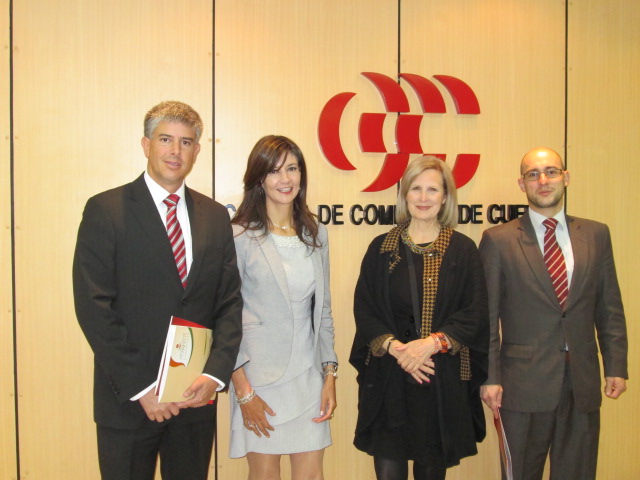
Dr. Yuriko Nakashima, Dr. Lisbeth Quesada Tristan, Dr. Jorge Ramos Guerrero, psychologist Ortencia Guiterrez Alvarez

Presentations by special guest Dr. Lisbeth Quesada Tristan of Costa Rica, referred to as the “abuela” or grandmother of pediatric palliative care, were a stand-out. (She’s actually young). Her work and a collaboration with her non-profit Fundacion Pro Unidad de Cuidado Paliativo (see www.cuidadopaliativo.org) were celebrated at a signing ceremony which included the Director of Guadalajara’s New Civil Hospital Dr. Francisco M. Preciado Figueroa, the Director of the Old Civil Hospital Dr. Benjamin Becerra Rodriguez, and Dr. Yuriko Nakashima representing both the New Civil Hospital Department of Pediatrics and the University of Guadalajara Medical School. Dr. Quesdada is also active with  ICPCN, the International Children’s Palliative Care Network.

Dr. Quesada tackled the following subjects with enthusiasm, humor, intelligence, and wisdom:

She started with a definition of palliative care – comfort care, relief from pain, and non-invasive procedures for irreversible medical conditions, progressive diseases with no cures, premature babies, and end-of-life. She asked, do you believe in aggressive procedures with a child hooked up to machines until life’s end or should the child be held in your arms, hearing a soothing voice, feeling the vibrations of love, and feeling a sense of security?  We are not clinicians of pain only, we are mostly providing quality of life in dire circumstances.

Other discourses:

Is palliative care a right or a necessity for children?

The main things everyone should know about pediatric palliative care

When “hello” means “good-bye”

Communication and support for children and adolescents with terminal illnesses

From Cocoon to Butterfly, the metamorphosis of the suffering child

How to Deal with Dysfunctional Families

The implications of sedation

Here is a paraphrased summation of Dr. Quesada’s comments:

It is offensive to say terminally ill patients. Please be careful with word choice, think about saying “children with life-limiting diseases.”

We must be part of a new paradigm with extensive outreach, going to children in their homes. (Dr. Quesada’s non-profit also serves isolated villages in the mountains of Costa Rica)

Respect children, their rights (they have rights even though not legally competent), their pain, and their wishes

Everyone is important until the last minute of their life.

To work with children one needs huge passion.

We could not do our work without volunteers!!

“Santa morfina”, blessed is the existence of morphine to help relieve pain

“Amar es saltar.”  Saltar literally translated is jumping but the meaning here is love is a way to overcome.

Pediatrician Dr. Jorge Ramos Guerrero (who holds a Master’s in palliative care from a Spanish university) delivered passionate, thoughtful reviews of…

History of Pediatric Palliative Care

Holistic Attention for Children in Palliative Care

Medicine Based on Positive Principles

Dr. Ramos outlined the history of care from Egyptian times to the present with artistic representations, the meaning of the Latin words Hospitum (providing hospitality) and Pallium (to relieve suffering), and reminded the audience that death is a normal process. He emphasized that the primary aspects of treatment are warm care by an interdisciplinary team, and that the objective is pain relief. He reminded the audience: this is not euthanasia. We are present in all moments to create quality of life until the end.

According to INEGI (government) statistics, there are 5-6,000 Mexican children with cancer each year and 56% of these children outlive their diagnosis. Part of holistic care is asking the patient what is most important for him or her. We must put ourselves in the patient’s shoes. With regard to current medicine, Dr. Ramos advocates a newer paradigm – more patient-centered care that offers the best science, the best communication (especially the ability to listen), and the best inter-personal relations.

Dr. Cesareo Gonzalez Bernal spoke of legal implications in palliative care at end-of-life, a subject that always needs continual review. Focusing on patient rights is key. Assisting a patient to die is against the law.

Dr. Regina Okhuysen-Cawley, a Mexican-born American physician working in Houston who specializes in palliative care and hospice, spoke of palliative care as it is used in intensive pediatric care, and how successful an integrative approach can be at the end of life.

Dr Patricia Ornelas and psychologist Ortencia Guiterrez Alvarez (Dr. Nakashima’s long-time colleague at Nuevo Hospital Civil) talked about how to confront death and offered each participant exercises in imagining his or her end-of-life.

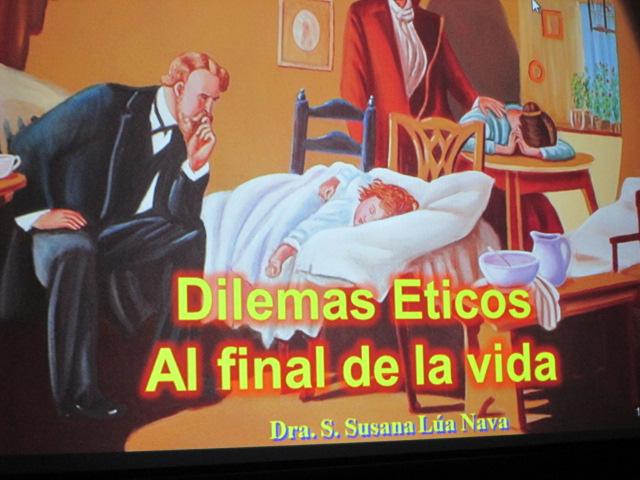
Other themes covered by other pediatric palliative care pioneers were how to give the bad/sad news, ethical dilemmas in palliative care, the importance of the nurse on the palliative care team, and spirituality of children.

Madre Martina Zamaya Tamayo, a nurse nun with a Master’s in Bio-ethics, was in the lobby outside the Guadalajara Congress to represent the only 24-7 palliative care hospital in Jalisco, Juntos Contra el Dolor. See www.juntoscontraeldolor.com. She introduced Dr. Susana Lua Nava’s book El Enfermo: Terreno Sagrado (The Ill: Sacred Terrain) to the attendees. Representatives from a dermatological supply house gave out free samples of medicinal lotions.

It was an honor to be in the company of dedicated, informed, and passionate healthcare professionals focused on comfort care and pain relief for ill children.

Note:

No medical schools in Mexico currently offer specializations in palliative care, although according to a Human Rights Watch report from October 2014, six of the country’s 102 medical schools offer some courses. Palliative care diplomas can be received from a palliative care institute in Guadalajara or Mexico City but this is not the same as 2-3 years of specialty training abroad. Mexican doctors usually travel to Argentina, Chile, Cuba, or Spain for this specialization. Anesthesiologists can order morphine, others cannot, unless certified by the government through special courses. And for whatever reason, according to one of the speakers, pediatricians have not been readily included in the arena of palliative care in Mexico to date.

Another note:  

It seems to be in the hearts and minds of Mexican healthcare providers to develop and implement more palliative care services for children.

Dr. Rut Kiman of Argentina, representing  the  ICPCN (International Children’s Palliative Care Network), and Diedrick Lohman of Human Rights Watch, traveled to five states of Mexico in 2015 to see if a December 2014 initiative to include children in palliative care in Mexico was being implemented. They visited the states of Guanajuato, Hidalgo, Morelos, Queretaro, and Toluca. Although they found pediatric palliative care in its infancy,  Dr. Kiman wrote “it is hoped it will soon be a reality in Mexico thanks to the efforts of professionals, non-governmental organizations, and health policy makers.”
Aging, Hospice, Mexico, Palliative Care, Senior Services

2nd International Palliative Care Congress in Guadalajara, Mexico – Oct 2015

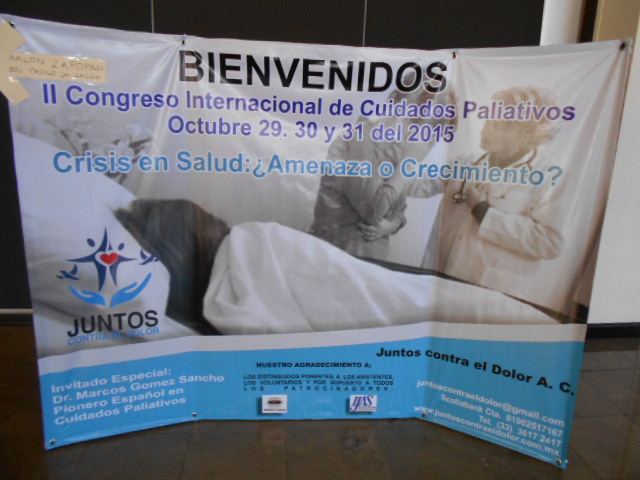
Juntos Contra el Dolor, AC (United Against Pain) a palliative care non-profit in Guadalajara, Mexico produced its 2nd International Palliative Care Congress (II Congreso Internacional de Cuidados Paliativos) at Expo Guadalajara October 29, 30, and 31, 2015. Physicians, psychologists, social workers, tanologists, nurses, and hospice volunteers participated in a study of the theme, Health Crisis: A Threat or an Opportunity for Growth?

Juntos Contra el Dolor Palliative Care Congress, Oct 2015, Mexico
Juntos Contra el Dolor 2nd International Palliative Care Congress, Guadalajara, Mexico   October 2015

Dr. Marcos Gomez Sancho, pioneer and thought leader in palliative care from Spain’s Canary Islands, was the main speaker. He spoke of the History of Death in Different Cultures, the Agony of Death vs. Dying in Peace, and, Advice for Family Caregivers in Terminal Situations. In addition to his own conclusions, he chose quotes from poetry, music, psychiatrists, and authors, as well as art work, to illustrate his main points:

the family must allow the ill person to make their departure

the experience of the person who is dying can help those who are witnessing their passing

the worst deaths are for those attached to machines (extreme personal pain, extreme financial costs)

the care team must be inter-disciplinary for best positive outcomes (attending to psycho-social, economic, physical, and spiritual needs of patients and families)

Dr. Marcos Gomez Sancho of the Canary Islands, Spain
Dr. Marcos Gomez Sancho of the Canary Islands, Spain, thought leader in palliative care signing one of his books

Dr. Gomez played a tape of Greek singer Demis Roussos’ Morir al Lado de Mi Amor (To Die Beside My Love), which reiterates a common last wish. He also quoted Austrian neurologist Sigmund Freud, “If you want life, prepare for death.”

Here below are You Tube links to Demis Roussos’ music in Spanish and French. (The Congress heard audio only, it did not view photos):

https://www.youtube.com/watch?v=193oMUtQzGE with Spanish sub-titles

https://www.youtube.com/watch?v=S5pu-FheBAo woman admirer’s production with no sub-titles

https://www.youtube.com/watch?v=QTBQm5RWUcw  in French

Other compelling lectures included anesthesiologist Dr. Beatriz Angelica Flores Garcia’s controversial topic Morfina vs. Marihuana. She outlined how morphine and marijuana can be used for pain relief. No one on the panel of professionals, nor anyone from the audience, could agree about use of either or both, and/or effects.

Psychologist Ortencia Gutierrez Alvarez focused her talk about crisis in the family as it relates to decisions. Conclusion? Allow free will of the patient. Psychologist Fabiola Montoya Martin del Campo who has worked with youth with cancer for over 20 years shared stories of the bravery and wisdom of children facing crisis. Dr. Cristina Orendain, a well-known naturopath with a number of health food stores in Guadalajara, spoke about tryptophan for pain relief and as a mood enhancer in our food and in supplement form.

Juntos Contra El Dolor founder Dr. Silvia Susana Lua Nava, an expert in palliative care and a nun, was the guiding light behind the conference together with Sister Martina Zumaya Tamayo, a nurse nun with a specialty in bio-ethics. They offer an integrated model for Mexico including best possible professional care with support for both patient and family. They welcome persons of diverse socio-economic background, religion, age, and race at their hospital for care, counseling, or to arrange in-home services.


Hda. Madre Silvia Susana Lua Nava, MD

Dr. Lua offered her own account about suffering and pain as an opportunity for spiritual growth. In 2015 she experienced three invasive surgeries, one to correct a surgery gone wrong. From age 19 to 2015 she endured five other surgeries. The presentation of how she learned to confront and overcome pain and the unknown was both amusing and inspiring. Dr. Lua is also the author of a book about palliative care which shares her insights, El Enfermo: Terreno Sagrado (The Ill: Sacred Ground).

Dr. Manuel Centeno from OPD Hospital Civil Guadalajara (the new civic hospital Dr. Juan I. Menchaca) addressed the most frequent problems treating patients with cancer of the colon. Nurse Elisa Gutierrez Andrade spoke of placement and complications involved with surgically implanted PEG’s (percutaneous endoscopic gastronomy), stomach feeding tubes. In both instances, explicit photos were shown and the lessons about care were clear and convincing.

Maria de Jesus Gonzalez Romo spoke of home nursing care and a not unusual circumstance – attending to men who have two families – two “wives” and two sets of children all meeting at the man’s death bed. Gonzalez spoke of what the patient suffers physically, psychologically, and spiritually – and how survivors deal with the patient’s pain and their own. Lots of drama – anger, forgiveness, fighting – but also a lot of love.

Attendees earned 20 continuing education credits and a diploma from the Colegio Nacional de Cuidados Paliativos de Jalisco, www.comecupal.com.mx

A note about palliative care in Mexico:

The Ministry of Public Health instituted a law in 2009 that all citizens should have access to palliative care (pain relief and comfort for chronic diseases and at end-of-life). In October 2014 the Human Rights Watch conducted a study which showed the availability of palliative care is uneven and limited throughout the country. There are also politics associated with obtaining opiods. See article at http://www.ehospice.com/ArticleView/tabid/10686/ArticleId/13355/language/en-GB/Default.aspx

A note about Juntos:

As with most non-profits, Juntos Contra El Dolor relies on donors – pharmaceutical companies, the Catholic church (which provides the housing), volunteers, and others. Throughout the year Juntos hosts weekly educational activities in an effort to support its professionals and its expenses. Dr. Nava and two other nuns are unpaid. Funds for cleaning supplies, diapers, kitchen items, linens, gasoline for in-home visits, nursing staff, nursing supplies, and upgraded office equipment are always in need. Juntos is registered as an international non-profit and all donations are tax deductible by deposit to the Juntos Contra El Dolor account at ScotiaBank CTA 01002517167. More information is available at tel. (52)(33) 3617-2417, http://www.JuntosContraElDolor.com, or at juntoscontraeldolor@gmail.com.

The web site for Dr. Marcos Gomez Sancho is http://www.mgomezsancho.com


End-of-Life Care, Hospice, Mexico, Palliative Care

World Palliative Care and Hospice Day – A Note from Guadalajara, Mexico

Juntos Contral El Dolor team

I have the honor of serving as an observer and volunteer at Juntos Contra El Dolor (United Against Pain), a palliative care hospital and hospice in Guadalajara, Mexico.

Its founder, Dr. Susana Lua Nava, is a graduate of the medical school at UAG (Universidad Autonoma de Guadalajara).  She did further training in the Canary Islands with Dr. Marcos Gomez Sancho, considered a highly-regarded thought leader in palliative care.

Dr. Lua, also a nun, is dedicated to creating an integrative model for Mexico which addresses the needs of not only the patient, but of the family as well.

Her non-profit produces educational seminars on palliative care for both professionals and the public.  On October 29, 30, and 31 Juntos Contra El Dolor is sponsoring a 20-hour continuing education international conference at Expo Guadalajara entitled “Crisis en Salud: Amenaza o Crecimiento?” (Health Crisis: A Threat? Or an Opportunity for Growth?).

Pain management pioneer Dr. Marcos Gomez Sancho of Spain will focus on the “Culture of Death in the Latin World”, and “Dying in Peace.” Other themes include morphine vs. marijuana, the psychological struggle in patients with terminal diseases, how the family handles a crisis and makes decisions, interventions when pain is difficult to control, nutrition, and more.

Juntos Contra El Dolor is located in the parish of San Bernardo (Mezquitan Country), known for its dedication to social justice. There is a day center for Down’s Syndrome children, a drug and alcohol live-in re-hab, a senior home, and the hospital.

Juntos Contra El Dolor serves all regardless of socio-economic standing, religious preference, age, or race.  See http://www.JuntosContraElDolor.com.

Above is a photo of the Juntos team.  Dr. Lua is in the center.

Ecuador, Ecuador Senior Living

Ecuador National Treasures – The Three Marias (Las Tres Marias) – Singing Sisters from Ibarra

Every older adult is a treasure.

I am blessed to encounter many such treasures.

Here’s how I got to meet Ecuador national treasures Las Tres Marias, The Three Marias, senior singing sisters from Ibarra…

I was at Quito’s new airport waiting for the driver. A car pulls up, a man in a starched white shirt jumps out and with a lot of enthusiasm waves. Lo and behold, it’s Luis, an Afro-Ecuadorian. It’s the first time we have met. He is going to accompany me for a site visit to a luxury senior living home and then to my hostal. On the way to my appointment I ask where he’s from. Ibarra he replies. “Do you happen to know The Three Marias?” I ask.  The stars are in alignment, of course he does, and he can make the arrangements and drive me to meet them!

So a few days later, Luis picks me up in the La Floresta area of Quito for what will be a long, yet amusing, day trip.

First stop, the Otavalo market where we will ask and ask for one of the sisters through Luis’ Afro network. The market is huge and extends for several blocks. It takes over 30 minutes to locate Maria Gloria’s place on the sidewalk. All of a sudden (I was beginning to wonder) there she is with a huge grin on her face.

Maria Gloria travels every Friday and Saturday by bus (over an hour, sometimes two) from her home in the Chota Valley to sell produce from her garden, usually plantains, avocados, and guyabitos. I found her to be open-hearted, humble, and gracious.  She is also unabashedly honest.  “We are products of colonialism.  We have always been slaves, first of the Jesuits, and then racism.”  How did you learn to sing, I asked?  “My parents taught us to sing when we were children, and my father played in a band.”

Maria Gloria Pavon of Las Tres Marias
Maria Gloria Pavon of Las Tres Marias singing trio

We say good-bye to Maria Gloria in Otavalo and head for Chalguayacu in the Chota Valley, way past Ibarra. Ibarra is the largest town on the way to the Colombian border. When we arrive in the village (approximately 2000 inhabitants and completely Afro-Ecuadorian), lots of kids rush to surround the car. And there beside the car, on the sidewalk, are Maria Rosa Elena and Maria Magdalena Pavon.

Maria Rosa is 75 (not confirmed) and the oldest. She sells liquor out of her home. Every Saturday morning she takes a bus to purchase the liquor in Ibarra. She doesn’t say more, other than she has a husband.

Maria Magdalena is a curandera (a healing person) and has diabetes. I found her to be a gentle soul. She likes to go to the senior center each weekday to meet up with about 40 others. The senior center is not open on the weekend, otherwise we would have made a point to stop there too.

Wendy, Maria Rosa, Maria Magdalena

The sisters have never studied music. Their homes (all on the same street) have no running water and the tile roofs don’t appear to be sturdy. They love to travel and told me they wish to be invited to play in Cuenca. In 2012, Ecuador’s Ministry of Culture bestowed upon them the Bicentennial Medal of Cultural Merit for their unique style of music.

On the way back to Quito, a bonus. Luis brings me to meet his wife Silvia and daughter Alexa who live in a village down the road from Chalguayacu. Luis shares a flat with other family members in Quito during the week. He hopes to move his wife and daughter to Quito soon.  As you can feel from the photo, they have sweet energy.

driver Luis, daughter Alexa, wife Silvia

The links below introduce the music and the Chota Valley of The Three Marias…

https://www.youtube.com/watch?v=PtkJ9BnOYe0

https://www.youtube.com/watch?v=Mizkw1-Olxc

https://www.youtube.com/watch?v=1DO7zHUY6jg

Note:

There are 1.2 million Afro-Ecuadorians. Their ancestors have been in the country since the mid-1500’s.  A brief, well-written history about them is at the link below…

http://www.ecuador.com/blog/ecuador-afro-ecuadorians-and-the-culture-of-esmeraldas


Ecuador, Ecuador Senior Living, Emergency Preparedness, Expats, Health & Wellness Mexico, Living Abroad

Cotacachi Health Chapters, Ecuador End-of-Life Planning Discussion

On June 7, 2015 I had the pleasure of speaking to the Cotacachi Health Chapters group at Gran Hotel Primitivo about End-of-Life Planning for Norte Americanos. (Cotacachi is a charming Andean city 2 1/2 hours from Quito).

My hosts were community organizer Caroline Goering – a true delight – and a team of other amazing, supportive people – Dan and Janda Grove, Mike and Linda Munhall, and Bill and Ann Henry. What to do in case of a health emergency, especially if you don’t speak Spanish, is their focus.

Caroline introduces Wendy
Caroline introduces Wendy Jane Carrel
Cotacachi Health Group, June 2015
Cotacachi Health Group


school marm...
school marm…

We discussed physicians, who to call and why, transportation, the importance of having end-of-life documents prepared, attorneys and notaries, cremation options, and disposition of remains to North America.

Fortunately, bi-lingual nurse practitioner Mary Grover, a former Peace Corps volunteer, can be of service to the estimated 200 expats in the area. I introduced Mary to those who had not met her.

A special thanks to CHC for the invitation. I was exhausted by the time I arrived, but content to meet a group that understands the importance of planning ahead, just in case, when living abroad.

Ecuador, End-of-Life Care, Hospice, Palliative Care

Hospice Nuns Offer Love and Palliative Care in Cuenca, Ecuador

Cuenca High Life just posted an article I wrote about the precious hospice nuns of Cuenca, Ecuador.  They offer the energy of love and light, plus comfort and serenity to those who are gravely ill and making their transitions.

Here below is a link to the article…

http://cuencahighlife.com/one-of-cuencas-best-kept-secrets-the-siervas-de-maria-servants-of-mary-hospice-nuns-provide-the-support-of-a-loving-family/

I shall miss these remarkable ladies (eight total) but am looking forward to meeting up with others of their order in Guadalajara and suburban Los Angeles.

Precious Servants of Mary - Sister Marina, Sister Magdalena, Madre Teresa
Precious Servants of Mary – Sister Marina, Sister Magdalena, Madre Teresa
Aging, Assisted Living, Ecuador, Ecuador Senior Living, Senior Living

Cuenca, Ecuador Nun Honored for Work with Indigent Older Adults

I am happy to say that an ode to one of my heroines, Sister Patricia Rodriguez, a nun with the Sisters of Charity, has been published.  (See the highlighted link below) .

The City of Cuenca recently honored her amazing contributions not only to seniors but to the community at large.

I have had the pleasure of following Sor Patricia’s work since 2011.  She is indeed inspirational, and, a lot of fun to be around.

The photo below was taken at an Italian restaurant in Cuenca.

I love Sor Patricia, "coordinadora" at Hogar Miguel Leon
I love Sor Patricia, “coordinadora” at Hogar Miguel Leon

At 86 and still going strong, Sister Patricia Rodriguez is honored for her service to Cuenca’s abandoned seniors and to the community.


Aging, Ecuador, Ecuador Senior Living, Expats, Health & Wellness Mexico

End-of-Life Planning Discussion at Cuenca Chamber of Commerce, May 6

In March, I published an article on the importance of End-of-Life Planning for North Americans and others who live overseas.  Here is a link to the article in case you missed it.

http://cuencahighlife.com/why-creating-an-end-of-life-plan-in-ecuador-is-a-good-idea-for-expats/

There was quite a bit of response. Most responders asked for a seminar.

For those of you who missed announcements in Cuenca High Life, Gringo Post, and Gringo Tree the last few days, here below is the information for the event which will  focus on three main subjects:

1. Why you need a physician ahead of time

2.  Why you need a legal document (an Ecuadorian document if you reside in Ecuador) stating your end-of-life wishes

3.  What the process is for cremation and why it is so difficult

95anios-banner-mailing

Cuenca Chamber of Commerce Sponsors End-of-Life Planning Discussion Wednesday, May 6

Mark your calendars for 11:00 am Wednesday, May 6 for an important discussion on End-of-Life legal matters and cremation/burial options in Cuenca, Ecuador.

Senior care consultant Wendy Jane Carrel will moderate a panel with attorney Grace Velastegui and Camposanto Santa Ana Funeral and Cemetery General Director Simon Toral.

Presentations will be followed by a question and answer session to address your pressing concerns.

May 6, 2015 11:00 a.m.
Cuenca Chamber of Commerce 3rd floor (there is an elevator)
Federico Malo y 12 de Abril facing Parque de la Madre (view map)
Cuenca

☎ 07 284-2772 ext 233 attn: Gabriela Maldonado

Here below is a photo from the May 6 meeting, deemed a success by the Cuenca Chamber of Commerce.  Almost 250 persons were in attendance.  There are approximately 10,000 North Americans resident in Cuenca , Loja/Vilcabamba, and places in-between.

Director General Simon Toral, Attorney Grace Velastegui, Senior Care Consultant Wendy Jane Carrel, Chamber President Atty Jaime Moreno
Director General Simon Toral, Attorney Grace Velastegui, Senior Care Consultant Wendy Jane Carrel, Chamber President Atty Jaime Moren
Aging, Ecuador, Ecuador Senior Living, End-of-Life Care, Health & Wellness Mexico, Long-Term Care, Palliative Care

Palliative Care Training for Healthcare Professionals in Cuenca, Ecuador at Hospice Foundation FASEC

Ethical dilemmas at End-of-Life

FASEC (Fundacion al Servicio del Enfermo de Cancer/Foundation Serving Those Ill with Cancer), together with Care Partners International of Washington state, and the University of San Francisco, Quito hosted a palliative care training in Spanish for five days, April 20-24, the first in a series of four trainings for physicians, nurses, psychologists, volunteers, and others. The well-attended event drew healthcare workers from Cuba, Cuenca, Europe, Mexico, and the U.S.

The main speaker was Dr. Susana Lua Nava, a highly regarded Mexican educator and nun who teaches throughout Mexico and at UAG (Universidad Autonoma de Guadalajara). She runs a hospice, Juntos Contro El Dolor (United Against Pain), with three nurse nuns and a staff of volunteers. Dr. Lua and her team are dedicated to the alleviation of pain in all – no matter a patient’s background, religious belief, or economic position.

Dr. Lua, author of El Enfermo, Terreno Sagrada/The Ill, Sacred Terrain, offered several slides of her work in Mexico and Spain, gave stunning examples of patient care, and spoke about dying at home or in a hospital (advantages and disadvantages of both), myths and realities on the use of morphine, the art of sharing sad news, and preparing the spirit, among other subjects. The most riveting discussion was on ethical dilemmas, a subject she teaches often – why and who one tells or does not tell of their terminal condition based on socio-economic backgrounds, culture, expectations, and other factors.

The next FASEC trainings are scheduled for the second week of June, the third week of July, and a week in October.

For contact information and more story details please click on the link below.

http://cuencahighlife.com/cuenca-palliative-care-training-educates-the-public-and-healthcare-community-first-of-four-training-session-sponsored-by-fasec/

Aging, Ecuador, Ecuador Senior Living, Health & Wellness Mexico, Senior Services

Cuenca, Ecuador Inaugurates New City Senior Center

Mayor Marcelo Cabrera, his wife, city dignitaries, employees, and approximately 150 seniors were present Sunday morning, April 19, as Cabrera proudly inaugurated one of Cuenca’s special projects, the “first free public senior center” also known at El Hogar del Abuelos (Home of the Grandparents).  Eight other city senior centers are in the planning stages.

See Cuenca High Life article at link below

http://cuencahighlife.com/cuenca-mayor-cabrera-inaugurates-new-city-senior-center/

Cuenca Ecuador's new city senior center in the El Vergel neighborhood
Cuenca Ecuador’s new city senior center in the El Vergel neighborhood