

I am excited about Dementia Innovations, a group of fine folks in Wisconsin who have created LIVASU, a more affordable and hopefully sustainable option for memory care where couples and/or family members live with their loved ones. The project opens in July of this year. Here is a blog about the efforts based on my chat with their inspirational leader and Co-founder Mary Pitsch:
In an aging world where affordable memory care is becoming harder to find, LIVASU is pioneering a new approach in rural Wisconsin.
Inspired by the famous Dutch dementia village Hogeweyk, which opened in 2009 and serves 180 residents, this project brings a unique Midwestern touch to specialized senior living.
The name LIVASU—a portmanteau for “Living As Usual”—reflects the organization’s core philosophy.
“Our focus is a culture shift that restores autonomy to residents and prioritizes normalcy,” says Co-Founder and Board President Mary Pitsch of the non-profit Dementia Innovations, a social worker with over 30 years of experience serving older adults.
What is LIVASU?
Located on a 79-acre campus in the rural Town of Wilson, Wisconsin, LIVASU is a village of high-quality manufactured homes designed specifically for those with memory care needs. Unlike most institutional settings where residents pay a monthly fee or fee for life, LIVASU residents own their homes and live alongside their spouses, family caregivers, or on their own with support staff.
The model supports the Aging in Place preference of many Americans, especially boomers, the first of whom turn 80 in 2026.
LIVASU also provides a model that balances safety and freedom, empowering residents to choose what works for them emphasizes Pitsch.
LIVASU breaks away from “lockdown” restraints of traditional care by providing an open environment:
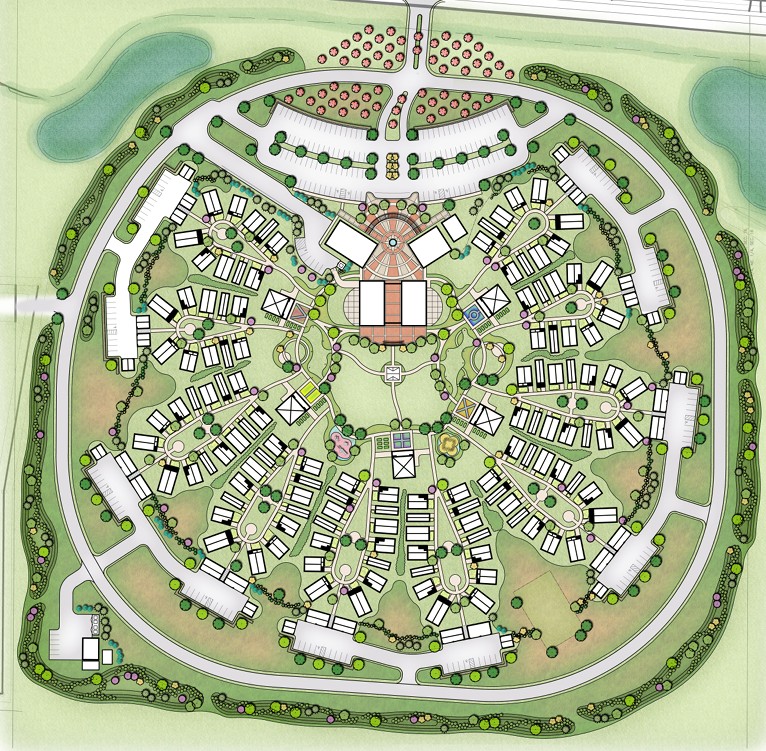
- Natural Boundaries: The community is not gated. Instead of fences, the perimeter design uses “strategic landscaping to create natural barriers,” notes Pitsch, “it is typically Midwestern.”
- Discreet Monitoring: Rather than physical restraints, the campus utilizes motion-sensor cameras that allow staff to monitor safety without infringing on privacy.
- Psychological Comfort: By prioritizing quality of life over “safety at all costs,” LIVASU aims to eliminate the urge to “escape” or “elope.” When residents feel at home, the desire to leave the environment diminishes.
Site plan of LIVASU in Town of Wilson, Wisconsin:
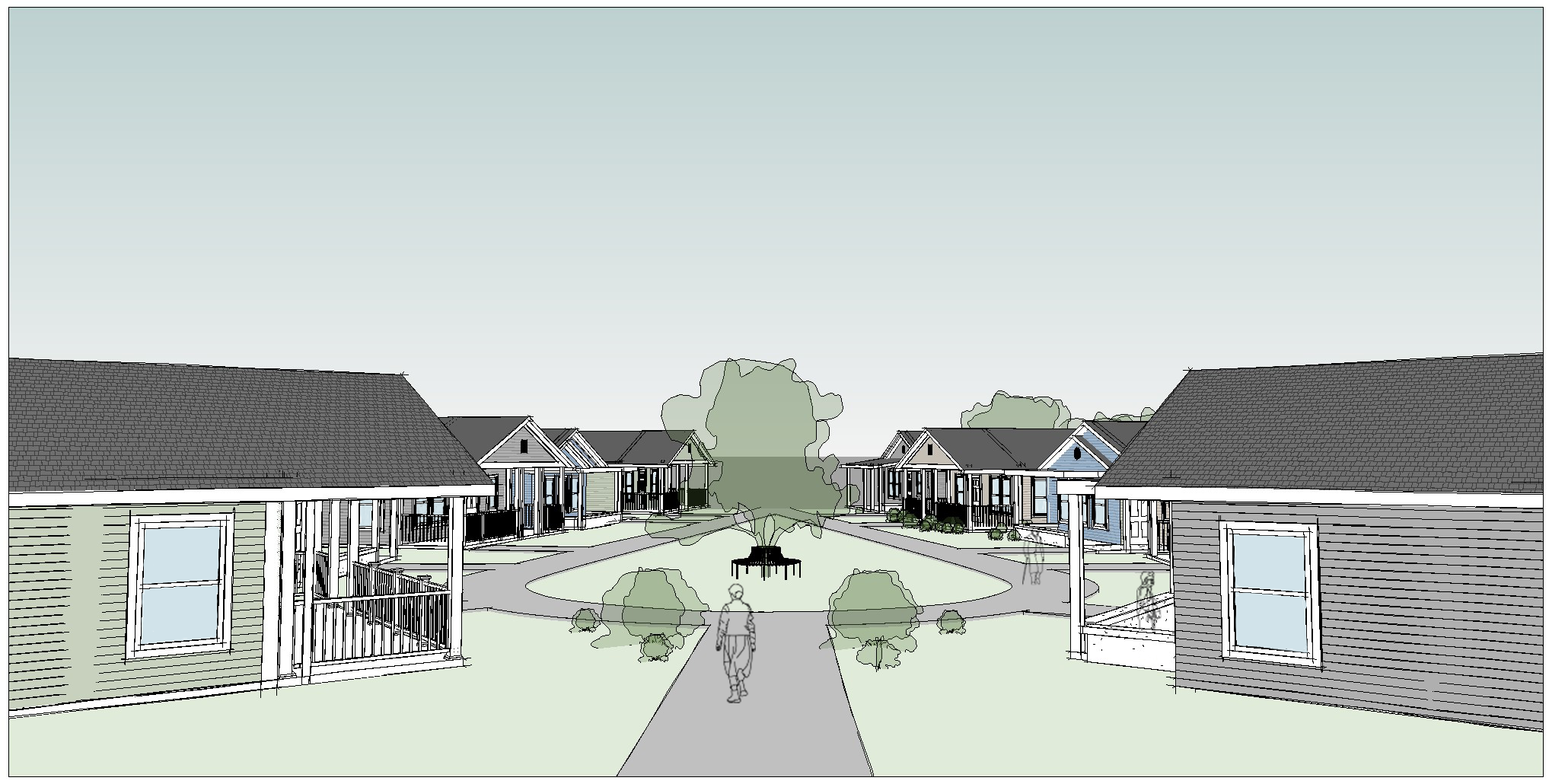
Rendering of one section of LIVASU in Town of Wilson, Wisconsin:
What services and amenities are provided at LIVASU?
A gym, a spa, a grocery store, a farmer’s market, hobby spaces, village golf carts, on-site care and support staff, walking paths, and in Phase II a restaurant open to the public.
Who is LIVASU intended for and how did the concept develop?
“We came up with the LIVASU alternative care model for those who might not do well in traditional care settings,” shared Pitsch.
There are approximately 130,000 people in Wisconsin with Alzheimer’s.
The LIVASU concept, 10 years in development, began with a grass roots Task Force on solutions for dementia crisis situations for three years. That led to LIVASU’s formation and a 6-year journey researching traditional settings, noting what the challenges were and what was missing, what would work in the community, how to offer crisis prevention through environment, and just as important, how to make it affordable.
The Dementia Innovations team learned from emergency responders, the police, hospitals, and caregivers what could alleviate crisis situations.
On-line trainings were held remotely during COVID with Hogeweyk, and then a team travelled to The Netherlands for a site visit.
What does it cost to live at LIVASU?
Depending on the model, the 124 thoughtfully designed homes cost between $95,000 and $175,000. There is no property tax. “We feel owning your own home is key,” states Pitsch.
The homes are arranged with front porches facing other front porches.
There is a monthly service fee for care and support staff. The amount is determined according to needs. Unlike Hogeveyk, which is inside a gated campus, there is no nursing unit, though medicine at home and hospice will be welcome on the LIVASU grounds. Hogeveyk is for dementia residents only. Again, spouses and other family caregivers may live with their loved ones at LIVASU. Aside from possibly providing more stability for those with memory care issues, LIVASU could be a welcome solution for loved ones who prefer not to place their significant others in homes.
Solo agers with dementia may buy a home and pay for support services. Solo agers will need a fiduciary to handle financial and other affairs before and after their demise.
Once the village is full, priority will be given to Wisconsin residents.
The homes may be sold at any time by the current residents.
Note: The average U.S. price per month for memory care is $8,000/month not including doctor visits, meds, diapers, and transportation (double that at places on east and west coasts). Depending on the memory issue (Alzheimer’s – 70% of cases, Frontotemporal, Lewy Body, Vascular dementia, or other) lifespan from diagnosis can be from five to 20 years. When you do the yearly math the cost for care in a conventional setting is approximately $100,000 per year. In one of the video’s below you will hear the sobering statistics: 1 in 3 older adults die of dementia, and, by 2040 there may be a 53% increase in the number of persons who suffer from cognitive decline.
When will LIVASU open?
LIVASU opens in July of 2026.
“This has been a 10-year journey that started with a three year task force of community members. What we envision is all new, there is no road map, we are learning each day,” adds Pitsch.
Here are two links to videos about LIVASU:
You may read more about LIVASU at https://dementiainnovations.org/ Contact information is as follows: tel. 920 395-9533 or info@dementiainnovations.org
There are other alternative and emerging non-institutional memory care projects around the U.S. located in San Diego, Baltimore, Kansas, and New Jersey. In 2003, Geriatrician Dr. Bill Thomas was one of the first to pioneer community-based care in residential settings for long-term care at his Green House Projects and Eden Alternative homes.
In the resource section below, you will find links to read about the Hogeweyk secured dementia village.
© All rights reserved. Wendy Jane Carrel 2026
Wendy Jane Carrel is a trusted older adult advocate and consultant who has hands-on experience with healthcare systems, retirement options, senior living residences, and end-of-life care in Mexico, Ecuador, the U.S., and other countries. She provides informed, culturally sensitive transition guidance and curated options for families and elders. Her website is http://www.WellnessShepherd.com
Resources
https://www.alzint.org/resource/numbers-of-people-with-dementia-worldwide
https://www.statista.com/topics/3722/alzheimer-s-disease-and-other-dementias/
https://www.nih.gov/news-events/nih-research-matters/risk-future-burden-dementia-united-states
https://pmc.ncbi.nlm.nih.gov/articles/PMC9495472/#https://www.pbs.org/video/mary-pitsch-on-the-idea-and-goals-of-livasu-dementia-village-4aunek/ PBS interview with LIVASU’s Mary Pitsch
https://operabeds.com/en-us/blogs/news/dutch-dementia-village# photos of Hogeweyk and a video.
 Wellness Shepherd