In a few days I am heading to Hermosillo, Sonora to meet with the principals of a new palliative care residence, review some assisted living/long-term care homes, and join a colleague in San Carlos (two hours south near Guaymas) for a vital conversation on navigating the unexpected in Mexico.
We’ll be diving into the ‘why’ and ‘how’ of preparing for healthcare emergencies and end-of-life care in Mexico – a journey that requires understanding different laws, cultural nuances, and a healthcare system that can feel complex when you’re far from home.
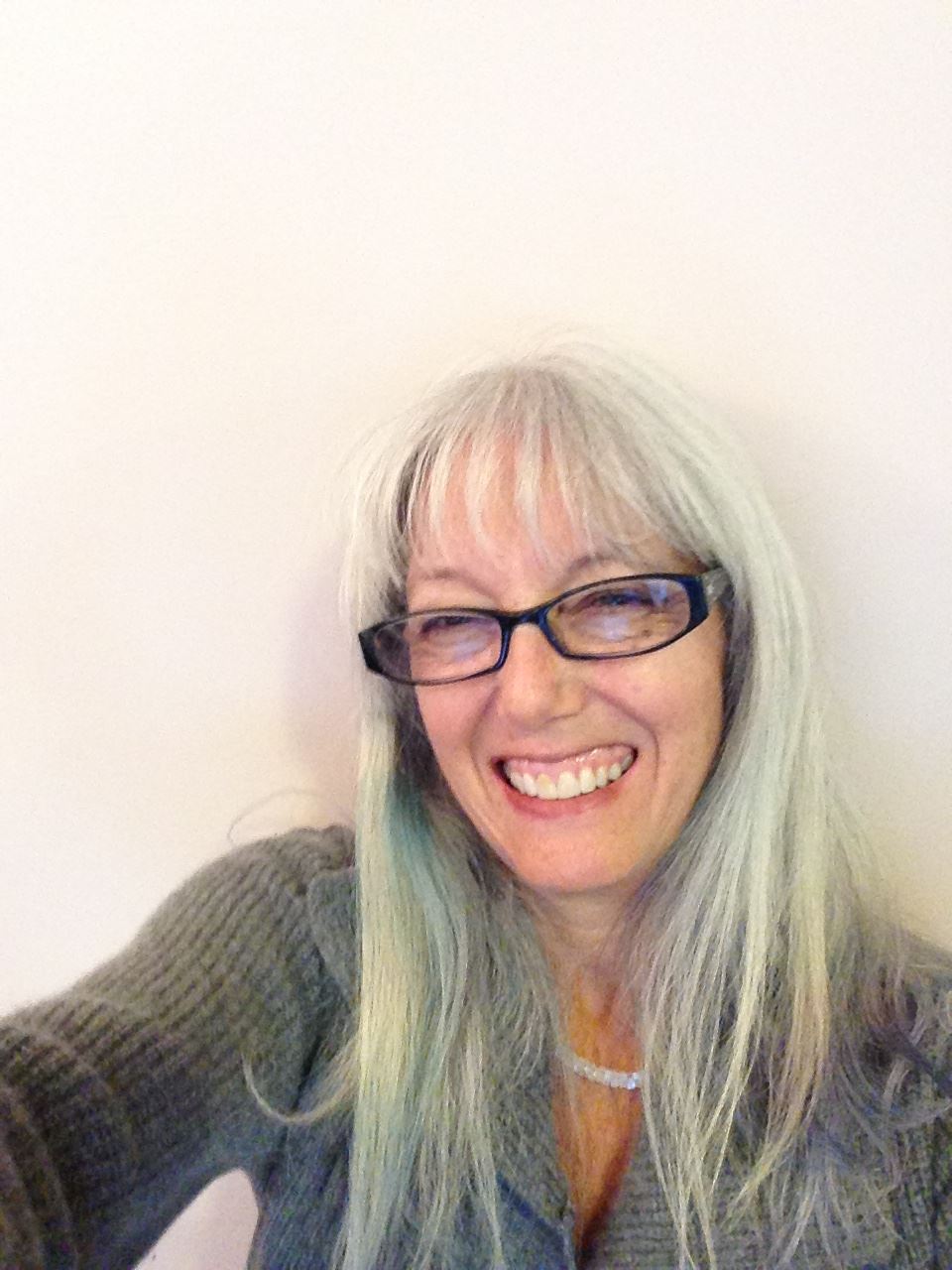
My Death Educator and End-of-Life Doula colleague Marta Macbeth will share about her experiences with a dying loved one in San Carlos and Hermosillo as well as the use of cannabis for comfort care. Here is a photo of lovely Marta:
I will also share stories and focus on the importance of advance care documents plus building a support system if you are an expat. Together with Marta we will discuss the palliative care options currently available in the Guaymas-San Carlos-Hermosillo area.
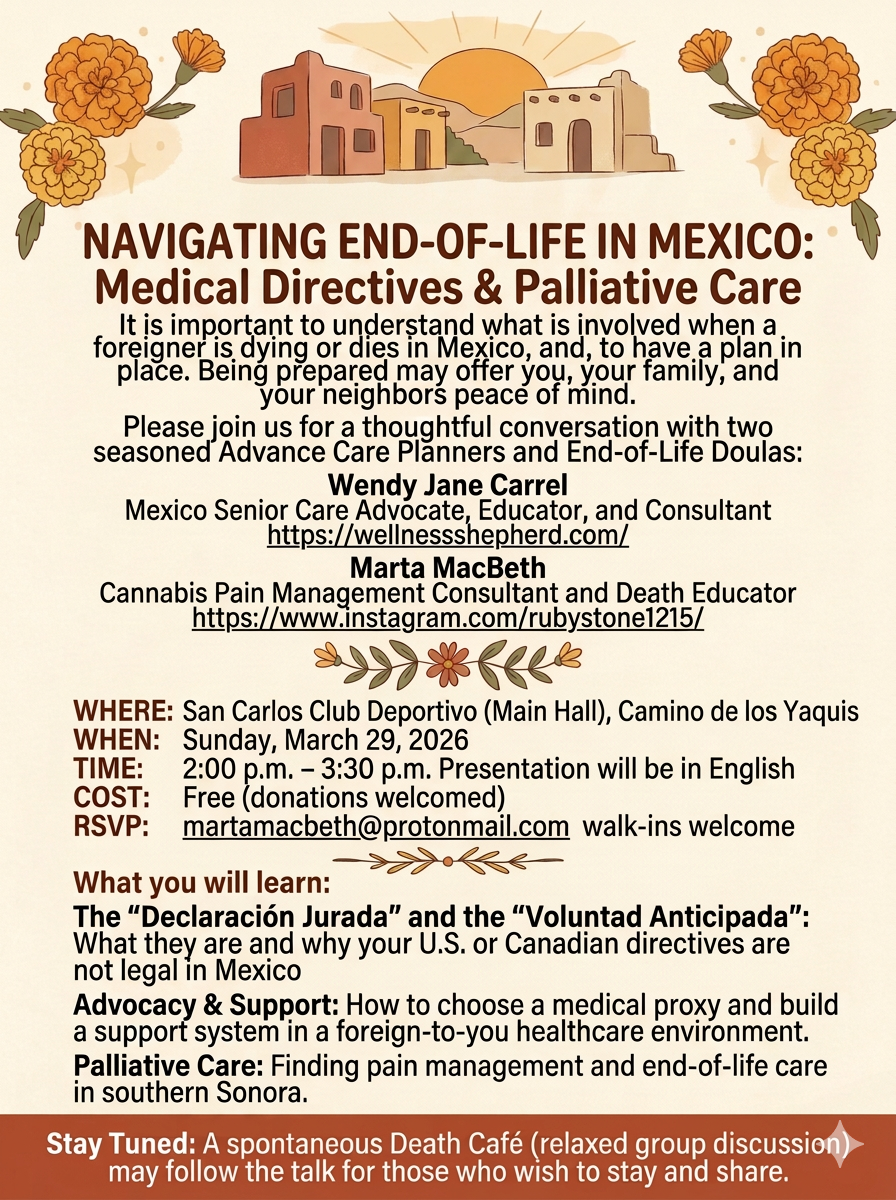
Here below is a poster of the free, open to the public event if you have friends or colleagues in Sonora who may wish to attend.
Below the poster is a link to my blog, based on 11 years of hands-on experience, about Dying in Mexico and how to prepare.
Wendy Jane Carrel, MA, is a trusted older adult advocate and consultant who has hands-on experience with healthcare systems, senior care residences, and end-of-life care in Mexico, Ecuador, and other nations. She acts as a healthcare liaison providing informed, thoughtful guidance and curated, compatible care options for individuals, and for families and their loved ones. She is a speaker and published author on subjects related to senior well-being and a trauma-informed end-of-life doula. Wendy’s web site is http://www.WellnessShepherd.com.
While conducting research on health care and end-of-life options for older adults in Mexico, and volunteering at a Guadalajara palliative care hospital and “hospice” (not a term often used in Mexico, and not a term used by the hospital), I have witnessed both expected and unexpected deaths of Americans, Canadians, other foreigners, and Mexicans. In the case of Mexicans, the procedure following death is almost seamless, with rare exception.
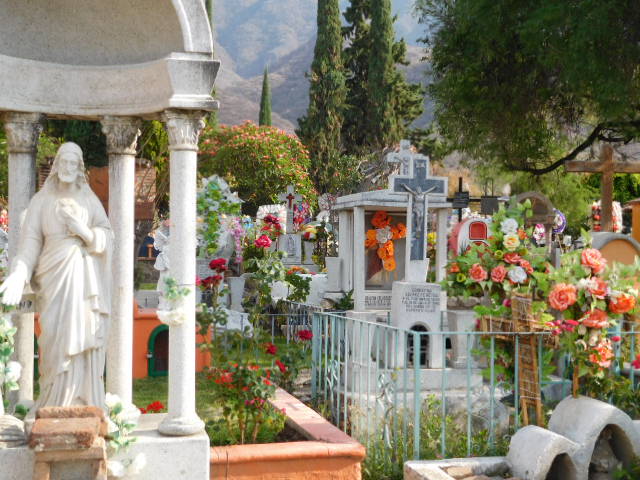
Chapala Municipal Cemetery, Lake Chapala, Mexico
The question is, how will you prepare for such a situation if you are not Mexican?
Here is some of what I’ve learned in expat havens from Alamos to Ajijic, Mazatlan to Merida, and Tijuana to Oaxaca:
If you wish to save your family, other loved ones, and your neighbors considerable grief and time, it is important to understand what is involved when a foreigner dies in Mexico, and, to have a plan in place.
This goes for 18-year olds, 40-year olds, and especially for all persons over age 60.
Even though the subject is one many of us prefer to avoid, family and friends back home, as well as your local neighbors, will be grateful if you plan ahead. Planning ahead might even give you peace of mind!
WHAT TO BE AWARE OF
The system of law is different. If you are from Canada, England, or the U.S., you are accustomed to common law, not civil law based on Napoleonic code. The rules governing disposition of human remains in Mexico are not the same as at home. The time and bureaucratic requirements required to negotiate the Mexican system, post-death, can be daunting.
Laws governing end-of-life options and protocol are not federal. Laws vary from state to state regarding advance healthcare directives and the right to choose not to receive medical treatment if it is clear you are dying.
Mexico is a country with predominantly Catholic traditions. These traditions influence choices. If you are Catholic, the system may seem familiar, such as burial over cremation. If you had chosen to live in Buddhist or Hindu Asia, cremation would be a relatively easy matter involving fewer steps as cremation is common practice. Or, you could have opted for a Tibetan sky burial!
The Mexican culture, language, and way of thinking are unique. Most of all, procedures may be unfamiliar and complex.
PREPARING AHEAD FOR YOUR DEMISE & DISPOSITION OF REMAINS IN MEXICO
Legal Documents
The one key Mexican legal document you need to acquire for best outcomes is a “declaración jurada ” (more or less the equivalent of a living will) stating your dying wishes for comfort, how you wish to die, how you wish your body handled, your burial, cremation, and other desires. This document must be created before your demise. The declaración jurada will almost always insure your plan is followed. It is prepared by notaries (notarios), attorneys who are notarios, or attorneys who create the document and send you to a notario. The document is apostilled with the notario according to the Hague Convention which establishes a legal framework to resolve cross-border legal issues in family law and civil matters.
Current costs for the federal apostille are around 2200 MX pesos, 755 MX pesos for the legalization, 100 to 400 MX pesos per page for translation (many offices that assist foreigners write the documents in Spanish on one side, English on the other), about 30 pesos per page for official government certification, and between 1000 and 5000 Mexican pesos for the Poder Notorial (Power of Attorney) fee. Amounts may vary office to office. Refer to your local attorney or notary for exact amounts and details. Amounts may increase each year.
Note: Powers of Attorney (equally important for pre-death and health care complications), and wills regarding your property (usually a Testamento Publico Abierto) and fidelcomisos (for those owning property near the coastline or a border) are separate documents. Please consult with attorneys and notaries for specific advice. Once a year, older adults can receive a 50% discount in the month of September for wills relating to property (home, car, jewelry, and other assets).
Most notaries create and offer you two or three apostilled original copies of your declaración jurada. One copy stays with the notario. Carefully file your copies and if possible, create one photocopy for your glove compartment if you drive, place another in a binder or file at home, and scan and send a copy for cloud storage.
Note: Some funeral homes offer notarized Letters of Intention for cremation or burial. This, in addition to your declaración jurada, is a somewhat reliable back-up. These funeral homes will give you a card to carry on your person at all times; the card contains your name and other details plus their contact information. Not all funeral homes offer this service.
Your Advance Health Care Directive or Five Wishes from home is not valid in Mexico even if notarized, apostilled and translated into Spanish unless you get lucky.
You are best off incorporating preferences from your Advance Health Care Directive or Five Wishes (https://fivewishes.org/) into your Mexican legal document or declaración jurada. Several expats in Jalisco have chosen to do this with their attorney/notarios or attorneys and notarios.
As mentioned, many living wills/declaración juradas for foreigners, unless you live in a rural area, are written in Spanish on one half of the page, and English on the other. This is the most important document you can obtain relating to your end-of-life wishes.
Note: there is no guarantee your healthcare requests will be honored by doctors, hospitals, and ambulance services, just as in your home country. Your cremation request will be honored if it is in writing and your papers are presented.
Another helpful legal document exists if you are diagnosed with a terminal illness, the “voluntad anticipada” or “directriz”.
As of this writing, if you live in one of the Mexican states that have the Ley de VoluntadAnticipada (Advance Healthcare Directive law) you may refuse life-sustaining medical treatment. This document is created by a notario or your healthcare institution.
You may also incorporate your wish to refuse life-sustaining medical treatment in your living will/declaración jurada.
The states which have created and implemented the law of Voluntad Anticipada to date are Aguascalientes, Chiapas, Chihuahua, Coahuila, Colima, Guanajuato, Guerrero, Hidalgo, Jalisco, Michoacan, Nayarit, Mexico City, Mexico state, Oaxaca, Puebla, San Luis Potosi, Sonora, Tlaxcala, Veracruz, Yucatan, and Zacatecas.
Burial in Mexico
Burial in Mexico could be easier than shipping a casket home and less expensive, with one exception. Many cemeteries offer plots for purchase for a set period of time (usually six years) with the understanding that remains will be removed and buried elsewhere at the end of that period. Arrangements must be made in advance for relocation of remains or they may be removed to a communal grave.
There is now the option of green burial in the state of Guanajuato through the Elizabeth Kubler-Ross Foundation in San Miguel de Allende. At the time of this writing there is no other known green burial option in Mexico.
There are “natural” burials (linen shrouds, light wood caskets) in Jewish cemeteries at Lake Chapala, and in Mexico City, and Puerto Vallarta.
Note: There is less room at cemeteries in heavily populated areas. According to some city Pantheon (cemetery) directors, families with plots are burying loved ones 10 persons deep.
The population from Chapala to Jocotopec (north Lake Chapala) just south of Guadalajara, for example, is around 100,000, including 20,000 full-time ex-pats (numbers not exact). There are approximately 100+ deaths per year among the ex-pat community according to Chapala’s Registro Civil, Civil Registry office.
Ajijic Cemetery along Lake Chapala serves a population of 10,000-12,000. It is full unless a family sells you a plot there.
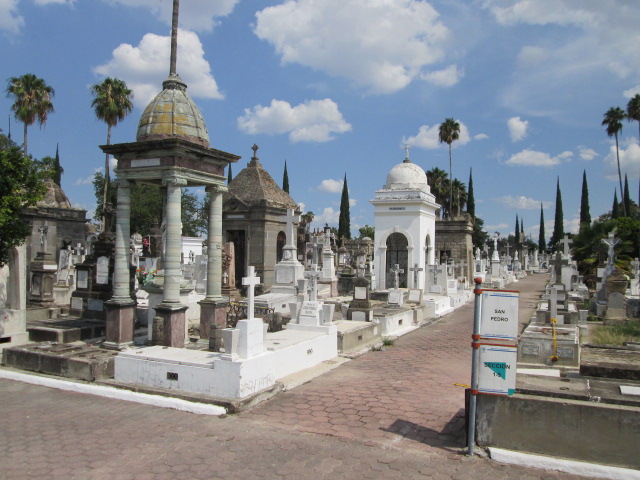
Ajijic Cemetery, Lake Chapala, Mexico
Cremation in Mexico
When death occurs in Mexico, local practices will govern how quickly a cremation can take place. In the state of Jalisco burial or cremation must be within 48 hours, or the body must be embalmed. There is one exception – a body can lie up to 30 days in refrigeration (if refrigeration is available and with permission) awaiting family members from out of country to view the remains. Then cremation or interment will take place. Cost for cremation in Jalisco, for example, is approximately 10,000 -15,000 Mexican pesos; costs for embalming, around 5,000 Mexican pesos. The prices escalate every year.
In Mexico your legal next-of-kin may request cremation or interment if you do not have a notarized living will with end-of-life wishes. It is unwise, however, to depend on good luck or miracles in this situation – again, best to have a Mexican living will, your declaración jurada.
Some churches in Mexico offer space for cremated remains in an urn or box in a mini-mausoleum setting. Here again, you are usually paying for a specified number of years.
Note: According to a U.S. Consulate web site, “if the deceased is to be transported between states in Mexico for cremation, the body must be embalmed. If the body is to be transported over 100 km a special transit permit is also required.”
Crematories
By law, a body is to be identified ahead of time. In Guadalajara, for example, no toe tags are used. Photos are taken of faces before the procedure. The name of the person is also written on a ticket. That ticket, serving as I.D., is inserted into a slot space outside the crematory machine.
Crematory Center, Guadalajara Municipal Cemetery, Mezquitan Country
Shipment of Remains Outside of Mexico
If you are American and wish your ashes or remains sent home, there is another step for a loved one or trusted advocate to complete after all Mexican death-related documents are obtained. (If you are Canadian, see the links in the Resources section below. Canadian procedures are not the same as American procedures). If your body has been cremated, a cremation certificate from the funeral home, an affidavit from the funeral director, and an original copy of the death certificate must be delivered to the nearest Embassy or Consulate. (See U.S. Government 7 FAM 258 DOCUMENTS TO ACCOMPANY REMAINS). If you die in a small city or rural area and cremation is your preference, understand the expense, effort, and permissions needed to fulfill this requirement.
According to the U.S. government, a consular officer will prepare a consular mortuary certificate to ensure “orderly shipment of remains and facilitate U.S. Customs clearance.” The certificate will be delivered to you in English and it will contain the essential information including cause of death.
As for shipment of remains in a casket, a U.S. consular officer will work to ensure that the Mexican funeral director and American funeral director are in communication to guarantee preparation of remains complies with local, U.S. Department of State, and federal requirements. All corpses going to the U.S. must be embalmed. The shipping time is approximately seven days.
Also note: DHL, Federal Express, and embassy diplomatic pouches cannot be used to ship cremated remains out of the country. There is no customs fee to ship remains to the U.S. Note: Shipment of embalmed remains in a casket outside of Mexico involves not only high cost, but red tape. Consider buying repatriation of remains insurance.
Other Details to Consider for Smoother Disposition of Remains in Mexico:
Someone to Act on Your Behalf, Preferably a Spanish-speaking Advocate
Are you a solo ager? Or a millenial digital nomad? Even if not, do you have at least three friends or neighbors in your community who will follow through with your wishes and instructions if you die in Mexico? Note: Do not depend on legal next-of-kin (spouse) or significant other to represent you. What if you both die in a car accident or other tragedy? It is best to delegate additional persons or a trusted attorney to take charge. Make certain this person understands and speaks good Spanish.
A Physician
Do you have a working relationship with a medical doctor who can be called immediately by the designated person or persons to declare cause of death and write the death certificate so an autopsy can be avoided? If you live in Jalisco do not call 911,an ambulance (Cruz Roja or Cruz Verde), the fire department (bomberos), or the police. Call the doctor, obtain the death certificate (Certificado de Defunción – delivered with three copies), then call the funeral home. The copies of the certificate are then delivered to the local Civil Registry (Registro Civil), the Ministry of Public Health, and INEGI (the National Statistics Office).
In places with several expatriates, funeral homes sometimes have doctors who can appear if your doctor is on vacation, but most doctors prefer a relationship with you before they will appear and sign a death certificate. Note: If foul play is suspected, an autopsy will be required and the police and fiscalia (the district attorney’s forensics department) will be involved.
Funeral company
Have you selected a funeral service or transporter to collect your body and handle your remains? Using a funeral service is necessary in most of Mexico, unless you are in a remote, rural village where you may be buried in a local cemetery.
Guadalajara Municipal Cemetery, Mezquitlan Country
Organ donation
Do you want your organs donated? Then your wishes must be written in your living will/declaración jurada or indicated on your Mexican driver’s license. Organ donations are handled by CETOT, the State Council of Organ Transplants.
Do you wish to donate your corpse for scientific study? If you die in Mexico City, your body may be welcome at UNAM’s Programa de Donacion de Cuerpo. Note: Many universities now use the TAQ Sistemas Medicos with synthetic human body parts for surgical instruction. The system comes complete with imaging equipment, computer interface, and surgical equipment.
Where to Place Remains. Do you wish your remains to stay in country or shipped home?
Chapala Municipal Cemetery, Lake Chapala, Mexico
Someone to Act on Your Behalf, Preferably a Spanish-speaking Advocate Part 2
Again, designate at least three people to oversee your affairs in Mexico in the immediate aftermath of your death. This is recommended based on witnessing situations in Ecuador and Mexico over a period of 15 years and accompanying distressed family members. Your ex-pat friends may travel quite a bit or may not be present at the time. Always plan for back-up. It is important understand and speak good Spanish.
Do your designees know which funeral service or transporter will collect your body? Do they know where your legal documents (passport, INM immigration green card, living will/declaración jurada – specific for cremation or burial, contact info) are and how to pay the funeral home if not pre-paid? Do they know where to locate your bankcard, cash, and/or documents 24/7? Do they have a set of your keys? Plan on leaving about 20,000 – 30,000 Mexican pesos or more for the certifying doctor, transportation, the funeral company, Civil Registry fees, and cremation so your friends are not left to raise funds.
Copies of Documents.
Your survivors will need several copies of critical documents – passport, residence card, living will/declaración jurada , death certificate, mortuary certificate, affidavit of Mexican funeral director, transit permit, et altri. The person(s) in charge must be told not to offer an original document to transit people, most bureaucrats, etc. – in most instances these entities receive copies. Place your documents in an easy to locate binder, scan them, and send them to cloud storage for retrieval. (You will have organized your passwords ahead of time and given them to your trusted designees).
Death Certificate (Acta de Defunción)
Who will obtain the Mexican government declaration of death with the appropriate stamps from the Civil Registry and the Ministry of Public Health? This is not only a death certificate but an authorization for burial or cremation. Some Mexican funeral homes have experience assisting with these matters, others not. Will your designees need to do it? Best to find out how to obtain the certificate in the state or province where you live so you can leave instructions. (See Resources section with links to information about death certificates in Mexico).
Register Death with Your Country’s Embassy or Consulate
Who will obtain the proper documents from the U.S. Embassy or Consulate, the Canadian Embassy or Consulate, or other foreign government representative in Mexico not only to register the death, but for remains transported home? Some funeral homes are accustomed to offering this service, others not. The embassy or consulate will prepare a Report of Death from the death certificate. Your family member or representative will use this document along with the Mexican documents if or when remains are transported out of Mexico. At the U.S. Consulate you are entitled to 10 to 20 original copies in English.
Spanish language skills are imperative
Depending on Spanish-speaking friends or Mexican friends during this process requires a Plan B. What if they are not available when needed? Have more than one person at the ready who can negotiate procedures in Spanish. There are a number of facilitators, translators, and attorneys who speak English or other languages, best to keep their information handy for your back-up group.
What happens if you die in Mexico, have no spouse, no next-of-kin, no legal documents stating your wishes, and no legal representatives?
Your body will probably be transported to a morgue, usually a SEMEFO (Servicio Médico Forense – Medical Forensic Service) building with refrigeration. Not all SEMEFO buildings have refrigeration or space, even if they have refrigeration. See video links at end of article with tours of SEMEFO in Guadalajara, Mexico City, Sinaloa and the Yucatan.
Your country’s representatives will be called. Each country has different procedures for handling such situations. Your body will probably be autopsied. Often, if no one claims your body, your remains will be placed in a communal grave in Mexico. Each state of Mexico and each rural area has different traditions and procedures.
Few people know where they will die or when. If you spend time in Mexico, or any Latin American country with deeply Catholic traditions, where family ties and support reign (i.e. you will be rescued and your loved ones will know what to do), as well as strict codes and preferences that may not be yours, please choose to prepare yourself.
Preparation hint: register your whereabouts and family contact information with your embassy or consulate The U.S. government, for example, has an excellent system for Americans at https://step.state.gov/. It is the Smart Traveler Enrollment Program and advises you of security risks in the place where you are living and assists with connecting family and others to you in case of emergency. Other places to register your emergency information are located in expat communities around the country. The registries are usually announced in local directories, magazines, English-language newspapers, or found by word-of-mouth. Some non-profit expat organizations provide registries as do churches and synagogues with English-speaking congregations.
End-of-Life Planning is critical for expats.
Create peace of mind for yourself, your loved ones, and your neighbors.
Note: Preparing medical directives for healthcare emergencies, and preparing wills, are subjects worthy of their own long articles and are not included above.
Note two: Physicians, hospital administrators, funeral directors, cemetery directors, city and province officials (including a district attorney forensics office), three attorneys, one notary, and a consulate were consulted with or interviewed in Mexico for this article.
Note three: If you are alone with no spouse, no children, and no one to rescue you, it is suggested you carry a copy of the funeral home card with contact information on you, plus a copy of key contacts including the notary public. When traveling, also carry a copy of your declaración jurada. If you have a car, it is recommended you keep a copy of your declaración jurada in the glove compartment.
Wendy Jane Carrel, MA, is a trusted older adult advocate and consultant who has hands-on experience with healthcare systems, senior care residences, and end-of-life care in Mexico, Ecuador, and other nations. She acts as a healthcare liaison providing informed, thoughtful guidance and curated, compatible care options for individuals, and for families and their loved ones. She is a speaker and published author on subjects related to senior well-being and a trauma-informed end-of-life doula. Wendy’s web site is http://www.WellnessShepherd.com.
You have permission to re-post the entire article or quote from the article when you include author’s name, biography, and contact information as above, and the copyright indicated below.
https://wdef.com/2018/09/19/morgue-director-fired-over-stench-of-157-corpses-in-truck/ September 2018 article reporting on two tractor trailers filled with unidentified corpses as there is not enough refrigerated space at the morgue in Guadalajara. A report by the English-language Guadalajara Reporter stated that corpses of two unrelated Americans, who died of natural causes, were stored in the tractor trailers, an indication that some stored corpses were identified first, not that it makes being stored in a tractor trailer palpable.
https://www.youtube.com/watch?v=kWNr53cWfxk Sinaloa SEMEFO, a report in Spanish about abandoned corpses and no refrigeration 2016, “muerte indigna.” Apparently a new building has been constructed since with refrigeration. Note: in places of extreme humidity and heat with no refrigeration, imagine the stench.
https://www.youtube.com/watch?v=5fNXN6XycPA According to the video, “drug dealer” tombs in Sinaloa represent the opposite kind of ending from an abandoned body left at the morgue. The Jardines de Humaya cemetery in Culiacán, Sinaloa, is known for its extravagant mausoleums, not all that dissimilar from the concept of the Mamluk tombs in Cairo Egypt’s City of the Dead (circa 642 AD). The video shows the tomb of Ignacio Coronel that apparently cost millions of pesos or dollars.
https://www.youtube.com/watch?v=B-mHof2axB4 According to this 2017 documentary video from Mexico City, if after three weeks no one identifies a body, it will usually end up in a communal grave. In another report, some bodies may go to a medical school for study.
https://tomzap.com/dying.html Dying in Puerto Escondido, Oaxaca, a 2013 report. At that time it was estimated one needed about 12,000 pesos to pay for cremation, now transportation and cremation will come to around 20,000 pesos, depending on the funeral home.
If you live in Mexico or Latin America, have you created a plan for what to do in case of an accident, natural disaster, or healthcare emergency?
Who is going to show up for you?! What if you are no longer able to speak and make decisions for yourself?
If you wish to save your family and other loved ones considerable grief and time, it is important to understand what is involved when a foreigner becomes ill or dies in Mexico or other Latin American nation.
Last month I had the pleasure of joining patient advocate and educator colleague Deborah Bickel of Be Well San Miguel to share with expats why it is wise to create a Mexican declaracion jurada (living will) and/or voluntad anticipada (advance healthcare directive). The voluntad anticipada is incorporated into the declaracion jurada in many sates. My role in the meeting was to give an overview of palliative care and hospice and how to find end-of-life support in Mexico.
We have each invested 14 years or more sharing with expats (Deborah in Mexico, Guatemala, and Nicaragua – me in Mexico and Ecuador) why planning is important no matter your age but especially if you are 55+.
Short list of reasons:
Mexican law is civil law
British, Canadian, and U.S. law is common law.
There are major differences.
If you arrive with an Advance Healthcare Directive or Five Wishes or other document legal in your native country, it will not be legal in Latin America unless you get lucky. In Mexico, you must create a declaracion jurada and/or voluntad anticipada if you want your wishes to be honored. Some attorneys and notaries will incorporate your home country wishes for you. These documents must be created BEFORE any accident, illness, or demise. As of this date only 14 of Mexico’s 32 states offer a voluntad anticipada. The purpose of the voluntad, sometimes referred to as a directriz, is to avoid legal, medical, and bioethical problems that could complicate the situation for you the patient or your family.
Mexico is a country with predominantly Catholic traditions. These traditions influence choices. If you are Catholic, the system may seem familiar, such as burial over cremation. If you had chosen to live in Buddhist or Hindu Asia, cremation would be a relatively easy matter involving fewer steps as cremation is common practice. Or, you could have opted for a Tibetan sky burial. If you wish to be cremated, you will need a notarized document stating this wish.
Latin Americans have large family systems. If something happens to you as a Latin American, a family member will show up and know what to do. Most expats live in Latin America alone or as a couple, sometimes with children.
The Mexican culture, language, and way of thinking are unique. Most of all, procedures may be unfamiliarand complex. Attitudes and response to accidents, illness, and death are different.
Non-Spanish speaking expats often need bilingual advocates to negotiate the system. At least three people are recommended to advocate for your wishes, and/or serve as your healthcare proxies. If one is not available, perhaps another will be.
April 16 is National Healthcare Decisions Day in the U.S. If you do not yet have a plan, every day is a good day to work on one no matter where you are.
Aileen Gerhardt, a fellow patient advocate and educator in Boston writes “decide, document, designate, and discuss!!” Good advice.
Wendy Jane Carrel, MA, is a Spanish-speaking senior care advocate from California. She has travelled Mexico for several years researching health systems, senior care, and end-of-life care to connect Americans, Canadians, and Europeans with healing options for loved ones. She is a compassionate companion and palliative care liaison, legacy writer, co-founder of Café Mortality Ajijic/now Death Café Ajijic and founding member/speaker of the Beautiful Dying Expo (USA). She is a trauma-informed, gentle End-of-Life Doula (National End-of-Life Doula Alliance proficient), and a speaker and published author on subjects related to senior well-being. Wendy’s web site is https://www.WellnessShepherd.com
Over the last 20 years, in Europe and most English-speaking countries, there has been a rise in the interest of death and dying education and related issues. There has also been more focus on a return to person and family-centered care that existed before modern medicine and continual interventions.
Even though Mexico’s Day of the Dead is dedicated to celebrating one’s ancestors every November 1 and 2, and family tradition is to be at home with the dying, there is a movement for more community outreach, open discussion of the subject, and a return to indigenous wisdom which may complement current customs.
U.S. educated transpersonal psychologist Wilka Roig, a Puerto Rican based in San Miguel de Allende, Mexico, founded the Elisabeth Kubler-Ross Foundation of Central Mexico in 2019 to meet this growing need.
“Whatever we can do to shift the paradigm, normalizing death, normalizing grief, that’s our mission,” comments Roig.
The Elisabeth Kübler-Ross Foundation in Mexico is a non-profit organization inspired by the work of Swiss psychiatrist, humanitarian and hospice pioneer, Dr. Elisabeth Kübler-Ross. Kubler-Ross’ seminal books (23) have been translated into more than 35 languages. On Death and Dying is her best known title (1969).
To meet the growing interest Roig hosts seminars (currently Zoom gatherings on-line in English, Spanish, and Portuguese) about serious illness, compassionate care, models of hospice care, green burials (Roig is dedicated to establishing a model in Guanajuato state), loss, grief, and more. The umbrella title is “Preparing for a Thoughtful Death” or “Preparandonos para una Muerte Cosciente” in Spanish.
Recent seminars have featured Ken Ross, Founder and President of the Elisabeth Kubler-Ross Foundation, and Dr. Christopher Kerr of Hospice and Palliative Care Buffalo, author of Death is But a Dream.
Dr. Christopher Kerr, Wilka Roig, MA April 21, 2021
Roig also hosts Death Cafes, Death Over Dinner discussions, and trains end-of-life doulas (non-medical professionals trained to care for psychosocial and spiritual needs of seriously ill patients and their families during and after the death process).
Roig is an end-of-life doula certified through INELDA, the International End-of-Life Doula Association based in New Jersey. Roig’s work as a doula is all volunteer.
According to Roig, she has been “accidentally” moving toward this work since childhood. “I’ve been listening, connecting, dreaming, embracing dying and loss, noting how the influence of the dearly departed is healing. Any work we do to be in touch with ourselves is end-of-life work,” adds Roig.
Since the beginning of time doulas, known as parteras (midwives), have been present in Mexico for births and deaths. There is a lineage of grandmothers, mothers, and daughters who do this work throughout the country. In many areas, where superstition reigns, end-of-life doulas are not spoken of, as they are sometimes associated with witchcraft.
During the pandemic Roig created an on-line 14-week doula course to teach compassionate accompaniment. She envisions community care that “encompasses teaching gardeners and housekeepers in different towns and states of Mexico how to be doulas and/or support end-of-life.”
Last year Roig trained doulas for Hola Hospice in Morelia, Michoacan. See article here:
“The Elisabeth Kubler-Ross Foundation is now an official place to begin the support of community death care in Mexico,” says Roig. Roig is moving closer to her goal of normalizing death and grief one person at a time.
Wendy Jane Carrel, MA, is a Spanish-speaking senior care specialist and consultant from California. She has travelled Mexico for several years researching health systems, senior care, and end-of-life care in order to connect Americans, Canadians, and Europeans with options for loved ones. She has investigated hundreds of senior housing choices in 16 Mexican states. Her web site is http://www.WellnessShepherd.com
Corona Virus is changing where we might be, what we are choosing to do, or what we are restricted from following through with in order to protect the health of others.
This is not a complaint. But it has come to signify postponing meaningful work or gatherings in person, especially with the vulnerable who depend on the presence of family and others who support them.
Circumstances have already created loss and a sense of abandonment for our elders worldwide. You may recall the sad circumstances of elders alone in ICU’s in Italy, as well as in assisted living homes in Georgia and Washington State in recent days where family members may not enter to hold their loved ones as they make their transitions.
Note: This post is being written from Jalisco, Mexico where I have been attending to older adults.
The state of Jalisco (second largest state with Guadalajara as its capital), lead by Governor Alfaro and public health officials, is doing its best to tame the rise of Corona virus. There are several cases throughout the state, reportedly brought in by a group of wealthy Mexicans who traveled to Colorado to ski in mid-March or by travelers (foreign and Mexican) returning from Germany, Italy, and Spain. All persons except those in necessary services have been asked to stay inside through March 29 except for buying provisions or medicine. No travel unless necessary is another request. It is likely the date will be extended. Borders are still open but flights to other nations have diminished. So far, not a single assisted living home in Jalisco has reported a case of the Corona virus.
I had plans to see colleagues in the Mexican highlands and then return home to California. Plans have changed.
I wish to thank several colleagues whom I was going to meet with or revisit in March and early April – folks dedicated to the well-being of older adults. May we meet again soon.
1001 thanks to Lydia Jane Failing, Francoise Yohalem, and Rev. Tom Roseillo of the Unitarian Universalist Fellowship outreach in San Miguel de Allende, Mexico. Warmest greetings and blessings to each of you, your fellowship, and your community-at-large.
I so appreciated your kind invitation to participate in the seminar “Thoughtful Dying in Mexico” with other colleagues March 20, even though it was necessary to postpone as a form of protection for all. My topic was to have been spiritual aspects of dying in Mexico based on psycho-social-spiritual support of older adults at Lake Chapala, plus my involvement with a palliative care mission in Guadalajara.
My thanks also to the owners of assisted living homes in San Miguel de Allende and Cuernavaca who were waiting for me, as well as to hospice nurse Elena Lopez of Hola Hospice and Luz Serena, an assisted living home in central Morelia with two rooms offering American standard hospice. I look forward to visiting all of you and writing about your dedication to quality of life for older adults on other dates.
Many thanks to Café Mortality colleagues Debi Buckland, Jane Castleman, Loretta Downs, and Darryl Painter for their dedication at Lake Chapala. We cancelled gatherings for March and April for public health reasons.
Discussions of our wishes and mortality, especially at this time of crisis, may have been meaningful for attendees, not to mention this co-host. We will find other ways to reach out through Facebook posts and more.
And, last but not least, a big shout out to my care liaison colleague in San Miguel de Allende, Deborah Bickel of www.BeWellSanMiguel.com who is deluged with requests for assistance at this time. Deborah’s colleague, nurse practitioner Sue Leonard, was to have been on the UU Fellowship morning panel on March 20.
Where ever you are and whomever you are I pray you are safe, comfortable, and remembering to breathe. As we reflect on the health of those around us, our own health, and new ways to reach out, let us remember the greater dangers for those less fortunate – the elderly, the homeless, and immigrants on the road, in camps, or in cages.
Please remember our healthcare workers, first responders, drivers, and food purveyors.
Please consider volunteering by sending money to a cause dear to your heart and/or healing thoughts for everyone on your path and on the planet.
And, remember to keep reading inspiring stories if you choose about nail salons converting to sewing centers to make masks, the Chinese manufacturer who sent medical masks in crates to healthcare workers in Italy with a poem by Seneca, the Italians who sing on their balconies to each other, the Spaniards who stand on their balconies applauding healthcare workers as they go off shift at a nearby hospital, the small businesses and their drivers offering take-out throughout the world, and thousands of other folks who make sacrifices as they continue to show up for others.
Senior care specialist and palliative care liaison Wendy Jane Carrel will speak at the Lakeside Presbyterian Church in Riberas del Pilar, Lake Chapala, on Wednesday January 29, 2020 from 2-3 p.m. about “Palliative Care and Hospice in Jalisco.”
The free public talk will cover Carrel’s years on a palliative care mission in Guadalajara, and introduce what is currently available in Jalisco for pain management, especially at end-of-life.
On January 22, same time, same place, Dr. Sam Thelin, who has a general medical practice in Chapala serving ex-pats, will review “NewHealthcare Options at Lakeside.” Thelin, an American, studied medicine at the highly-regarded private medical school UAG (Universidad Autonoma de Guadalajara). See http://www.drthelin.com
Wendy Jane Carrel, MA, is a Spanish-speaking senior care consultant from California. She has travelled Mexico for several years researching health systems, senior care, and end-of-life care in order to connect Americans, Canadians, and Europeans with options for loved ones. She has investigated hundreds of senior housing choices in 16 Mexican states. You may read more of her history at https://wellnessshepherd.com/about/ .
This is an exciting fall month for educational events.
Other than shepherding families to appropriate, compatible Mexican assisted living and ”nursing” care for their loved ones, pastoral care visits to sweet older adults at Lake Chapala (always a pleasure), and coordinating the production of health books (one a translation to Spanish), there are seminars to attend and blog about, plus informational talks I have prepared for ex-pats.
Here’s a partial calendar….
October 3 Future of Medical Cannabis conference on-line. Medical cannabis is not yet legal in Mexico, lots of challenges related to its release, but all is possible. Am keeping informed of movements in the U.S. and Canada. Some U.S. doctors are titrating down opioid prescriptions and other pain meds for their patients- slowly, by introducing medical cannabis at the same time.
Oct 16 Beautiful Dying in Mexico Power Point presentation at Lake Chapala Society. In honor of Mexico’s Day of the Dead, Dia de los Muertos, an overview of dying in Mexico – family and religious traditions, rituals, their origins and meaning, and why many Mexicans seem so comfortable with death. Told through stories I’ve been witness to volunteering at a palliative care hospital/hospice and/or as a friend on a village street in Ajijic, Mexico.
Oct 19 Medical Cannabis in Mexico Conference all day in Guadalajara
Oct 22 Preparing for Medical Emergencies at Lake Chapala Power Point presentation at Presbyterian Church
Oct 24-26 4th International Palliative Care Congress at UTEG in Guadalajara produced by www.JuntosContraelDolor.com, the palliative care hospital and service I volunteer with
Oct 30 Focus on Mexico Power Point presentation about Senior Care in Mexico, members only
I am grateful to Focus on Mexico, where I address the ever-changing topics in Mexico (and elsewhere) of independent living, assisted living, nursing care, Life Plan Communities (CCRC’s – there is only one so far with others being developed).
The next talk to the Focus on Mexico attendees is March 21 at 11:15 a.m. at a hotel in Ajijic, Mexico. See https://www.focusonmexico.com/focus-6-day-program/ Focus on Mexico offers seminars to folks interested in how to move to and/or live in Mexico. All presenters at Focus on Mexico are volunteers.
On Friday, March 29, I will be speaking at a FREE community event (open to the public) at the Lake Chapala Society Sala in Ajijic at Lake Chapala, Mexico at 2:00 p.m. on Why End-of-Life Planning is a Good Idea for Ex-Pats in Mexico.
Veladoras for Guadalupe and those we’ve lost, Mexico City Cathedral
Here below are links to articles I have written on the above-referenced subjects:
Wendy Jane Carrel, M.A., a Spanish-speaking senior care specialist, has spent over seven years traveling province to province in Chile, Ecuador, and Mexico researching senior living options. She acts as an advisor or liaison for those who wish assistance negotiating health systems, senior care options, end-of-life care, and disposition of remains.
While conducting research on health care and end-of-life options for older adults in Mexico, and volunteering at a Guadalajara palliative care hospital and “hospice” (not a term often used in Mexico, and not a term used by the hospital), I have witnessed both expected and unexpected deaths of Americans, Canadians, other foreigners, and Mexicans. In the case of Mexicans, the procedure following death is almost seamless, with rare exception.
Chapala Municipal Cemetery, Lake Chapala, Mexico
The question is, how will you prepare for such a situation if you are not Mexican?
Here is some of what I’ve learned in expat havens from Alamos to Ajijic, Mazatlan to Merida, and Tijuana to Oaxaca:
If you wish to save your family, other loved ones, and your neighbors considerable grief and time, it is important to understand what is involved when a foreigner dies in Mexico, and, to have a plan in place.
This goes for 18-year olds, 40-year olds, and especially for all persons over age 60.
Even though the subject is one many of us prefer to avoid, family and friends back home, as well as your local neighbors, will be grateful if you plan ahead. Planning ahead might even give you peace of mind!
WHAT TO BE AWARE OF
The system of law is different. If you are from Canada, England, or the U.S., you are accustomed to common law, not civil law based on Napoleonic code. The rules governing disposition of human remains in Mexico are not the same as at home. The time and bureaucratic requirements required to negotiate the Mexican system, post-death, can be daunting.
Laws governing end-of-life options and protocol are not federal. Laws vary from state to state regarding advance healthcare directives and the right to choose not to receive medical treatment if it is clear you are dying.
Mexico is a country with predominantly Catholic traditions. These traditions influence choices. If you are Catholic, the system may seem familiar, such as burial over cremation. If you had chosen to live in Buddhist or Hindu Asia, cremation would be a relatively easy matter involving fewer steps as cremation is common practice. Or, you could have opted for a Tibetan sky burial!
The Mexican culture, language, and way of thinking are unique. Most of all, procedures may be unfamiliar and complex.
PREPARING AHEAD FOR YOUR DEMISE & DISPOSITION OF REMAINS IN MEXICO
Legal Documents
The one key Mexican legal document you need to acquire for best outcomes is a “declaración jurada ” (more or less the equivalent of a living will) stating your dying wishes for comfort, how you wish to die, how you wish your body handled, your burial, cremation, and other desires. This document must be created before your demise. The declaración jurada will almost always insure your plan is followed. It is prepared by notaries (notarios), attorneys who are notarios, or attorneys who create the document and send you to a notario. The document is apostilled with the notario according to the Hague Convention which establishes a legal framework to resolve cross-border legal issues in family law and civil matters.
Current costs for the federal apostille are around 2200 MX pesos, 755 MX pesos for the legalization, 100 to 400 MX pesos per page for translation (many offices that assist foreigners write the documents in Spanish on one side, English on the other), about 30 pesos per page for official government certification, and between 1000 and 5000 Mexican pesos for the Poder Notorial (Power of Attorney) fee. Amounts may vary office to office. Refer to your local attorney or notary for exact amounts and details. Amounts may increase each year.
Note: Powers of Attorney (equally important for pre-death and health care complications), and wills regarding your property (usually a Testamento Publico Abierto) and fidelcomisos (for those owning property near the coastline or a border) are separate documents. Please consult with attorneys and notaries for specific advice. Once a year, older adults can receive a 50% discount in the month of September for wills relating to property (home, car, jewelry, and other assets).
Most notaries create and offer you two or three apostilled original copies of your declaración jurada. One copy stays with the notario. Carefully file your copies and if possible, create one photocopy for your glove compartment if you drive, place another in a binder or file at home, and scan and send a copy for cloud storage.
Note: Some funeral homes offer notarized Letters of Intention for cremation or burial. This, in addition to your declaración jurada, is a somewhat reliable back-up. These funeral homes will give you a card to carry on your person at all times; the card contains your name and other details plus their contact information. Not all funeral homes offer this service.
Your Advance Health Care Directive or Five Wishes from home is not valid in Mexico even if notarized, apostilled and translated into Spanish unless you get lucky.
You are best off incorporating preferences from your Advance Health Care Directive or Five Wishes (https://fivewishes.org/) into your Mexican legal document or declaración jurada. Several expats in Jalisco have chosen to do this with their attorney/notarios or attorneys and notarios.
As mentioned, many living wills/declaración juradas for foreigners, unless you live in a rural area, are written in Spanish on one half of the page, and English on the other. This is the most important document you can obtain relating to your end-of-life wishes.
Note: there is no guarantee your healthcare requests will be honored by doctors, hospitals, and ambulance services, just as in your home country. Your cremation request will be honored if it is in writing and your papers are presented.
Another helpful legal document exists if you are diagnosed with a terminal illness, the “voluntad anticipada” or “directriz”.
As of this writing, if you live in one of the Mexican states that have the Ley de VoluntadAnticipada (Advance Healthcare Directive law) you may refuse life-sustaining medical treatment. This document is created by a notario or your healthcare institution.
You may also incorporate your wish to refuse life-sustaining medical treatment in your living will/declaración jurada.
The states which have created and implemented the law of Voluntad Anticipada to date are Aguascalientes, Chiapas, Chihuahua, Coahuila, Colima, Guanajuato, Guerrero, Hidalgo, Jalisco, Michoacan, Nayarit, Mexico City, Mexico state, Oaxaca, Puebla, San Luis Potosi, Sonora, Tlaxcala, Veracruz, Yucatan, and Zacatecas.
Burial in Mexico
Burial in Mexico could be easier than shipping a casket home and less expensive, with one exception. Many cemeteries offer plots for purchase for a set period of time (usually six years) with the understanding that remains will be removed and buried elsewhere at the end of that period. Arrangements must be made in advance for relocation of remains or they may be removed to a communal grave.
There is now the option of green burial in the state of Guanajuato through the Elizabeth Kubler-Ross Foundation in San Miguel de Allende. At the time of this writing there is no other known green burial option in Mexico.
There are “natural” burials (linen shrouds, light wood caskets) in Jewish cemeteries at Lake Chapala, and in Mexico City, and Puerto Vallarta.
Note: There is less room at cemeteries in heavily populated areas. According to some city Pantheon (cemetery) directors, families with plots are burying loved ones 10 persons deep.
The population from Chapala to Jocotopec (north Lake Chapala) just south of Guadalajara, for example, is around 100,000, including 20,000 full-time ex-pats (numbers not exact). There are approximately 100+ deaths per year among the ex-pat community according to Chapala’s Registro Civil, Civil Registry office.
Ajijic Cemetery along Lake Chapala serves a population of 10,000-12,000. It is full unless a family sells you a plot there.
Ajijic Cemetery, Lake Chapala, Mexico
Cremation in Mexico
When death occurs in Mexico, local practices will govern how quickly a cremation can take place. In the state of Jalisco burial or cremation must be within 48 hours, or the body must be embalmed. There is one exception – a body can lie up to 30 days in refrigeration (if refrigeration is available and with permission) awaiting family members from out of country to view the remains. Then cremation or interment will take place. Cost for cremation in Jalisco, for example, is approximately 10,000 -15,000 Mexican pesos; costs for embalming, around 5,000 Mexican pesos. The prices escalate every year.
In Mexico your legal next-of-kin may request cremation or interment if you do not have a notarized living will with end-of-life wishes. It is unwise, however, to depend on good luck or miracles in this situation – again, best to have a Mexican living will, your declaración jurada.
Some churches in Mexico offer space for cremated remains in an urn or box in a mini-mausoleum setting. Here again, you are usually paying for a specified number of years.
Note: According to a U.S. Consulate web site, “if the deceased is to be transported between states in Mexico for cremation, the body must be embalmed. If the body is to be transported over 100 km a special transit permit is also required.”
Crematories
By law, a body is to be identified ahead of time. In Guadalajara, for example, no toe tags are used. Photos are taken of faces before the procedure. The name of the person is also written on a ticket. That ticket, serving as I.D., is inserted into a slot space outside the crematory machine.
Crematory Center, Guadalajara Municipal Cemetery, Mezquitan Country
Shipment of Remains Outside of Mexico
If you are American and wish your ashes or remains sent home, there is another step for a loved one or trusted advocate to complete after all Mexican death-related documents are obtained. (If you are Canadian, see the links in the Resources section below. Canadian procedures are not the same as American procedures). If your body has been cremated, a cremation certificate from the funeral home, an affidavit from the funeral director, and an original copy of the death certificate must be delivered to the nearest Embassy or Consulate. (See U.S. Government 7 FAM 258 DOCUMENTS TO ACCOMPANY REMAINS). If you die in a small city or rural area and cremation is your preference, understand the expense, effort, and permissions needed to fulfill this requirement.
According to the U.S. government, a consular officer will prepare a consular mortuary certificate to ensure “orderly shipment of remains and facilitate U.S. Customs clearance.” The certificate will be delivered to you in English and it will contain the essential information including cause of death.
As for shipment of remains in a casket, a U.S. consular officer will work to ensure that the Mexican funeral director and American funeral director are in communication to guarantee preparation of remains complies with local, U.S. Department of State, and federal requirements. All corpses going to the U.S. must be embalmed. The shipping time is approximately seven days.
Also note: DHL, Federal Express, and embassy diplomatic pouches cannot be used to ship cremated remains out of the country. There is no customs fee to ship remains to the U.S. Note: Shipment of embalmed remains in a casket outside of Mexico involves not only high cost, but red tape. Consider buying repatriation of remains insurance.
Other Details to Consider for Smoother Disposition of Remains in Mexico:
Someone to Act on Your Behalf
Are you a solo ager? Or a millenial digital nomad? Even if not, do you have at least three friends or neighbors in your community who will follow through with your wishes and instructions if you die in Mexico? Note: Do not depend on legal next-of-kin (spouse) or significant other to represent you. What if you both die in a car accident or other tragedy? It is best to delegate additional persons or a trusted attorney to take charge.
A Physician
Do you have a working relationship with a medical doctor who can be called immediately by the designated person or persons to declare cause of death and write the death certificate so an autopsy can be avoided? If you live in Jalisco do not call 911,an ambulance (Cruz Roja or Cruz Verde), the fire department (bomberos), or the police. Call the doctor, obtain the death certificate (Certificado de Defunción – delivered with three copies), then call the funeral home. The copies of the certificate are then delivered to the local Civil Registry (Registro Civil), the Ministry of Public Health, and INEGI (the National Statistics Office).
In places with several expatriates, funeral homes sometimes have doctors who can appear if your doctor is on vacation, but most doctors prefer a relationship with you before they will appear and sign a death certificate. Note: If foul play is suspected, an autopsy will be required and the police and fiscalia (the district attorney’s forensics department) will be involved.
Funeral company
Have you selected a funeral service or transporter to collect your body and handle your remains? Using a funeral service is necessary in most of Mexico, unless you are in a remote, rural village where you may be buried in a local cemetery.
Guadalajara Municipal Cemetery, Mezquitlan Country
Organ donation
Do you want your organs donated? Then your wishes must be written in your living will/declaración jurada or indicated on your Mexican driver’s license. Organ donations are handled by CETOT, the State Council of Organ Transplants.
Do you wish to donate your corpse for scientific study? If you die in Mexico City, your body may be welcome at UNAM’s Programa de Donacion de Cuerpo. Note: Many universities now use the TAQ Sistemas Medicos with synthetic human body parts for surgical instruction. The system comes complete with imaging equipment, computer interface, and surgical equipment.
Where to Place Remains. Do you wish your remains to stay in country or shipped home?
Chapala Municipal Cemetery, Lake Chapala, Mexico
Someone to Act on Your Behalf, Part 2
Again, designate at least three people to oversee your affairs in Mexico in the immediate aftermath of your death. This is recommended based on witnessing situations in Ecuador and Mexico over a period of 15 years and accompanying distressed family members. Your ex-pat friends may travel quite a bit or may not be present at the time. Always plan for back-up.
Do your designees know which funeral service or transporter will collect your body? Do they know where your legal documents (passport, INM immigration green card, living will/declaración jurada – specific for cremation or burial, contact info) are and how to pay the funeral home if not pre-paid? Do they know where to locate your bankcard, cash, and/or documents 24/7? Do they have a set of your keys? Plan on leaving about 20,000 – 30,000 Mexican pesos or more for the certifying doctor, transportation, the funeral company, Civil Registry fees, and cremation so your friends are not left to raise funds.
Copies of Documents.
Your survivors will need several copies of critical documents – passport, residence card, living will/declaración jurada , death certificate, mortuary certificate, affidavit of Mexican funeral director, transit permit, et altri. The person(s) in charge must be told not to offer an original document to transit people, most bureaucrats, etc. – in most instances these entities receive copies. Place your documents in an easy to locate binder, scan them, and send them to cloud storage for retrieval. (You will have organized your passwords ahead of time and given them to your trusted designees).
Death Certificate (Acta de Defunción)
Who will obtain the Mexican government declaration of death with the appropriate stamps from the Civil Registry and the Ministry of Public Health? This is not only a death certificate but an authorization for burial or cremation. Some Mexican funeral homes have experience assisting with these matters, others not. Will your designees need to do it? Best to find out how to obtain the certificate in the state or province where you live so you can leave instructions. (See Resources section with links to information about death certificates in Mexico).
Register Death with Your Country’s Embassy or Consulate
Who will obtain the proper documents from the U.S. Embassy or Consulate, the Canadian Embassy or Consulate, or other foreign government representative in Mexico not only to register the death, but for remains transported home? Some funeral homes are accustomed to offering this service, others not. The embassy or consulate will prepare a Report of Death from the death certificate. Your family member or representative will use this document along with the Mexican documents if or when remains are transported out of Mexico. At the U.S. Consulate you are entitled to 10 to 20 original copies in English.
Spanish language skills are imperative
Depending on Spanish-speaking friends or Mexican friends during this process requires a Plan B. What if they are not available when needed? Have more than one person at the ready who can negotiate procedures in Spanish. There are a number of facilitators, translators, and attorneys who speak English or other languages, best to keep their information handy for your back-up group.
What happens if you die in Mexico, have no spouse, no next-of-kin, no legal documents stating your wishes, and no legal representatives?
Your body will probably be transported to a morgue, usually a SEMEFO (Servicio Médico Forense – Medical Forensic Service) building with refrigeration. Not all SEMEFO buildings have refrigeration or space, even if they have refrigeration. See video links at end of article with tours of SEMEFO in Guadalajara, Mexico City, Sinaloa and the Yucatan.
Your country’s representatives will be called. Each country has different procedures for handling such situations. Your body will probably be autopsied. Often, if no one claims your body, your remains will be placed in a communal grave in Mexico. Each state of Mexico and each rural area has different traditions and procedures.
Few people know where they will die or when. If you spend time in Mexico, or any Latin American country with deeply Catholic traditions, where family ties and support reign (i.e. you will be rescued and your loved ones will know what to do), as well as strict codes and preferences that may not be yours, please choose to prepare yourself.
Preparation hint: register your whereabouts and family contact information with your embassy or consulate The U.S. government, for example, has an excellent system for Americans at https://step.state.gov/. It is the Smart Traveler Enrollment Program and advises you of security risks in the place where you are living and assists with connecting family and others to you in case of emergency. Other places to register your emergency information are located in expat communities around the country. The registries are usually announced in local directories, magazines, English-language newspapers, or found by word-of-mouth. Some non-profit expat organizations provide registries as do churches and synagogues with English-speaking congregations.
End-of-Life Planning is critical for expats.
Create peace of mind for yourself, your loved ones, and your neighbors.
Note: Preparing medical directives for healthcare emergencies, and preparing wills, are subjects worthy of their own long articles and are not included above.
Note two: Physicians, hospital administrators, funeral directors, cemetery directors, city and province officials (including a district attorney forensics office), three attorneys, one notary, and a consulate were consulted with or interviewed in Mexico for this article.
Note three: If you are alone with no spouse, no children, and no one to rescue you, it is suggested you carry a copy of the funeral home card with contact information on you, plus a copy of key contacts including the notary public. When traveling, also carry a copy of your declaración jurada. If you have a car, it is recommended you keep a copy of your declaración jurada in the glove compartment.
Wendy Jane Carrel, MA, is a trusted older adult advocate and consultant who has hands-on experience with healthcare systems, senior care residences, and end-of-life care in Mexico, Ecuador, and other nations. She is a healthcare liaison providing informed, thoughtful guidance and curated, compatible care options for families and their loved ones. She is a speaker and published author on subjects related to senior well-being. She is trauma-informed end-0f-life doula. Wendy’s web site is http://www.WellnessShepherd.com.
You have permission to re-post the entire article or quote from the article when you include author’s name, biography, and contact information as above, and the copyright indicated below.
https://wdef.com/2018/09/19/morgue-director-fired-over-stench-of-157-corpses-in-truck/ September 2018 article reporting on two tractor trailers filled with unidentified corpses as there is not enough refrigerated space at the morgue in Guadalajara. A report by the English-language Guadalajara Reporter stated that corpses of two unrelated Americans, who died of natural causes, were stored in the tractor trailers, an indication that some stored corpses were identified first, not that it makes being stored in a tractor trailer palpable.
https://www.youtube.com/watch?v=kWNr53cWfxk Sinaloa SEMEFO, a report in Spanish about abandoned corpses and no refrigeration 2016, “muerte indigna.” Apparently a new building has been constructed since with refrigeration. Note: in places of extreme humidity and heat with no refrigeration, imagine the stench.
https://www.youtube.com/watch?v=5fNXN6XycPA According to the video, “drug dealer” tombs in Sinaloa represent the opposite kind of ending from an abandoned body left at the morgue. The Jardines de Humaya cemetery in Culiacán, Sinaloa, is known for its extravagant mausoleums, not all that dissimilar from the concept of the Mamluk tombs in Cairo Egypt’s City of the Dead (circa 642 AD). The video shows the tomb of Ignacio Coronel that apparently cost millions of pesos or dollars.
https://www.youtube.com/watch?v=B-mHof2axB4 According to this 2017 documentary video from Mexico City, if after three weeks no one identifies a body, it will usually end up in a communal grave. In another report, some bodies may go to a medical school for study.
https://tomzap.com/dying.html Dying in Puerto Escondido, Oaxaca, a 2013 report. At that time it was estimated one needed about 12,000 pesos to pay for cremation, now transportation and cremation will come to around 20,000 pesos, depending on the funeral home.
In the course of one week of August 2018 a fellowship, a Death Cafe, and a talk group at Lake Chapala, Mexico hosted events related to considerations for end-of-life.
These events, intentionally or not, are part of the growing Death Positive movement around the world – places to share, plan, or think about what we want; to consider how we foresee our own passing; and to learn from others who openly share their experiences.
Wikipedia’s explanation of Death Positive:
“The death positive movement is a social and philosophical movement that encourages people to speak openly about death, dying, and corpses. The movement seeks to eliminate silence around death-related topics, decrease anxiety surrounding death, and encourages more diversity in end-of-life care options available to the public.”
Retiree ex-pats ages 50+ from Canada, Germany, the U.S., and the UK gathered at three different venues to hear or participate in interesting, lively, or poignant discussions about mortality.
The venues:
Lake Chapala Unitarian Universalist Fellowship
On a sunny lakeside morning, the fellowship hosted an inspirational, memorable service devoted to End-of-Life.
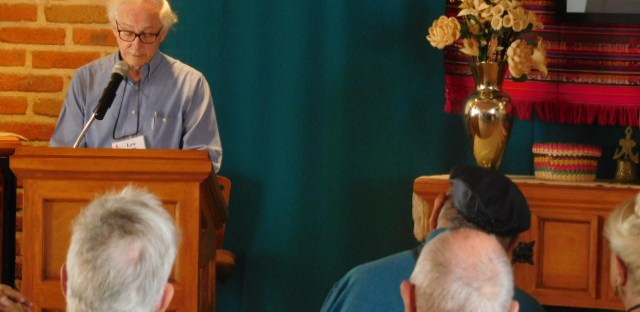
Sandy Wallin was the service leader. The sermon, “What I Learned from Charlie,” was delivered by Lew Crippen. Hymns related to transitions – I’ll Fly Away ( performed on a recording by the Humbard family), plus One More Step, and Spirit of Life. The postlude was Handel’s The Trumpet Shall Sound.
Crippen’s sharing was an endearing, sometimes funny, but definitely moving tale about how witnessing the dying of his beloved rescue cat taught him more about love and life.
Lew Crippen, Unitarian Universalist, Lake Chapala, Mexico
Service poetry included Mending Walls by Robert Frost, and the surprisingly amusing Let Me Die a Young Man’s Death (Roger McGough), beautifully read by Wallin.
Note: The tenets of the Universalist Unitarians have much in common with palliative care and hospice – “to honor the inherent worth and dignity of every person,” plus “justice, equity, and compassion in human relations.”
A group of American, Canadian, and German retirees and others recently gathered for the third Café Mortality Ajijic in Mexico August 2018. Thirty persons sat in an engaged way at six round tables and one rectangle table (added at the last minute) at Min Wah Restaurant. Conversation was uncommonly lively. Participants included a hospice chaplain (a new café volunteer), a hospice nurse, a hospice volunteer (a new café volunteer), three psychologists, a psychiatrist, one professor, one journalist, and others.
Currently, there are three co-hosts sharing the duties – Debi Buckland, Wendy Jane Carrel, and Loretta Downs, each with 20+ years devoted to some or all aspects of end-of-life care, planning, and transitions. Each Cafe Mortality is introduced by one of the hosts. The August café was heralded by Loretta Downs who flew in from Chicago to lead.
Jade Young and Laura Petit, observers and volunteers at Cafe Mortality Ajijic, August 2018
In the last few minutes, a representative from each table stood up to share with attendees interests and concerns discussed – how to die peacefully at home in Mexico, how to take one’s life legally in Mexico, how to die on your own terms in Mexico (have your wishes honored), and what happens in the afterlife.
These all-volunteer social gatherings which discuss death and dying respectfully and informally (no agenda) are now held in 52 countries. See http://deathcafe.com/
A review of the first Death Café Ajijic, held in February 2018, may be found at the following link:
The next Cafe Mortality is scheduled for October 9, 2018. Please RSVP to wellnessshepherd@aol.com if you wish to attend. Note: the venue may change.
Open Circle Ajijic
David Acuff, PhD, talk show host, and author of 15 books, spoke to over 300 attendees at Open Circle Ajijic on Creation of the Afterlife: Perspectives of Different Cultures. He brought forth views from Native Americans, Australian aborigines, Judeo-Christians, Buddhists, and Hindus about what happens when we die. He interspersed his presentation with audience breaks asking those present to find a partner to ask questions with such as…Where are we going after our demise? As at Café Mortality, the audience was fully engaged with the subject, voices were animated and lively.
David Acuff, PhD speaks about the After Life at Open Circle Ajijic
In closing, Acuff offered a new view of afterlife suggested from findings at tombs of the Nazca mummies in Peru. Perhaps, he shared, there is evidence we are not alone in the world. According to DNA research in the spring of this year, mummies from 300 A.D. and 1400 A.D. had three fingers on each hand and were not homo sapiens.
Maybe we do go somewhere else, time travel, or reincarnate… all food for thought.








 Wellness Shepherd
