Assisted Living Mexico, Mexico Retirement, Mexico Senior Living, Senior Care Mexico, Senior Living Mexico

Mexico’s Future as a Senior Living and Senior Care Destination for North Americans: Opportunities and Realities from CIAMAR 2025

We live in an aging universe, a universe where older adults live longer than ever before. 

The need for housing and care, especially affordable housing and care, is growing in all three North American nations – Canada, Mexico, and the U.S. (See the Statistics section for expected growth by 2030 and 2050 at the base of this review).

In 2003, when working at a luxury senior residence in Rancho Mirage, CA, it was evident that healthcare affordability for U.S. older adults would become a challenge or become completely cost prohibitive, especially if dementia was part of the equation.

This revelation ignited my desire to explore international options.

I started investigating Ecuador, Mexico, and other destinations for medical care, long-term care, and end-of-life care, subjects that remain dear to me and those I serve.

My hands-on experience as a Mexico senior living consultant conducting due diligence over a period of 11 years in 18 Mexican states (there are 31. The Federal District of Mexico City makes 32) has kept me engaged and open to what’s happening on the senior living front. An excellent place for me to learn more was as a speaker and guest at this year’s CIAMAR Wellness and Senior Living Investment Summit 50+ to 80, a conference produced by Javier Govi.

Govi is a “nearetiring” proselytizer and real estate entrepreneur who has believed in the growth of senior living in Mexico for American, Canadian, and Mexican retirees for more than a decade. His platform is focused on growth with corporate players from Canada, Mexico, Spain, the U.S., and other countries in Latin America.

My interest is in all sectors including smaller residences and intimate communities with sustainable futures.

Who attended CIAMAR 2025?   

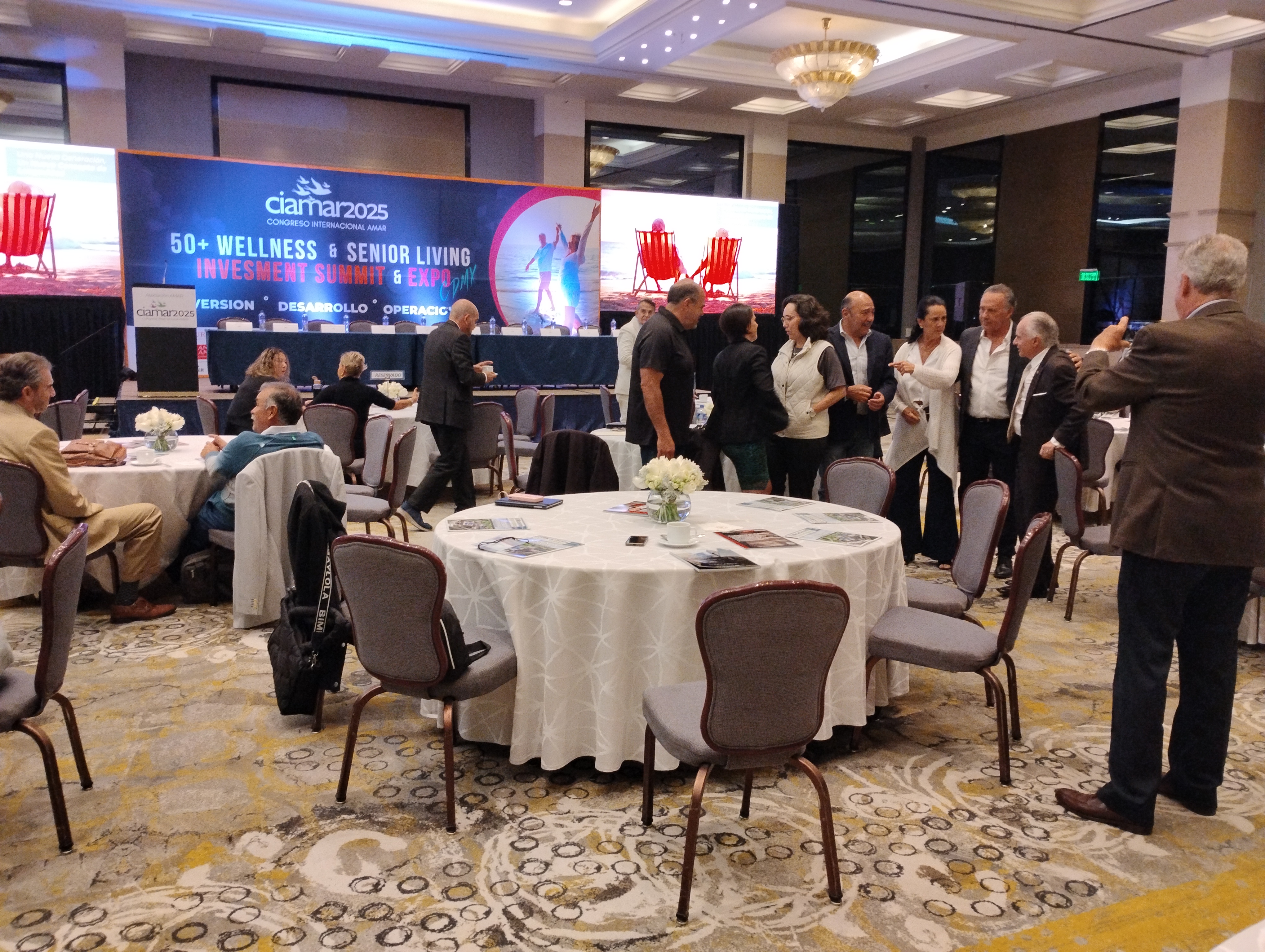
Between 150 to 200 persons attended the summit, gently modelled after NIC (National Investment Center) conferences in the U.S. with 1500 to 3,000 participants. The event was held at the Hotel Marquis Reforma in Mexico City.

Architects, bankers, real estate developers, senior living operators, tourism industry execs, one real estate appraiser, and entrepreneurs from around Mexico – Baja California Norte y Sur (Tijuana, Cabo San Lucas), Cancun, Cuernavaca, Leon, Merida, Mexico City, Puebla, Queretaro – and from other countries – Argentina, Colombia, Costa Rica, (Germany via Zoom), Panama, Spain, were present.

Below is a photo from the first day of the summit, almost an hour before we began.
What was on the agenda and who were the speakers addressing the opportunities?

https://ciamar.odoo.com/en/programa

https://ciamar.odoo.com/en/ponentes

Speakers from Latin America, mostly from Mexico, brought unique projects and perspectives, some are outlined further below.  

These Latin American entrepreneurs see opportunity in attracting Americans, Canadians, and Europeans. One of the speakers referred to the current wave of this cohort as “el tsunami blanco”, the “white tsunami”. (An interesting comment as some expats in Mexico have Afro, Asian, and Latino heritage).

Latin American entrepreneurs are also focused on culturally compatible senior living for their own populations. Is there a way to meld the different cultures? This is a subject that remains open for discussion.

Some Mexican senior living homes thrive on hosting expats as their primary residents.

Despite the perception outside Mexico that Mexican elders are taken care of at home, many still are, there are senior living enclaves for Mexicans around the country, though far fewer than with Mexico’s neighbors north of the border. 31% of 11 million Mexican homes have at least one older adult (INEGI 2020).

According to INEGI (Mexico’s National Institute of Statistics and Geography, 2020) there are approximately 1200 senior living residences including assisted living/nursing care/memory care (often combined into one residence unlike American and Canadian systems). In 2017 there were an estimated 800.

The numbers for Mexico do not include independent living/active adult enclaves but do include corporate senior living, smaller private pay residences, non-profits often run by nurse nuns, and government homes. These numbers fluctuate as numerous small start-ups often close.

In Canada there are approximately 2,076 assisted living/supportive living/retirement residences according to Science Direct. Another source says Canada has 571 assisted living residences. (See Reference section below). In the U.S. there are approximately 32,000 assisted living communities with a total of over one million beds.

The “Bucket List” panel below with Javier Govi CIAMAR founder/producer, Wendy Jane Carrel, Kerri Moon, and Oliver Sahlmann
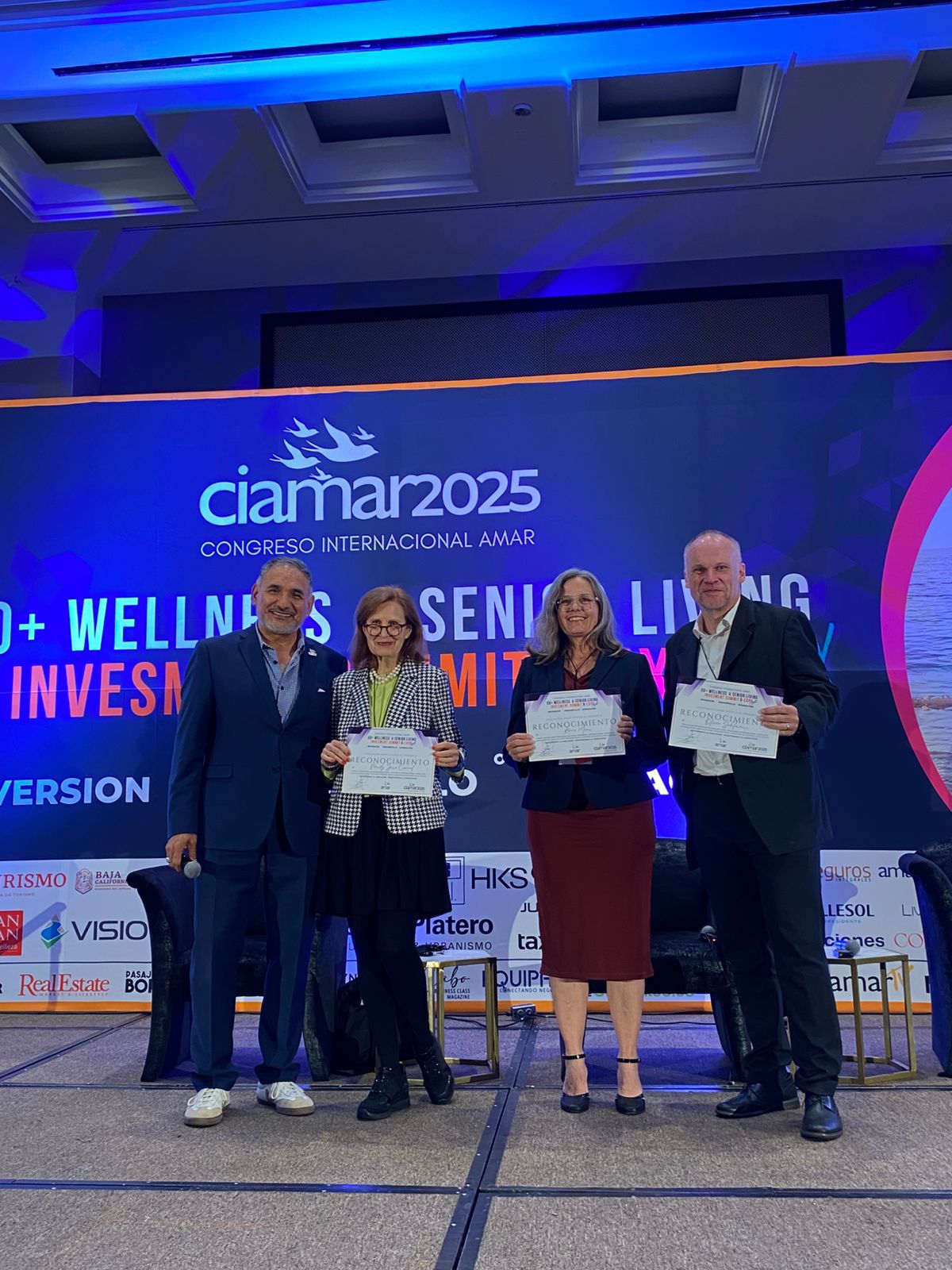
Three of us were invited to address the following question:

Who are the Americans, Canadians, and other foreigners considering Mexico for retirement and senior care?

We began our team presentation with a quick slide show of photos showing foreign residents in Mexico ages 60 to 100, couples and solo agers of diverse backgrounds (a growing number of Mexican Americans included), and those with diverse interests and preferences from no frills to resort-like settings.

Kerri Moon, an American entrepreneur who built one community at Lake Chapala and collaborated on the growth of the Namaste Community (another Lake Chapala expat community), pointed out, and we all agree, “the availability of caring workers who come from intergenerational households and are accustomed to respecting their elders could ensure superior staff-to-resident ratios giving Mexican senior housing a tremendous opportunity to succeed.”

Moon is currently spearheading a group seeking investors for a Memory Care Village at Lake Chapala. Find her at https://www.facebook.com/RetireInternationally/

Oliver Sahlmann, a business coach, former Volkswagen Mexico executive, and Mexico resident for 20+ years, shared about German retirees in Mexico.  “They come mostly for the sun, and, in winter months.” He presented some charming cultural stories to give the audience a feeling for the German mindset.

The main points of my contribution were the diversity of ages, backgrounds, and interests, that no one plan fits all, and that most retirees from Canada and the U.S. prefer to Age in Place in communities with other expats. Fewer prefer living among locals but those who do often thrive.

The migration of Americans and Canadians to Mexico for retirement and senior care is not new, it has existed for decades. Numbers increased noticeably since 2008 (U.S. economic challenges), COVID, and as mentioned above – the realization that we are living longer and there may not be enough funds for retirement and healthcare. The U.S. does not have universal healthcare, Canada and Mexico do to varying degrees.

For older adults who have long-term care insurance and are independently wealthy healthcare is not an issue. But the reality is, even with U.S. Medicare, and continued rumors of cuts for Medicare and Medicare Advantage programs, some older adults are seeking alternatives and solutions in other U.S. states or other countries.

Here are some highlights from CIAMAR 2025 sharing pride of Mexico, sustainable projects, unique visions, plus mention of notable vendor/summit supporters:

Javier Govi invited attendees to invest in the future of senior living in Mexico and LatAm, invest in the concept of Near Retiring (bringing Americans and Canadians to Mexico), consider Pueblo Magicos for aging (see Reference section below for explanation of this government initiative for magical villages), and most of all offer dignity, quality of life, and exceptional healthcare. Govi is the author of Nearetiring: Baby Boomers, Snowbirds, and Summerbirds, a Great Opportunity for Mexico and Latin America in Spanish.

Mac Kroupensky – Mac is a thought leader who teaches corporations, companies, and government how to create innovative change and motivate people and teams. For 10 years he taught at IPADE, Mexico’s equivalent of the Harvard Business School or France’s INSEAD. “To be a great leader you must be a great human being,” is his motto.

Kroupensky has a super enthusiastic presence. He regaled the audience by asking them to imagine an ideal retirement place – a city of 150,000 with medical infrastructure, security, and new technology. He pointed to Sofia, Bulgaria’s thriving tech and arts scene, a city of old and new. Most of all, that perfect retirement place would offer the best of humanity, people who care. He then added, the Mexico/LatAm Senior Living Investment Summit would offer invaluable expertise and talent. He is right, it did.

https://kroupensky.com/quien-es-mac/

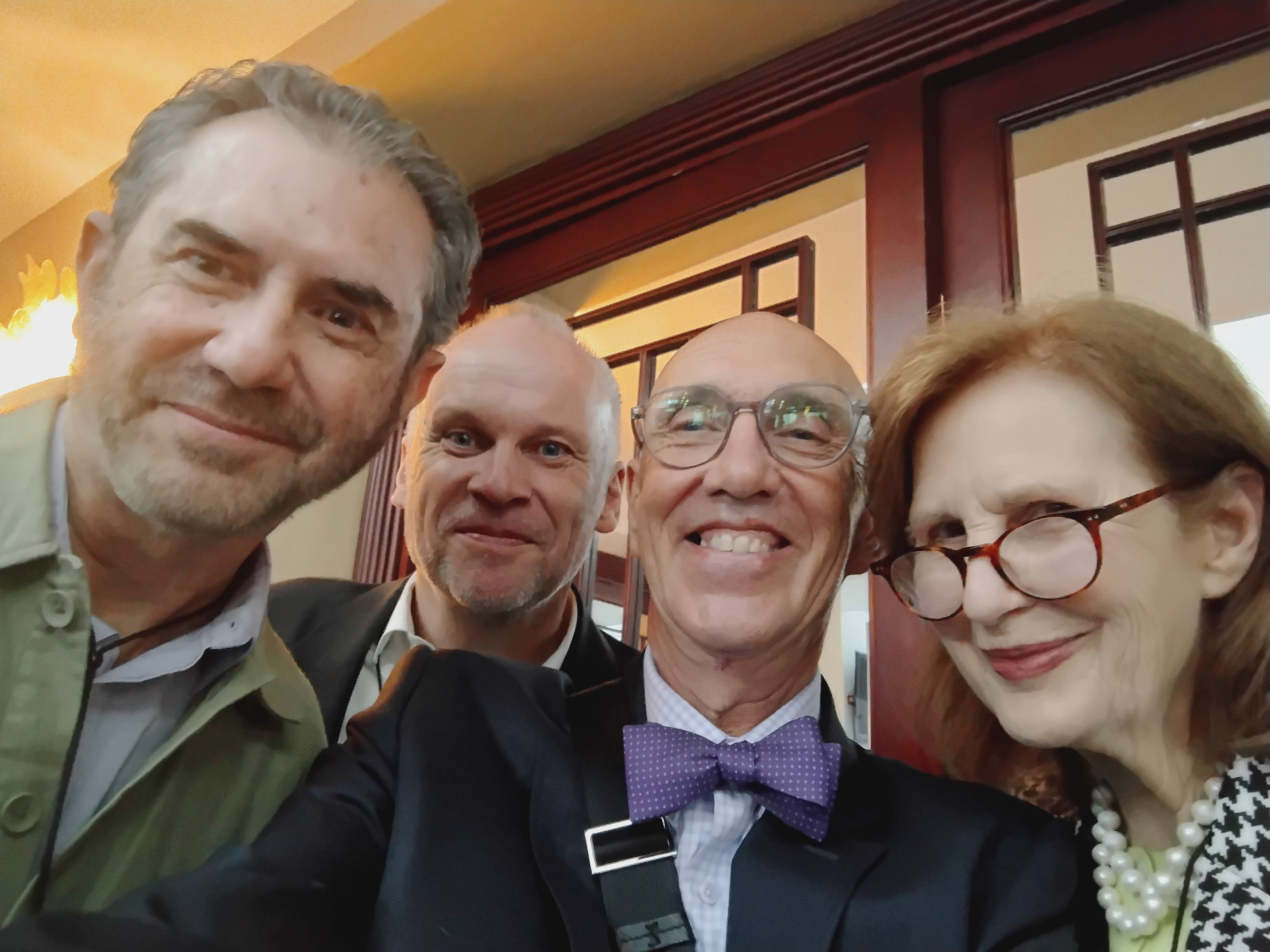
In the photo below: Rafael Garcia Turban international developer, Oliver Sahlmann, Mac Kroupensky, Wendy Jane Carrel at CIAMAR Mexico and LatAm Senior LIving Investment Summit 2025
Antonio Gonzalez-Quiros F. , Director of Ballesol Mexico, was the keynote speaker. Ballesol is a Spanish corporation that for 40 years has developed 55+ resorts, residential apartments, and assisted living. Ballesol has assisted living facilities in Queretaro and Mexico City. Note: Spaniards and Latin Americans investing in senior living have much in common – culture, language, law, and a familiar way of doing business.

Ernesto Oechlar former banker, former CEO of a family-owned senior living residence, advocate for holistic senior living, organic food, and positive mind set. He is currently a consultant for Neuro Change Solutions (NCS), a global network of corporate consultants trained by Dr. Joe Dispenza teaching how to apply the neuroscience of change to increase employee engagement, collaboration, and productivity for business results. Delightful to converse with him and with Mac Kroupensky about differences of perception within cultures.

Marta Parra, Co-Founder and Co-Director of Virai Arquitectura, Spain.  She was one of the last speakers and I wish more attendees could have listened to her enlightened presentation about creating accessible spaces and person-centered memory care with the energy of light, located in nature, and more. She is a pioneer in neuroarchitecture and sustainability for hospitals and senior living residences in Spain, Africa, and Latin America. Her slides and presentation were excellent. For more information see https://www.virai.eu/

Architect Carlos Sanchez of www.gomezplatero.com was a pleasure to listen to and learn from. He studied architecture in Torino, Italy and has worked on senior living projects in Medellín, Colombia and in Uruguay. 

Mario López is the founderof Taxáre. He is a real estate appraiser, consultant and enthusiastic investment project manager for real estate businesses. You can find him as “Mario El Valuador” on Instagram, Tik Tok and his podcast Un Express de Real Estate on You Tube @soymariolopez. He showed us drawings of an eye-catching urban city design for Tijuana intended for retirees and others – modern towers, gated, secure, flat and walkable, alongside the Pacific Ocean, with sustainable architecture, lots of gardens and amenities. If and when such a project is manifested, I can see folks with this concept as their aging in place vision filling it up fast. Based on my several due diligence visits to Tijuana, the city would benefit from a project such as this.

Juan Pablo Payró an Architect/Masterplanner/Designer/Developer shared about Agrihoods and Wellness Community projects in Queretaro, San Miguel de Allende, Holbox, Bacalar, and Los Cabos. He is a co-developer with Javier Govi’s Grupo AMAR. I contacted him to share photos or a website but have yet to receive a reply.

Salvador Rivas, an articulate, cultivated British-Mexican architect, has worked on prestigious international projects. His web site is www.srivasarchitects.com . I contacted him for information related to senior living projects but have yet to receive a reply.

There were many worthy presenters. Apologies to those not mentioned.

A special shout out to Jose Manuel Diez for his elegant, gracious energy as Master of Ceremonies and to the amazing AMAR and CIAMAR support team who produced this event.

Attendees I also appreciated meeting:

Juan Jose Perez Rifel shared with me an appealing project for Queretaro, one of my favorite Mexican cities. He is with www.st-austin.mx (see concept photos at the website). As I understand St. Austin owns the land. The first project is an eco-sustainable hospital which will serve as the property anchor with plans to expand to a medical district with doctor’s offices, a senior living residence (no precise details), a commercial center, gardens, and more. I am eager to see it when it is built.

Visiting from Lake Chapala was Jorge Garcia de Leon who is head of operations at Rancho Salud Village, see www.rancholasaludvillage.com or their Facebook page.  His father-in-law owns the land in this eco-friendly, holistic, sustainable, multicultural, co-housing community of homes for Aging in Place. I have witnessed the growth over 11 years from two homes to a plan for 21 and eventually 30+ with pool, vegetable and herb gardens, and more. I am a fan of Jaime Navarro, his lady Sara, and their passion for healthy, independent living.

Roberto Madruga Avensa of Mexico City has “four legally clear parcels for development” for an Aging in Place/Wellness project in the Pueblo Magico (magical village) of Ixtapan de la Sal. The project is known as Reserva Reforma and there is no website yet. Sr Madruga envisions a completely flat, walkable community with local healthcare within five minutes, a hospital you would be flown to by air ambulance if needed, living spaces with doors, floors, and more following the 150 Residencial Universal Living Design standards. Sr. Madruga’s wife is a geriatrician. They have travelled to Italy, Spain, and Switzerland to look at senior care. The Reserva Reforma concept would appeal to American and Canadian couples and solo agers if and when such a project is built may be a few years from now.  In any event, the vision is a match with many folks who wish to move to Mexico, Baby Boomers especially.

Alejandro del Rio of Leon, Mexico.  Family property on many acres in nature with a villa, a large home, lots of green trees, brick walls. It has been or is being converted into a senior living residence. See https://www.plenityland.com/ for photos and contact information.

Nelly Vasquez Sanchez of Gravasa Immobiliaria in Puebla and Oaxaca is a real estate agent and a newbie to the senior living world.  She shared with me she attended the conference because she wishes to learn how to provide for expat residents. She paid attention to each presentation. She was a joy to get to know as she represents a younger generation that has an interest in aging. https://www.facebook.com/igruvasa/?locale=en_GB

Mauricio de la Cerda, VP Growth for www.angela.care was at a vendor table sharing how to receive pills in a pill pack organized by day and time (breakfast, lunch, dinner), delivered to you at home. Angela Care works in collaboration with Amazon Pharmacy.

Vendor Roberto Sanchez of Gerflor.com, a French flooring company, shared my kind of waterproof, antimicrobial, soft to fall on, quiet, no glue, fast installation flooring. I wish this flooring was mandatory in Mexican residences as injuries from falls could be less severe. Most residences have slippery tile flooring. I also had a secret desire that the Marquis Reforma Hotel where the summit was held would remove its marble floors. We were there in rainy season!! Here is the GerflorUSA website: https://www.gerflorusa.com/

Where is the money?

With the talent I witnessed and all the possibilities shown on multimedia around the conference center (some visually inviting, stunning in fact), I was mystified. I wondered why so many worthy older adult projects presented at the summit have not been built.

What has prevented architects, developers and others from manifesting their visions?

If I had not been breathless and a bit under the weather, nor missed the presentation that may have explained more “Where is the Money?” I may have learned more. Kudos to CIAMAR for the discussion.

So, I canvassed Mexican speakers and attendees and asked if they would please share what they see as obstacles.

The answers included government bureaucracy (heard this several times, heard this the most), challenging local laws requiring 2-3 years for permission to build, issues with land permits, financing, construction, and “voluntad” or will power and motivation for investment in this sector.

There is a growing venture capital market in Mexico of local and international investors. Most of the capital is being invested in technology, especially fintech.

Many architects and developers in senior living are essentially like movie producers. They create an idea, develop it, and shop it from place to place for financing.

It requires remarkable resilience and will power to be a Mexican entrepreneur in the senior living sector.

CIAMAR 2026 will focus on technology in senior living.

Summary

The need for senior living – housing and care, especially affordable housing and care, is growing in all three North American nations – Canada, Mexico, and the U.S.

For several decades Mexico has been a destination for Americans and Canadians. Now, with dwindling retirement funds, healthcare plans that are not flexible, and overall rising costs for housing and healthcare, the opportunity for more development is evident.

Senior living south of the U.S. border may be a continuing retirement trend.

Growth is slow as developments are often stalled by government bureaucracy, land permit issues, the ability to raise capital, and more.

Some Mexican developers are focusing on generations age 50+, especially those who are active and fit, seeking affordable luxury and a wellness environment.

© All rights reserved. Wendy Jane Carrel 2025   

Wendy Jane Carrel is a trusted older adult advocate and consultant who has hands-on experience with healthcare systems, retirement options, senior living residences, and wellness programs in Mexico, Ecuador, and other countries. She provides informed, culturally sensitive transition guidance and curated options for families and elders moving to Latin America. Her website is http://www.WellnessShepherd.com

Resources:

https://www.sciencedirect.com/science/article/abs/pii/S152586102200559X# Canadian long-term care statistics

https://bytescraper.com/b2b-database/list-of-assisted-living-facilities-in-canada

https://www12.statcan.gc.ca/census-recensement/2011/as-sa/98-312-x/98-312-x2011003_4-eng.cfm Canadian housing, dwelling statistics

https://www.technavio.com/report/senior-living-market-analysis an overview of U.S. market analysis growth for future senior living

https://dspace.mit.edu/handle/1721.1/108882# MIT study on real estate development opportunities for senior living in Mexico.  2017 2017 study on opportunities for senior living in Mexico

https://www.definitivehc.com/resources/healthcare-insights/assisted-living-facilities-us U.S. statistics for assisted living residences

https://en.wikipedia.org/wiki/Pueblos_M%C3%A1gicos Pueblos Magicos are part of a Mexican government initiative to create interest in its small towns with historical or magical charm.

I wrote the article below in 2016, it is dated in part.

Statistics

Statistics for burgeoning population growth in North America:

Canada – 7.6 million older adults representing 18.9% of the population according to Statistics Canada 2024. Statistics project seniors could make up 23% of the population by 2030 and nearly 26% by 2068

Mexico – 10.6 million adults over age 65 according to INEGI the Mexican Statistics Bureau, and Statistica.com. AARP International suggests older Mexican adults will represent 30% of the population by 2050 an increase of 277%.

USA – The number of Americans 65 and older is projected to increase from 58 million in 2022 to 82 million by 2050 (a 42% increase) according to a 2024 study by the Population Resources Bureau.

Assisted Living Mexico, CCRC's in Mexico, Expats Mexico, Health & Wellness Mexico, International Retirement, Life Plan Communities Mexico, Mexico Senior Living

Senior Living Investment Summit Mexico and Latin America September 3-4, 2025

I am on my way to Mexico City to speak at a Senior Living Summit being held at the Hotel Marquis Reforma September 3-4, 2025 about the growing need to create evolved, affordable, holistic enclaves of well-being for older adults to age in place, age in community, and more, a subject on my mind since 2003.

Quick history:

In 2003, when serving as nighttime administrator and day time admissions and marketing officer at an exemplary (still is) memory care campus in Rancho Mirage, California, (thank you owner and mentor Floyd), the writing was on the wall.

Unless you are blessed with excellent health your entire life and have experienced no accidents, in the U.S. the cost of adequate long-term care at home or in a residence, could easily require up to $1 million per person with 2025 fees and pricing. With long-term care insurance at several hundred dollars a month, only 80% of costs would be covered.

This awakening was the impetus to look internationally for more affordable options with quality care and medical infrastructure. Mexico and Ecuador, by virtue of proximity, were places I conducted due diligence and developed hands-on experience with locals and expats, as well as other nations farther away.

Thankfully, as a trusted older adult advocate and consultant I have met like-minded souls on my path including Mexico’s Javier Govi, the « nearretiring » proselytizer and real estate entrepreneur behind CIAMAR’s 9th edition Wellness and Senior Living Summit for 50+ to 80.

About 100 to 150 persons are expected to attend the gathering gently modelled after NIC (National Investment Center conferences in the U.S. with 1500 to 3,000 participants).

The concept to develop and expand senior living options is growing in Latin America as the silver tsunami is not just an American/Canadian/European phenomenon, it is worldwide.

Attendees will be real estate developers, venture capitalists, architects, brokers, folks from the tourism industry, and senior living operators who will meet, greet, and assess future potential for collaboration.

I will be on the Bucket List panel with two others to talk about expats who migrate to Mexico and other countries in Latin America and what their expectations are.

Here is a link to the summit home page: https://ciamar.odoo.com/en

Here is a link to the speaker page: https://ciamar.odoo.com/en/ponentes

If you are unable to access it, here is how my bio reads:

Wendy Jane Carrel

Founder, Wellness Shepherd

A trusted older adult advocate and consultant who has hands-on experience with healthcare systems, retirement options, senior living residences, and wellness programs in Mexico, Ecuador, and other countries. She provides informed and thoughtful transition guidance and curated options for families and elders moving to Latin America.

©  Wendy Jane Carrel 2025 http://www.WellnessShepherd.com

Aging in Place, Tuscany, Italy, Mexico Senior Living, Senior Care Italy, Senior Care Mexico

Aging in Place & Senior Care in Italy – A Snapshot from Tuscany

In October I spent three weeks in Italy celebrating the 90th birthday of “Super Silvana” the last living person of her generation who has witnessed my life since I was a teenager. Her nickname comes from her daughter and friends who have spent a lifetime watching her overcome obstacles. She was a child during WWII living in the countryside, and later, the sole support of her daughter and other relatives. My heartfelt thanks to Silvana and her daughter for permission to share. Here is what I observed:

Aging in Place

Silvana is aging in place with dignity and self-respect, her way, as much as possible.

From my point of view, it is not easy without unlimited resources and optimum health in Italy, nor almost anywhere else in Europe. Nordic countries and The Netherlands may be mini exceptions. (I have seen well-thought-out senior living and support in Stockholm and outside Amsterdam).

Silvana’s circumstances are what Americans would refer to as middle class. She worked her whole life, ran a small business, and owns a condominium in an attractive section of Florence a few hundred yards from the Arno River. She has been a widow for over 35 years.

She is aware of the importance of diet, buys the freshest food, and continues to create meals from scratch. She used to go to open-air markets but recently has found most produce at the Esselunga market behind the back gate of the condominium. Years ago, we drove to the Tuscan towns of Impruneta or Poggibonsi on weekends and returned with the best quality olive oil, chianti, cheeses, and more. Today this is accomplished by or with her super capable and loving daughter, her only child, who lives next door, and works full-time.

Here below is a photo taken by her daughter outside the Esselunga market under the hot (over 100 degrees) October sun.

Silvana’s home is immaculate – open any armoire and you will find the best quality linen, beautifully laundered and ironed. Ditto for her clothing. In the entrance hall she keeps a marble bowl of necklaces – pearls, Murano glass, and others on a sideboard. When she goes to the supermarket or for a café, she will (unless it is too hot) be wearing a necklace, earrings, and fine watch. Next to the sideboard is her walker for the street.

Guess who cleans the condo, prepares meals, does the laundry, and makes certain all is in order. Silvana!

When you meet her, she exudes kindness, and love. She is an appreciator of life, always smiling and seeing the best in you and those whom she meets. She is a woman of immense energy, generosity, and intelligence. She worries about others and knows her neighbors and their stories. Every day she walks one flight up to check on another aging in place lady who is the caregiver for a severely disabled daughter. The lovely lady upstairs receives no respite or support from social services, neither does Silvana.

The precious little dog in the photo by her daughter below is Nina, Silvana’s companion during the day while her daughter works.

On Thursdays a hairdresser comes to coif Silvana’s hair. The hairdresser also attends to the ladies upstairs. This is Silvana’s investment in feeling better and “a posto” or okay.

Silvana’s attractive appearance defies what she is feeling almost 24/7 – unrelenting pain from rheumatoid arthritis, scoliosis, osteoarthritis, and other co-morbidities.

Nighttime Challenge

Nighttime is more difficult than daytime. Sleep is interrupted with shooting pain despite evening medication. When she gets up to use the bathroom, it is not easy. It takes a while to lift her body comfortably from the bed. (The bed she carefully chose gives best possible comfort and support for her condition). She is wise and focuses on remaining stable as she rises; it is a chore to walk the short distance. She does not use a walker in the house or to navigate at night. The lighting is good. But what if she falls?

Socialization

Silvana loves her independence, walking the local streets and around the condo compound every day. Unlike many disabled and ailing who are retired, she is supremely socialized, though it would be helpful to have visitors or a regular companion during the day other than neighbors who stop by outside her window. Game shows on TV are not of interest, the news is. She enjoys reading and crossword puzzles. Her mind is sharp.

Almost every day I was there we walked to the city center looking to replace my favorite Igi & Co. wedge walking shoes. Each time we went it was a charming adventure watching how she would dart ahead of me with her walker, so excited. She attracts folks like magnets on the street, in stores. It is fun to watch. As you may have surmised, she is super friendly and has a gift for storytelling.

We were late returning from the center one evening and decided to hop on a tram instead of walking back. As she enters the tram with her walker she is smiling and announcing how much she appreciates everyone’s help and she is sorry if she is disturbing anyone. Passengers smile broadly, transfixed by her charisma and warmth. I wish I had thought to make a video of the experience. It was such a pleasure to watch.

Assisted Living in Italy

Silvana has absolutely no interest in a senior living home even if she could afford the prices. There are a handful of “luxury” residences, homes run by nuns, and homes partially supported by the government in Tuscany known as RSA (Residenza Sanitaria Assistenziale – sanitary residence care).

The photo below is of a typical modern assisted living in Florence. The photo is only to show an example, not to recommend or endorse.

In Italy, there is private pay assisted living, and as in the U.S., you will be moved if you require nursing care. Prices range between 2500 and 4500 euros per month, depending on the city and the region. I visited four residences in Florence and two in Pistoia on this trip. My priority was to be with Silvana as much as possible, observe her health, and see if we could discover some surprise solution to ease her aging in place. My last trip was to see Silvana’s loving oldest sister before she passed away – fortunately, with good care paid for in part by the Italian government.

Home Health Aides (known as “badanti”)

Receiving help at home is not paid for or assisted by social services unless you are uncommonly poor and gravely disabled – blind, deaf, paralyzed, etc. Silvana might welcome a “badante”, a caregiver, though she might not readily admit this. She tries not to show it, but she is understandably tired. She is not a complainer. Keep in mind it is cultural to not discuss your woes outside your family, and just as important, is the desire to “fare una bella figura” an idiomatic way of saying always put your best foot forward.(Badante is from the Italian verb badare, to take care of). 

There are agencies for a badante, male or female, in larger Italian cities. In Tuscany and other provinces there is also an underground market (or hidden job network) of migrant Peruvian, Moldavian, and Romanian badantes, some apparently without residency. I heard stories (not confirmed) about abuse or theft on occasion by caregivers who are not vetted or bonded. On the other side, there are stories of “modern servitude” by Italian families hiring badanti.

Below is a photo of a large agency on Via del Sansovino in Florence. There are three other agencies in city center.

According to a British study by Giuliana Costa the hiring of migrant badanti to relieve Italian families has been on-going since around 2000. The average price of a badante starts at about 800 euros/month (about $900 USD) and goes to 1500 euro (about $1600 USD) or 2000 euro per month ($2200 USD) not including room and board. The average gross monthly salary of middle-class Italians is currently 3650 euros, the current average middle class pension is 800-1200 euros/month or more). With prices rising around the world since COVID, the cost for a badante continues to increase.

The situation is challenging if you are caught in the middle. Italian families, the traditional caregivers, must now work or care for their own children as well as their parents.

Depending on which statistics you study, Italy has the second or third largest population of older adults in the world, following Germany or Japan. In Italy today, there is not enough support for the growing population of older adults.

Average Middle-Class Pension in Italy, Will It Pay for a Badante?

The average middle class pension in Italy is around $16,572.22 USD/year.  Monthly, that comes to 1370 euros, but the pension is more likely 800 to 1000 euros per month. Even if your condo is owned, you are paying condo fees, water, gas, electricity, transportation, food, doctors, clothing, and miscellaneous expenses.  Are you able to pay a badante who will need his or her own room + board?  If you are lucky perhaps you may find someone for a few short hours at 10-12 euros per hour. But over time the expense may become prohibitive.

If you own a home and have a pension above the poverty line, it is a given that government social services will tacitly expect your family to care for you. This makes me wonder what happens if you are a solo ager with no support.

If you are above the poverty line in Tuscany, you must pay a fee to go to a senior center, a day care center, receive social worker support and other services. If the choice is paying utilities and eating, will you pay for day care? As far as I have learned from research, there is no organization such as Meals on Wheels in Florence for example, and even if there was, Silvana prefers choosing what food is most healthful for her. I was hoping to learn about a non-profit organization of volunteer companions that visit older adults. Florence does, however, have a volunteer service that drives extremely disabled older adults to doctor appointments.

The local government social services in Florence are housed in the ASL Ufficio di Assistenza (the Assistance Building) which includes the ISEE, the government entity which assesses your economic condition (Equivalent Economic Situation Indicator).

What happens if Silvana has a fall, a stroke, and needs serious care?

Government healthcare will kick in, but for some services, she may be paying in part. Her daughter sends good thoughts to the universe every day so that her mother will not have an accident, so do I.

The national health system in Italy includes state hospitals which are funded by taxes. If you are Italian, or a resident, you do not pay as a patient for the hospital. For scheduled surgery, a referral from a doctor is required. In acute situations, you can go to an emergency room (Pronto Soccorso) without a referral.

What works…

Italy has provided universal healthcare since 1978 through the Ministry of Health and its SSN Servizio Sanitario Nazionale. This service is available to all Italians and Italian residents. Until the last few years, according to many, it has been a positive experience. Recently, due to staff shortages, COVID, and fewer euros to support the system, it takes longer to receive attention. Fortunately, Silvana has an SSN geriatrician whom she is pleased with. SSN does not include dentistry and psychological support. There is also private pay medicine in Italy and private pay health insurance. Many Italians are now participating in both public and private insurance, the latter if they are able to afford it.

Conclusion

The review above is a snapshot. A proper evaluation would require several months or a year of due diligence and observation to understand the changing system of care for older adults in Italy.

Again, as with the U.S. and most “western” nations, much has changed in the last 10 or 20 years – mostly diminishing social services plus higher cost of living and cost of care prices.

My Italian trip made Mexico, (where I focus my energies coordinating senior care, senior housing, and end-of-life care), seem comparatively less complicated and more affordable for Americans, Canadians, or Europeans seeking to age in place outside their home country.

Through Mexico’s INAPAM and DIF, all nationals and residents may participate in programs and activities designed as poverty reduction strategies. Senior centers act as daycare centers with socialization (there are government centers in rural areas as well as metropolitan areas), seniors receive discounts for travel by bus locally and long distance, Mexican national seniors receive a small monthly amount for expenses, and DIF homes (not that many in the country), provide a roof over one’s head and care.

Wendy Jane Carrel, MA, is a Spanish-speaking (and still Italian-speaking) senior care advocate from California. She has travelled 13 states of Mexico for more than 20 years researching health systems, senior care, and end-of-life care. She provides housing and care solutions and guides transitions in/to Mexico for Americans, Canadians, and Europeans. She is a compassionate companion and palliative care liaison, legacy writer, a trauma-informed End-of-Life Doula (National End-of-Life Doula Alliance proficient), and a speaker and published author on subjects related to senior well-being. Wendy’s web site is https://www.WellnessShepherd.com

References:

https://journals.openedition.org/osb/1536 Private Assistants in the Italian Care System, Facts and Policies by Giuliana Costa

https://www.ncbi.nlm.nih.gov/pmc/articles/PMC5868556/  well-presented “badante” case study in the city of Verona from 2017.  

https://cafebabel.com/en/article/badante-the-ghosts-of-italian-society-5ae00a19f723b35a145e5e21/  how migrant caregivers are often exploited in Italy

https://cafcisltoscana.it/isee   Social Services in Tuscany, Italy   Assistance for pregnancy, university tuition, older adults and more, if you qualify.

https://housinganywhere.com/Italy/average-salary-italy

https://en.wikipedia.org/wiki/Healthcare_in_Italy

https://www.yourcare.eu/press/assisted-living-boom-predicted-in-italian-cities/ average 2023 monthly salaries for in-home caregivers

https://www.gruppolameridiana.com/en/residenza-sanitaria-assistenziale-rsa-works/   RSA homes in Italy

© Wendy Jane Carrel, 2023 

Jewish Senior Care Mexico, Life Plan Communities Mexico, Mexico Senior Living, Nursing Homes Mexico, Senior Care Mexico, Senior Living Mexico

A Mexican Surprise – Cuernavaca Senior Care for the Jewish Community

Hanukkah 2022

Aside from dedication to senior care in Riverside County, California (Coachella, Palm Springs, Rancho Mirage), I have made a point of visiting small and large older adult residences in places I travel to. During the last 25 years I have gratefully been received at innumerable homes in California, Chile, Ecuador, Italy, and Mexico.

I must say, after spending time in Mexican government (DIF homes – department of social services), non-profits (mostly run by nuns), and for-profit homes in 16 states of Mexico, Eishel Nuestro Hogar (Eishel Our Home) in Cuernavaca, is a standout.

Possible reasons why…

This residence functions well because those in charge are serving older adults as their mission. And with compassion. In this way, residents and personnel feel at home despite any minor shortcomings.

At Eishel the director, the physician in charge, and the Board of Directors are transparent. They welcome all who wish to learn about their residence. You may eat a meal, spend the night, or stay longer if you wish to acquaint yourself with the environment. This is unusual.

Few homes in Mexico choose to be as open. Few homes have web pages with authentic photos. For financial and social reasons, many Mexican homes, if they have an Internet presence, choose Facebook.

Culturally, Jewish people are super organized. They care and support each other well. Yes, this is a biased statement, yet it is based on years of observation. (I was NOT brought up in the Jewish faith).

Let’s do a walk through of Eishel Nuestro Hogar/Eishel Our Home :

First, I was expected. Nice !!

For obvious reasons, there is serious security. The modern compound is walled. Within double-locked doors the guards reviewed my ID, then called the administrator.

I was shown to the courtyard where I waited on a comfortable bench with a view through glass front doors to the synagogue. The air was crisp, dry, and warm. (Cuernavaca is known for its spring climate throughout the year).

Synagogue at Eishel Nuestro Hogar, Cuernavaca, Mexico

Within minutes the administrator (who came on her day off) greeted me with the physician in charge. They generously gave their time for a detailed and meaningful tour of the entire compound.

From an American point of view Eishel is a CCRC – a Continuing Care Retirement Community with independent living, assisted living, rehabilitation, nursing care, and end-of-life accomodation. The difference from most CCRC’s in the U.S. is that you offer a monthly donation, and do not own.

Eishel is an A.C., Asociación Civil, a non-profit that has existed in various forms since 1947, 75 years ago. (The first recognized assisted living with 24/7 care in the U.S. opened in Portland, Oregon in 1981).

The Eishel campus has lovely manicured grounds, two modern two-story residences, an outdoor theater, a sculpture garden, an herb garden, two gazebos, and a wall of plaques recognizing the donors.

A gazebo at Eishel Nuestro Hogar facing the independent living indoor/outdoor dining room

Eishel Nuestro Hogar Donor Garden

The fresh herb garden is maintained by residents, the chef, and kitchen staff. In addition to herbs there are tomatoes, lettuce, peppers, and more. Pineapples, blackberries and strawberries also grow on the grounds.

We visited residents in their comfortable airy rooms, the nursing floor, and stopped by the currently empty end-of-life suite with one large light-filled room for the resident patient and another room for his or her family.

Note : Even though some senior living administrators in Mexico have thought to create hospice within senior living, Eishel is the only residence I have visited that has sustained such a space. HOLA (Hospice of the Angels) tried this concept in their Morelia assisted living residence for two years during the pandemic. Unfortunately HOLA closed for a variety of reasons.

The nursing floor …

Eishel Nuestro Hogar Infirmary

Dr. Golub attending to patients in nursing floor day room at Eishel

Nursing floor dining room with views to nature and tables to accommodate reclining wheelchairs. Visitors from other countries have come to see the unusual curved tables so they might replicate similar practical tables in their nursing areas.

There are two sparkling, immaculate kitchens honoring kosher tradition.

Eishel’s current population of 72, with room for 140, is mostly Mexican. There are residents from Europe and the U.S. The languages most heard are Spanish, Yiddish, and English, in that order. Entrance is for anyone of Jewish faith either Ashkenazi or Sephardic. One must be 65 years of age, wish to live there, and agree to the rules. Persons with aggressive behavior or on dialysis are not admitted. Please see the web site which outlines requirements. Your monthly payment is a donation to the non-profit.

Photo of rehabilitation patio with Dr. Golub greeting residents, and Director Gonzalez in black and beige blouse dancing in front of a resident

Activities include movies (there is a theater), tai chi, trips, art classes, occupational therapy, and more. There is a library. A 70-year-old retired coffee table book author from Mexico City shared with me that he teaches writing. He lives at Eishel for « the fabulous year-round weather, intellectual conversation, the food, and the sense of community. »

According to the director, there is little staff turnover. Some employees stay 25 years.

Every two months Eishel publishes a full-color mini-magazine, a gazeta. There are articles by board members, residents, and staff on a variety of subjects.

Meaning of the name Eishel :

The Hebrew letters Eishel or Aishel (aleph, shin, lamed) are an acronym for Achila (feeding), Shtiya (drinking), and Linah (lodging). Since ancient times, Eishel denoted an inn.

In case you are wondering about population of Jews in Mexico and the rest of the world :

According to the Pew Research Center there are about 14 million Jews around the world representing 0.2% of the global population:

“While Jews historically have been found all around the globe, Judaism is highly geographically concentrated today. More than four-fifths of all Jews live in just two countries, the United States (41%) and Israel (41%).”

According to American Jewish Aging Services there are over 95 Jewish organizations or homes serving older adults in the U.S.

According to Wikipedia approximately 70,000 Jews (both Ashkenazi and Sephardic) live in Mexico (primarily Cuernavaca, Lake Chapala, Mexico City, Puerto Vallarta, and San Miguel de Allende). Another 230,000 live in Argentina.

The first Jews, known as Crypto or Converso Jews because they converted to Catholicism during the Inquisition in Portugal and Spain, came to the Americas with Christopher Columbus on his first expedition (according to Wikipedia and information from the University of Florida George A. Smathers Libraries). They were called cryptos because they secretly practiced their faith but were publicly Catholics.

Summation

My visit was satisfying. Eishel is an unusual Mexican senior home. Its administrators show they are vested in well-being. At this time the residents are mostly Jewish Mexicans and the help is mostly Mexican. The atmosphere is comfortable and convivial, likely the result of residents having much in common. The true reveal would be living there or visiting Eishel over a period of time.

You may read more about the Eishel home and staff at https://www.eishel.org/ or write to mr.gonzalez@eishel.org

Wendy Jane Carrel, MA, is a Spanish-speaking senior care specialist and consultant from California. She has travelled Mexico for several years researching health systems, senior care, and end-of-life care to connect Americans, Canadians, and Europeans with options for loved ones. She has assessed hundreds of senior housing choices in 16 Mexican states. Her web site is https://www.WellnessShepherd.com

Resources:

https://es.wikipedia.org/wiki/Jud%C3%ADos_en_Am%C3%A9rica_Latina_y_el_Caribe   Most Latin American Jews live in Argentina – 230,000; 70,000 live in MX.   In Argentina there are all-Jewish senior care homes, I easily located three on the Internet.  https://beitsion.org.ar/ , https://hogarledorvador.org/quienes-somos/ (modern), https://auno.org.ar/el-hogar-israelita-refugio-para-los-abuelos 4

https://ajas.org/senior-living-resources/find-a-jewish-senior-community/map-of-all-jewish-senior-communities/ map of Jewish senior living communities in the U.S., about 70 total, most in New York, New Jersey, and Florida.

https://www.tabletmag.com/sections/community/articles/the-jews-of-san-miguel-de-allende

Assisted Living Mexico, Ex-pats in Mexico, Mexico Senior Living, Retirement in Mexico

Senior Living Models in Mexico – What Expats May Be Looking at in 2021

Last month Steve Moran, senior housing veteran and colleague, kindly invited me to talk with him about senior living in Mexico. (Steve has experience in Mexico leading humanitarian missions).

We spoke about what I’ve learned and experienced researching healthcare, housing, and hospice in 16 Mexican states, mainly places where expats live.

He asked if there are any Belmont Village or Brookdale style developments. (There is a Belmont Village in Mexico City).

Belmont Village, Santa Fe section, Mexico City

When we finished the chat, I sent Steve an article to post on Senior Living Foresight that outlines what we discussed – current models for senior living and/or senior care in Mexico and what is up and coming.

Not surprisingly American, Canadian, Mexican, and Spanish senior care providers have been looking to expand or initiate development in Mexico.

Here is the link to the article:

Please note:  I do not receive any referral fees or funds from any senior living homes in Mexico.

Wendy Jane Carrel, MA, is a Spanish-speaking senior care specialist and consultant from California. She has travelled Mexico for several years researching health systems, senior care, and end-of-life care in order to connect Americans, Canadians, and Europeans with options for loved ones. She has investigated hundreds of senior housing choices in 16 Mexican states. Her web site is http://www.WellnessShepherd.com.

Tree flowers, Lake Chapala, Mexico
Assisted Living Mexico, CCRC's in Mexico, Ex-pats in Mexico, Life Plan Communities Mexico, Mexico Senior Living, Nursing Homes Mexico, Retirement in Mexico, Senior Care Mexico

Senior Living in Mexico – A Chat with SLF’s Steve Moran and Wendy Jane Carrel, Senior Housing and Care Specialist Mexico

When recovering from dental surgery and in an altered state, I was interviewed by colleague and dedicated senior care advocate Steve Moran. For more than 10 years Steve has published an on-line magazine reaching thousands of U.S. senior housing executives and their teams – Senior Living Foresight.

Below is a link to our overview chat about Senior Living in Mexico which may be located on Steve’s web site, LinkedIn, and You Tube. (Please scroll to bottom of copy to find link if you are interested).


Part of the 36 minute video is out of sync; it also skips and flip-flops in places.


Toward the end Steve talks about a phone number. If you stay through that one minute, there is a brief mention of Medicare. One of the most asked questions by Americans looking to Mexico is: ” will Medicare be accepted”?


The video is not required viewing
. 😉 The intention is to offer helpful information.


I am accustomed to researching, interviewing, listening, and participating in private one-on-ones. I am unaccustomed to being the center of attention. I have much to learn about being on camera.

Thank you Steve for including me in the discussion!!!!


Health & Wellness Mexico, Hospice Mexico, Mexico Senior Living, Palliative Care Mexico, Senior Care Mexico

Mexican-American Nurse Elena Lopez Opens First Residential Hospice in Morelia, Michoacan, Mexico

In January 2020 Los Angeles-based nurse and case manager Elena Lopez realized the first part of a 20+ year vision – to return to Mexico to open a hospice, the first in her native state of Michoacan.

HOLA Hospice of the Angels/Hospicio de los Angeles Founder Elena Lopez
with Charge Nurse Claudia

There have been previous efforts since the 1970’s to create hospice homes in Mexico following models in Canada, the UK, and the U.S. For financial reasons, as well as the predominant family cultural value of caring for the ill at home through end-of-life, the hospice home model with others doing the caring has yet to be accepted or sustainable. There have been hospice homes but none have survived.

How will Lopez create a sustainable model?

Lopez’ residence Hospice of the Angels has married assisted living care with rooms for hospice. Assisted living is a concept prevalent in every state of Mexico.

Lopez has attracted not only local Michoacanos but Mexican-Americans with life-limiting illnesses who wish to live their last months in their native land. Note: It costs families in the U.S. up to $20,000 or more for remains to be shipped from the U.S. for traditional Catholic burial. Choosing Mexico for end-of-life helps defray these expenses for Mexicans living in Canada or the U.S. and allows local family to be present.

Lopez continues to train staff – nurses, caregivers, and volunteers, despite the pandemic -based on her professional experience in California at VITAS, Kaiser Permanente, and in private service. In 2020 her staff also received End-of-Life doula training (psycho-social practical and ritual support) with psychologist and doula Wilka Roig of the Elisabeth Kubler-Ross Foundation of central Mexico. Roig is headquartered in San Miguel de Allende. (See www.ekrmexico.org ).

Hospice of the Angels currently has 10 assisted living residents. The home hosted five hospice patients this year. There are 15 staffers including Luisa Fernanda Ruiz Montiel psychologist/tanatologist who holds a PhD (former professor), the accountant, and an attorney.

Despite COVID, Lopez and team have managed to keep the virus out of the home, and, host fundraisers. Residents are busy with small therapy dogs, arts and crafts, visits by priests, and music performances. Recently, American hospice nurse Ian McCartor, known for creating inspirational Legacy Songs for his patients in English and Spanish, played and sang at the home.

Priest visits residents and staff at HOLA Hospice of the Angels/Hospicio de los Angeles in Morelia, Michoacan, Mexico

An out-patient hospice service in Morelia and neighboring areas has not been deemed practical. It is considered unsafe to send doctors, nurses, and caregivers out at night due to heavy cartel activity.

At Hola Hospice of the Angels, each room offers a bed for the patient and a bed for a family member, a model first instituted in Mexico by Dra Susana Lua Nava at Juntos Contra el Dolor, the first and only level one 24/7 palliative care hospital in the neighboring state of Jalisco.  See www.JuntosContraelDolor.com

Mexican end-of-life care is provided through out-patient or in-home services in most states. Since the Mexican Palliative Care Law of 2009, there is now a broader view for care of the ill that includes those with life-limiting, painful illnesses that may last many years.

How to find Hospice of the Angels:

Fundación Hospicio de los Ángeles

Miguel Silva 149  Morelia, Michoacan de Ocampo, 58260, Mexico

Website: www.HospiceoftheAngels.org

Facebook page:  https://www.facebook.com/Fundacion-Hospicio-de-Angeles-450224751784959/ 

Tel.  52 443 275-0279 office; 52 443 331-6647 cell; and USA cell 213 706-1111

Additional hospice project for Uruapan, Michoacan, Mexico:

Lopez is collaborating simultaneously with a Michoacano whose life dream has been to open a home for older adults. The gentleman donated land in a tranquil forest area. Part of the home will be dedicated to assisted living and nursing care, the other part to hospice which will be headed up by Lopez. Architect Ivan Marin of Morelia will fuse old Michoacano style (lots of wood) with Japanese Zen-style structure – healing light, views to nature from all sides, and tranquility (a hard-to-find concept in Mexico). Two years ago Lopez and Marin travelled to Japan to study hospice and architectural concepts they could incorporate. Lopez says she envisions a quiet, meditative, sacred place. They plan to break ground within two years.

Wendy Jane Carrel, MA, is a Spanish-speaking senior care specialist, consultant, and Mexico senior living writer from California. She has travelled Mexico for several years researching health systems, senior care, and end-of-life care in order to connect Americans, Canadians, and Europeans with options for loved ones. She has investigated hundreds of senior housing choices in 16 Mexican states. Her web site is http://www.WellnessShepherd.com.

Assisted Living Mexico, Ex-pats in Mexico, Mexico Senior Living, Nursing Homes Mexico, Senior Care Mexico

Assisted Living Homes at Lake Chapala, Mexico Brace for COVID-19

Taking care of frail or gently infirm older adults, even in “good” times, is a challenging job. For many of us in senior care it is also a satisfying way to serve, and offers rewarding engagement.

But how does one rally to protect and defend older adults living in senior communities from COVID-19, the newest corona respiratory virus with multiple symptoms and possibly an unmerciful death, perhaps alone?

Precious American senior at a Lake Chapala assisted living home offering love to a little crab

Medical experts and tragic statistics share that older adults are more vulnerable than others to this borderless virus. A recent New York Times article reports an estimated one-fifth of U.S. deaths are linked to nursing facilities often due to inadequate protection and/or compensation for staff who sometimes work in more than one building to financially survive.

COVID-19 is now in Mexico. It flowed from Asia to Europe and the U.S. first. As of April 18, 958 Mexicans over age 60 have been hospitalized and 160 have required intensive care, representing 37% of the population. (No number is known from senior homes if any, but most patients had underlying health conditions).

Inspired by the response of healthcare workers around the world and despite distressing international and local news, all hands are on deck at approximately 25 assisted living/”nursing” homes at Lake Chapala, Mexico, one hour south of Mexico’s second largest city Guadalajara.  Residents are ex-pat and Mexican retirees and do not represent typical populations in other parts of the country.

Garden area, assisted living, Riberas del Pilar, Lake Chapala, Mexico

Important note: In Mexico, there are no nursing homes as they are defined north of the border. Acute care is in hospitals only. Assisted living homes offer some nursing care and rehab. There is more or less a one size fits all approach to senior care in Jalisco state and the rest of Mexico, with exceptions.

Shelter-in-place began March 19, the date of the first confirmed case in Guadalajara. Since then I’ve been engaged by phone and e-mail with home owners and staff where I have found appropriate care for “gringos”.  I am also in touch with precious residents via phone, e-mail, and sometimes Skype.

The virus has probably been present at Lake Chapala far longer than April 22, the date of the first reported but yet to be confirmed COVID-19 case locally.  Why? Because the lake is a major destination for American, Canadian, and European retirees and/or residents who travel extensively.

What protocols have been in place at assisting living/”nursing homes” since mid-March?

First, no visitors allowed, until further notice.

Each lakeside home (4 to 20 residents, owned by Mexicans or ex-pats) is doing what it can to adhere to guidelines from Jalisco Governor Enrique Alfaro and his Ministry of Health, as well as to those of the World Health Organization (WHO). In a land not known for high health standards and cleanliness, and where compliance for the greater good is not the norm, it is impressive what this virus has prompted at assisted living/”nursing homes”.

Restful Assisted Living grounds in San Juan Cosala overlooking Lake Chapala

Hand washing for all, several times. Hand sanitizers at all entry ways.

Hand sanitizer on mini-tables outside every room for doctors, nurses, caregivers, and residents.

Personal Protective Equipment (PPE) such as masks and gloves are provided for staff and residents, including masks for sitting in outside garden areas. These items are in regular supply. This is unusual as hospitals countrywide do not have enough PPE. Outside China, Mexico is the largest manufacturer of PPE. Mexico, ironically, sent a majority of its supplies to help China months ago. There is a cottage industry in every lakeside village making cotton double fabric washable masks at reasonable cost. Not the same as N-95 masks which are intended to be disposed after each use in clinical settings and are a challenge to clean. Home-made masks are, however, a helpful alternative.

Staff has stopped wearing scrubs on their way to work.

Rooms for staff to change from street clothes to scrubs have been created. Some places had these areas before with private lockers included.

Washing machines are going all day with resident clothing and staff clothing.

Staff stopped wearing scrubs to work based on hospital doctors and nurses being assaulted with bleach, hot coffee, eggs, or beatings because scrubs identify them with the virus. From Guadalajara to Merida healthcare worker abuse incidents have been markedly on the rise. Some essential workers have been prevented from entering their apartments or evicted by landlords who fear contagion. In one city, hospital workers now live in a hotel. See The Guardian article at end for more details.

Daily disinfection multiple times of door handles, railings, ground walkways

Double the work keeping dementia care residents safe

Food for kitchens now delivered to entry gates, fewer trips out

Meals served in rooms. Disposable utensils instead of flatware.

So far, no staff shortages and no cases as of this writing. Staff is showing up, fear or not. This could change if the infection takes hold. The majority of healthcare workers are young and have families.

One building picks up all staff for work so they do not travel by bus. The ideal situation, though not possible in most places, is having staff live on campus for the duration of the outbreak. Hogar Miguel Leon, a senior home housing 30 residents in Cuenca, Ecuador, for example, has outside staff living with the nurse nuns who are in charge.

Most homes, despite the added work load for prevention and preparation, are addressing isolation and possible loneliness issues of their residents. Volunteer visitors, outside entertainment, and chair yoga teachers on campus are no longer present. There is instead accelerated collaboration with faith communities, the Lake Chapala Society, other service groups, and individuals providing phone trees and Zoom chats. Adopt-a-Senior is happening. Facebook provides various resource guides for COVID-19 and delivery services on lakeside group pages. Example: one home orders to-go lunches which are delivered by a restaurant every Friday.

Assisted living for abandoned Mexican women near Jocotopec, Lake Chapala. An extraordinary volunteer service is offered by ex-pats.

Technology. There is a sudden rise in Facetime and Skype use. Zoom conferencing has been implemented and used for daily or weekly news and events. For those who are cogent, this technology is happily received.  For the most part, there are not so many innovations for dementia residents. No one has mentioned the use of telemedicine which is on the rise in the U.S.

Culture.  In Mexico, life works depending on who you know. Owners and staff network for support with family, friends, and colleagues for solutions – Facebook reigns.

As mentioned, the majority of homes at Lake Chapala implemented public health advice promptly and with uncommon vigor.

But will the rest of the community outside these homes rally for COVID-19 and honor quarantine and face mask measures?

Is there a way to prevent unprecedented loss of life in assisted living at Lake Chapala?

Senior living homes may not be able to prevent outbreaks, but they are working on delaying them. They are taking known measures to protect vulnerable populations and staff. But the variables are many and luck is required. As in the U.S., testing is slow to arrive.

And, the virus is invisible, so prevention may be an impossible task. Staff could unwittingly be silent carriers. Local quarantines are suggested and are not enforced. Mexicans enjoy gathering in large groups, no matter what, even when they’ve been asked not to.

The song Ay Yay, Yay Yay… Canta, No Llores comes to mind for Mexico in the time of COVID-19. Sing, Don’t Cry, continue on. The words represent a mindset for suffering and profoundly sad situations which the majority of the population has endured for five centuries. The country is rich in resources. Few are well-to-do. The rest struggle to put food on the table. Singing is a way to continue every day.

In closing, gratitude to all Mexican healthcare and essential workers, unsung heroes and heroines. Thank you for your presence. You demonstrate tremendous strength and courage. May you and those you care for be protected in the days ahead.

Final note: The majority of older adults in Mexico cannot afford healthcare, let alone assisted living or in-home care. The majority of assisted living/”nursing home” residents at Lake Chapala are ex-pats, even though there are a number of Mexican residents. Each home has private rooms and baths, few have shared rooms, What’s available at the lake is not typical of the rest of Mexico where almost 900 senior homes are generally more crowded and contagion more likely.


Wendy Jane Carrel, MA, is a Spanish-speaking senior care specialist and consultant from California. She has travelled Mexico for several years researching health systems, senior care, and end-of-life care in order to connect Americans, Canadians, and Europeans with options for loved ones. She has investigated hundreds of senior housing choices in 16 Mexican states. Her web site is http://www.WellnessShepherd.com.


You have permission to re-post the article when you include author’s name, biography, and contact information as above.

© Wendy Jane Carrel, 2020

Resources:

https://www.theguardian.com/world/2020/apr/23/mexico-health-workers-attacked-covid-19-fears  Mexican healthcare workers being attacked throughout the country

https://medium.com/@richardensor_50805/a-chat-with-mexicos-coronavirus-czar-e2117a3a4757  Economist reporter interviews Mexican Deputy Minister of Health Hugo López-Gatell April 5, 2020, excellent overview of the public health situation

https://mexiconewsdaily.com/news/coronavirus/40-of-seniors-have-survived-covid-19-without-hospitalization/  Mexican seniors who have survived

https://www.bestoflakechapala.com/lake-chapala-steps-up-a-covid-19-resource-guide/

https://www.seniorlivingforesight.net/life-after-covid-19-technologys-starring-role-in-affordable-senior-housing/   technology is making a positive difference for quality of life and care in places where it is affordable and can be implemented

www.reuters.com/article/us-health-coronavirus-canada-seniors/we-are-failing-our-grandparents-canadas-trudeau-says-as-covid-19-hammers-nursing-homes-idUSKCN2253I6  Canadian nursing home situation

https://www.nytimes.com/2020/04/17/us/coronavirus-nursing-homes.html  about a fifth of U.S. virus deaths are linked to nursing facilities

https://ktla.com/news/california/socal-nursing-homes-among-hardest-hit-in-covid-19-outbreak/  list of CA nursing homes affected by virus…. 70%% of deaths in Long Beach.    April 20, 2020

https://www.helpage.org/guidelines-for-care-homes-for-older-people-in-the-context-of-coronavirus-covid19/  Help Age International guidelines for care homes

Assisted Living, Assisted Living Mexico, Death in Mexico, Dying in Mexico, Mexico Senior Living, Senior Care Mexico

Corona Virus Changes Plans for Jalisco, Mexico Older Adults, Travelers, and the World

Corona Virus is changing where we might be, what we are choosing to do, or what we are restricted from following through with in order to protect the health of others.

This is not a complaint. But it has come to signify postponing meaningful work or gatherings in person, especially with the vulnerable who depend on the presence of family and others who support them.

Circumstances have already created loss and a sense of abandonment for our elders worldwide. You may recall the sad circumstances of elders alone in ICU’s in Italy, as well as in assisted living homes in Georgia and Washington State in recent days where family members may not enter to hold their loved ones as they make their transitions.

Note: This post is being written from Jalisco, Mexico where I have been attending to older adults.

The state of Jalisco  (second largest state with Guadalajara as its capital), lead by Governor Alfaro and public health officials, is doing its best to tame the rise of Corona virus. There are several cases throughout the state, reportedly brought in by a group of wealthy Mexicans who traveled to Colorado to ski in mid-March or by travelers (foreign and Mexican) returning from Germany, Italy, and Spain. All persons except those in necessary services have been asked to stay inside through March 29 except for buying provisions or medicine. No travel unless necessary is another request. It is likely the date will be extended. Borders are still open but flights to other nations have diminished.  So far, not a single assisted living home in Jalisco has reported a case of the Corona virus.

I had plans to see colleagues in the Mexican highlands and then return home to California.  Plans have changed.

I wish to thank several colleagues whom I was going to meet with or revisit in March and early April – folks dedicated to the well-being of older adults.  May we meet again soon.

1001 thanks to Lydia Jane Failing, Francoise Yohalem, and Rev. Tom Roseillo of the Unitarian Universalist Fellowship outreach in San Miguel de Allende, Mexico. Warmest greetings and blessings to each of you, your fellowship, and your community-at-large.

I so appreciated your kind invitation to participate in the seminar “Thoughtful Dying in Mexico” with other colleagues March 20, even though it was necessary to postpone as a form of protection for all. My topic was to have been spiritual aspects of dying in Mexico based on psycho-social-spiritual support of older adults at Lake Chapala, plus my involvement with a palliative care mission in Guadalajara.

My thanks also to the owners of assisted living homes in San Miguel de Allende and Cuernavaca who were waiting for me, as well as to hospice nurse Elena Lopez of Hola Hospice and Luz Serena, an assisted living home in central Morelia with two rooms offering American standard hospice.  I look forward to visiting all of you and writing about your dedication to quality of life for older adults on other dates.

Many thanks to Café Mortality colleagues Debi Buckland, Jane Castleman, Loretta Downs, and Darryl Painter for their dedication at Lake Chapala. We cancelled gatherings for March and April for public health reasons.

Discussions of our wishes and mortality, especially at this time of crisis, may have been meaningful for attendees, not to mention this co-host. We will find other ways to reach out through Facebook posts and more.

And, last but not least, a big shout out to my care liaison colleague in San Miguel de Allende, Deborah Bickel of www.BeWellSanMiguel.com who is deluged with requests for assistance at this time. Deborah’s colleague, nurse practitioner Sue Leonard, was to have been on the UU Fellowship morning panel on March 20.

Where ever you are and whomever you are I pray you are safe, comfortable, and remembering to breathe.  As we reflect on the health of those around us, our own health, and new ways to reach out, let us remember the greater dangers for those less fortunate – the elderly, the homeless, and immigrants on the road, in camps, or in cages.

Please remember our healthcare workers, first responders, drivers, and food purveyors.

Please consider volunteering by sending money to a cause dear to your heart and/or healing thoughts for everyone on your path and on the planet.

And, remember to keep reading inspiring stories if you choose about nail salons converting to sewing centers to make masks, the Chinese manufacturer who sent medical masks in crates to healthcare workers in Italy with a poem by Seneca, the Italians who sing on their balconies to each other, the Spaniards who stand on their balconies applauding healthcare workers as they go off shift at a nearby hospital, the small businesses and their drivers offering take-out throughout the world, and thousands of other folks who make sacrifices as they continue to show up for others.


Assisted Living Mexico, CCRC's in Mexico, Life Plan Communities Mexico, Mexico Senior Living, Nursing Homes Mexico

Wendy Jane Carrel Speaks to American Retirees About Senior Care and Senior Housing in Mexico

Wendy Jane Carrel will address a group of American retirees about senior care and senior living options in Mexico at Focus on Mexico, Thursday, February 27 in Ajijic, Mexico. (Ajijic is a village with a population of around 10,000 at Lake Chapala, one hour south of Guadalajara, the country’s second largest city).

Her talk will cover Mexican senior care models (including those owned by Americans, Canadians, and other foreigners), and senior care options in expat retirement havens around a country often better known for its tequila, tamales, and mariachi.

See https://focusonmexico.com/focus-6-day-program/ for more details.

Carrel recently wrote an article about corporate senior living developments in Mexico that was posted on Senior Living Foresight, a popular senior housing news site in the U.S. The link to the article is below.

https://www.seniorlivingforesight.net/mexican-assisted-living-and-life-plan-communities-of-80-residents-set-to-attract-american-canadian-and-other-retirees/


Wendy Jane Carrel, MA, is a Spanish-speaking senior care specialist and consultant from California. She has travelled Mexico for several years researching health systems, senior care, and end-of-life care in order to connect Americans, Canadians, and Europeans with options for loved ones. She has investigated hundreds of senior housing choices in 16 Mexican states. Her web site is http://www.WellnessShepherd.com.