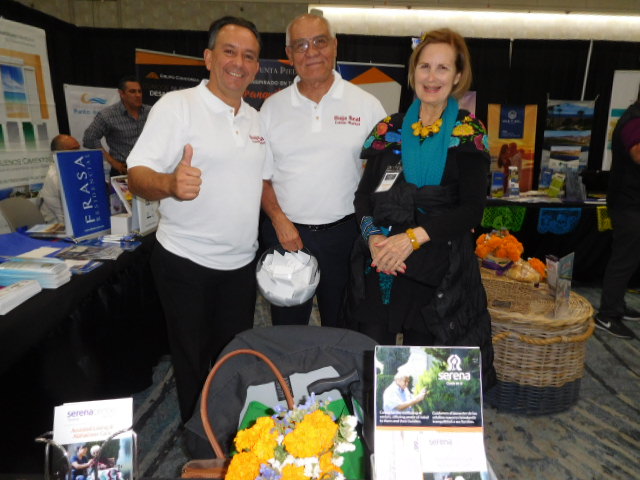
On November 2 the newspaper San Diego Union-Tribune hosted a free event that attracted a 50+ crowd interested in subjects related to aging. Main speakers were Patricia Schultz (author of 1000 Places to See Before You Die) and Captain Dale Dye, USMC retired (author, filmmaker) focused on veterans and others.
November 2, 2019
Most of the activity at the San Diego Convention Center was at booths. Among the participants offering information were AARP, Leading Age, healthcare service providers, a cancer awareness initiative group, estate planners, Medicare Advantage Plan insurers such as Humana and SCAN, retirement counselors, senior movers, senior living placement consultants, a sleep therapy advisor, and others.
The highlight for me, related to some of my work as a senior placement consultant for Mexico, was to meet up with Miguel Angel Torres and Marisa Molina of Serena Senior Care in Baja California. I toured their Rosarito assisted living home last year and am eager to return to see their latest developments. I appreciate their dedication, enthusiasm, and focus on quality care. See www.serenacare.net plus links to videos found on their web site.
As an aside, Serena offers residents and visitors to Baja a Full Assistance Card for $99/year ($198 per couple). The Full Assistance Card offers ambulance services, roadside assistance, a 24-hour bi-lingual call center, discounts, and access to online medical records. Have not seen this service in action so am not in a position to comment on it. Information on this is at the web site listed above.
Miguel Angel Torres, one of his supporters, and Wendy Jane Carrel Assisted Living Consultant for Mexico at Serena Care booth
Corey Avala of www.RetireBaja55.com was also present to encourage folks to retire early and “affordably” to one of three developments he is involved with. Have not seen them.
Jane Garcia, a realtor from Dream Home Mexico was also there to espouse the benefits of retiring to Mexico.
One of the advantages of Baja California for assisted living and retirement, aside from the lower cost of living, is its close proximity to San Diego for health care through the Veteran’s Administration, and U.S. healthcare for American ex-pats who wish to return in case of need.
Many thanks for the warm reception by the San Diego Union-Tribune sponsor team! Many thanks to the San Diego Union-Tribune for producing the San DiegoEldercare Directory 2020 available in print at the expo, and also available on-line at http://www.sandiegoeldercare.com. The directory includes listings of independent living and long-term care throughout San Diego County.
I always look forward to addressing folks from Canada, Europe and the U.S. at Focus on Mexico one-week seminars, currently held every two to three months at the Real de Chapala Hotel, Lake Chapala, Mexico.
Most attendees are considering a move to Mexico for a variety of reasons – adventure, climate, housing costs, more affordable healthcare, retirement, and more!
Placard in front of modest assisted living home, Jocotopec, Lake Chapala
The newbies will see my Power Point presentation Thursday morning, August 8, outlining various models of senior living and senior care in Mexico – government, non-profit, and for profit independent living, assisted living, memory care, and Life Plan Communities/CCRC’s. My photos of senior living options are from various states in Mexico from Baja California to Merida in the Yucatan, all ex-pat havens.
To date, Lake Chapala attracts the fastest growing and largest community of ex-pats in Mexico.
I am a Spanish-speaking senior care specialist for Mexico, serving Americans, Canadians, and Europeans who are discovering they may not be in a position to retire, or, may outlive their savings. They are looking for more affordable aging options at home or abroad.
Where are these retirees choosing to move if going abroad?
Mexico … for the most part, because of its proximity to Canada and the U.S., milder weather, opportunities for new life adventures, and most of all, access to medical and senior care at one-third to one-half less than at home – a major concern, just in case, even for those who are super fit and who follow a healthy lifestyle.
This boom is no surprise to developers from Canada, Mexico, Spain, and the U.S. who have anticipated the rise in the number of retirees from Canada and the U.Sfor over 10 years – to Baja California, Mazatlan, Oaxaca, Puerto Vallarta, San Miguel Allende, and the Quintana Roo/Yucatan states where Merida and Cancun reign. Large numbers of ex-pats continue to arrive.
Many new retirees – boomers, boomers bringing parents, and some Gen-Xers – love technology, travel, and learning. They like to drive, to explore. Some will continue to work on-line. More than anything they enjoy their independence. They seek ways to live more economically, and, use Mexico as a home base for more travel.
They have unique interpretations of what independent living means. Generally, the vision is of a person 50 or older, usually but not always retired. The overriding lifestyle goal is AGING IN PLACE either within a community where one is self-sufficient, or in a community providing services such as meals, laundry, cleaning, and transportation.
Mexico is preparing to offer a variety of such choices in beach environments or the colonial highlands.
However, unlike the U.S., retirees must not expect choices as diverse as an all Hindu, laughing yoga, retired postal worker, artist, Japanese, or Presbyterian senior community, nor any development as large as a Sun City.
The most aggressive housing expansion has been at Lake Chapala, one hour south of Guadalajara, Mexico’s second largest city, which also boasts an international airport.
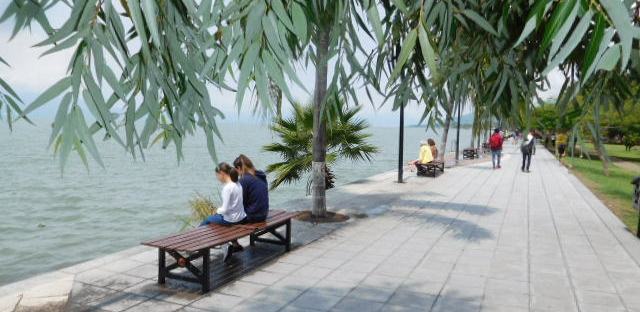
Ajijic malecon, Lake Chapala, Mexico
What kind of housing are retirees finding at the lake?
If not stand-alone private homes, most retirees are on the look-out for living akin to 55+ communities near golf courses, shopping, gyms, spas, and the company of other ex-pats.
What’s in the offing at Lake Chapala?
Three large construction projects – two Life Plan Communities with independent living (with moves to assisted living or nursing care as part of a long-term plan), and one “luxury” development of condos and casitas not unlike already existing communities known as El Dorado, El Parque, or The Raquet Club replete with tennis courts, pools, a club house, gym equipment, and gardens. The new projects may open by 2021.
The two newest additions for independent living at Lake Chapala are:
Namaste Lake Chapala Community tiny houses, a co-housing enclave in the village of Ajijic. Its founder is American James F. Twyman, a body/mind/spirit author and musician who travels the globe as a “peace troubadour.” The Namaste community opens its doors to the public for morning meetings to discuss or review A Course in Miracles.
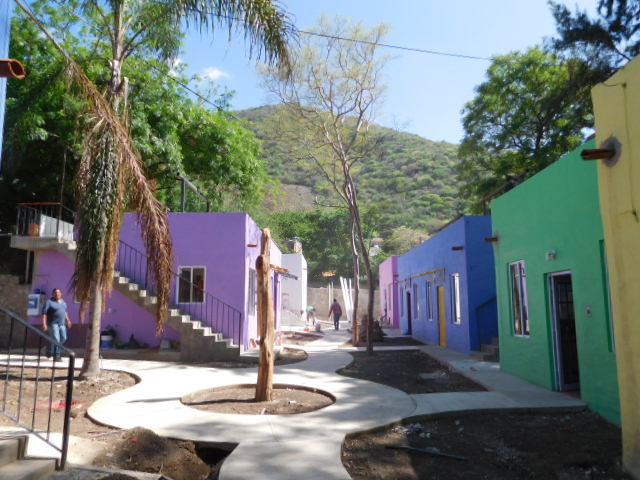
Namaste Community Patio, Lake Chapala
Namaste offers 12 brightly painted homes providing 300 SF to 600 SF of living space, each with kitchen, bath, and living areas. The Namaste concept is to age in place affordably, bringing healthcare in should it be needed. Meals are communal, or taken to your residence if you wish silence.
Namaste Co-Housing Community, Lake Chapala, Mexico
Namaste Co-Housing Communty, Lake Chapala, Mexico
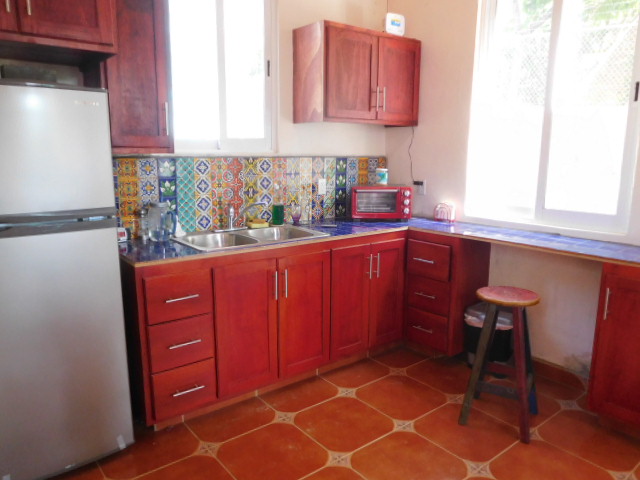
First Completed Namaste Tiny House Kitchen
As of this writing, all but one of the homes have been purchased and/or rented. For more information see www.NamasteLakeChapala.com or call Kerri Moon, Head of Sales, at (510)250-3002, a U.S. phone number.
Ohana Independent Living in San JuanCosala, 20 minutes west of Ajijic, is the other newbie. The owners are bi-lingual geriatric nurses. Even though there is no assisted living or nursing care at their two story independent living home on the lake, folks with walkers who can take care of themselves are welcome. An elevator is currently being installed.
Ohana Independent Living main gate entrance, Lake Chapala
Ohana Independent Living is located on a large lakefront estate with sprawling lawns, close to nature. There are 12 rooms. Each residence has mountain or lake views. There is a balcony on the second floor facing the lake. Rooms are partially furnished or decorated to one’s preferences. Dogs are welcome. Meals are included, as well as laundry, maid service, and parking. There is no web site. For more information call Alonzo Garcia at 52 331 495-6167.
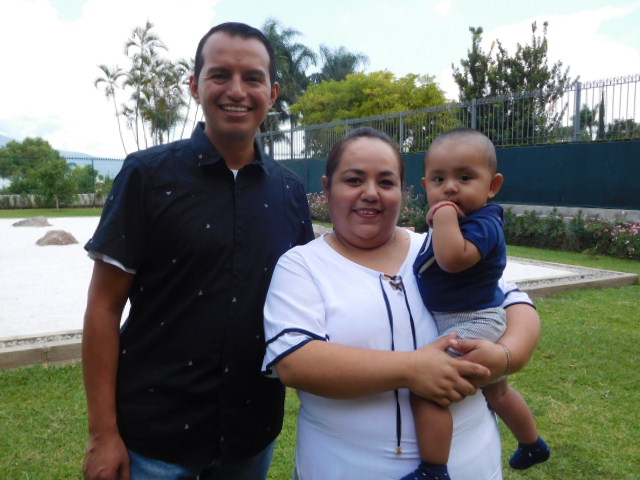
Alonzo, Ana, and Adam bi-lingual owners of Ohana
Patio at Ohana Independent Living, Lake Chapala
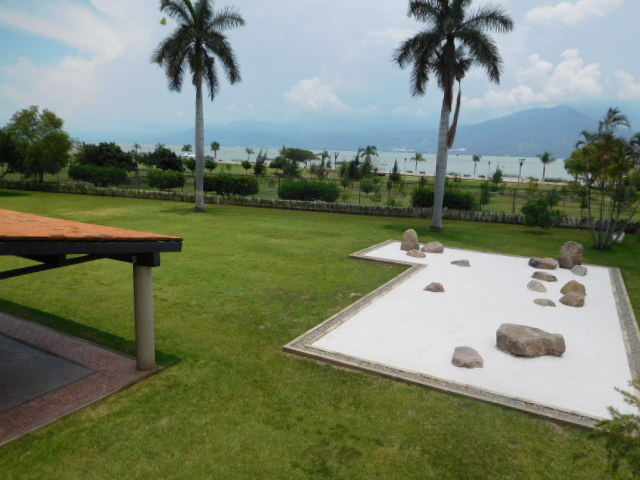
Cloudy day view of Lake Chapala from Ohana Independent Living
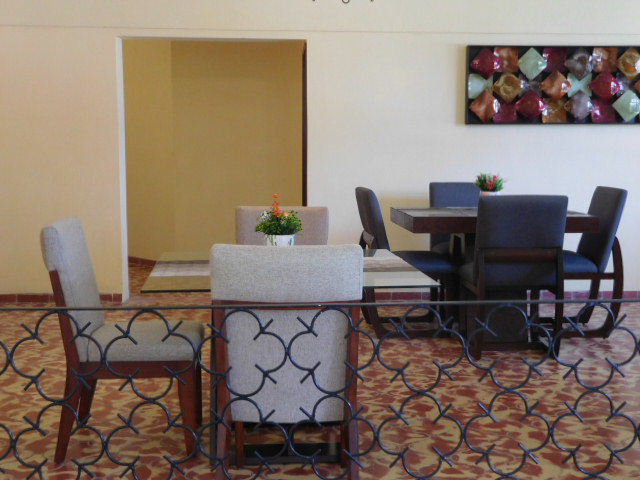
Dining room, newly opened Ohana Independent Living, Lake Chapala, Mexico
Summation:
There are currently three independent living residences with meals, laundry, maid service, and parking for your car at Lake Chapala. There is a fourth residence, owned by a physician, with no parking. If you became seriously infirm at any of these places, you would be required to move somewhere else. Monthly fees range from $1200 to $1800/month USD, the average cost of Mexican assisted living with no frills.
There are another four communities designed as individual apartments for older adults. Stretching the interpretation, there are about seven more that have a community feel but are exclusively rentals; the renters happen to be older adults. There are also four hotel apartments, some with kitchens, rented long-term by older adult ex-pats.
There are two intentional co-housing communities. Other than Namaste there is Rancho La Salud Village in West Ajijic. It consists of a group of larger homes created for aging in place and green, sustainable living. There are no communal meals, each resident is on his or her own. RLSV was founded in 2010 by Jaime Navarro and his wife Sara Villalobos, together with “green” architect Rick Cowlishaw. See www.ranchollasaludvillage.com
As of this writing, other “independent living” and/or senior living projects for ex-pat retirees are in the works throughout Mexico awaiting, for the most part, American and Canadian boomers.
Wendy Jane Carrel, MA, is a Spanish-speaking senior care specialist and consultant from California. Over a period of several years she has traveled state to state in Mexico researching health systems, senior care options, end-of-life care, and disposition of remains. She volunteers at the only 24/7 palliative care hospital/hospice in Jalisco that also has a community outreach service. http://www.WellnessShepherd.com or contact her at wellnessshepherd@aol.com.
You have permission to re-post the entire article when you include author’s name, biography, and contact information as above.
Throughout 2018, I have been invited to address Focus on Mexico participants, a lively and engaged group of mostly retirees from Canada and the U.S. curious about Mexico, curious enough to perhaps make a move.
I talk about senior living options, including possibilities at Lake Chapala.
I share a power point presentation with a few statistics and show photographs based on several years of due diligence and relationship building in 16 states of the country. I review independent living, assisted living, and nursing care – what’s here, what the differences are from home, what’s missing, and what is being created for the next generation that may be in need – boomers.
My VOLUNTEER talk shares an insider’s view for those who wish to consider living south-of-the-border. Other speakers focus on real estate, banking, buying cars, health insurance, medical care, bringing pets, etc.
My next talk is the week of October 29, 2018.
Wendy Jane Carrel with Michael Nuschke, Director of Focus on Mexico, addressing participants
If you are interested to learn about Focus seminars and activities, please see their web site at http://www.FocusonMexico.com. The popular education group is celebrating its 20th year.
Note: My articles are posted on http://www.WellnessShepherd.com. Sometimes they are re-posted on other web sites. If an article does not have my by-line, it is not by me. And, I do not post lists.
Some folks with good intentions, but without senior care experience and/or education, write articles and create lists with recommendations. Unless they are health care professionals, they may not be conversant with possible challenges of moving older adults from one nation to another, where the staff turnover is high, how the staff is trained, how med management is handled, what the activities are, and other subjects related to quality of life.
Gardens at Casa de las Lunas in Puerto Vallarta with independent living, assisted living and respite care, private pay
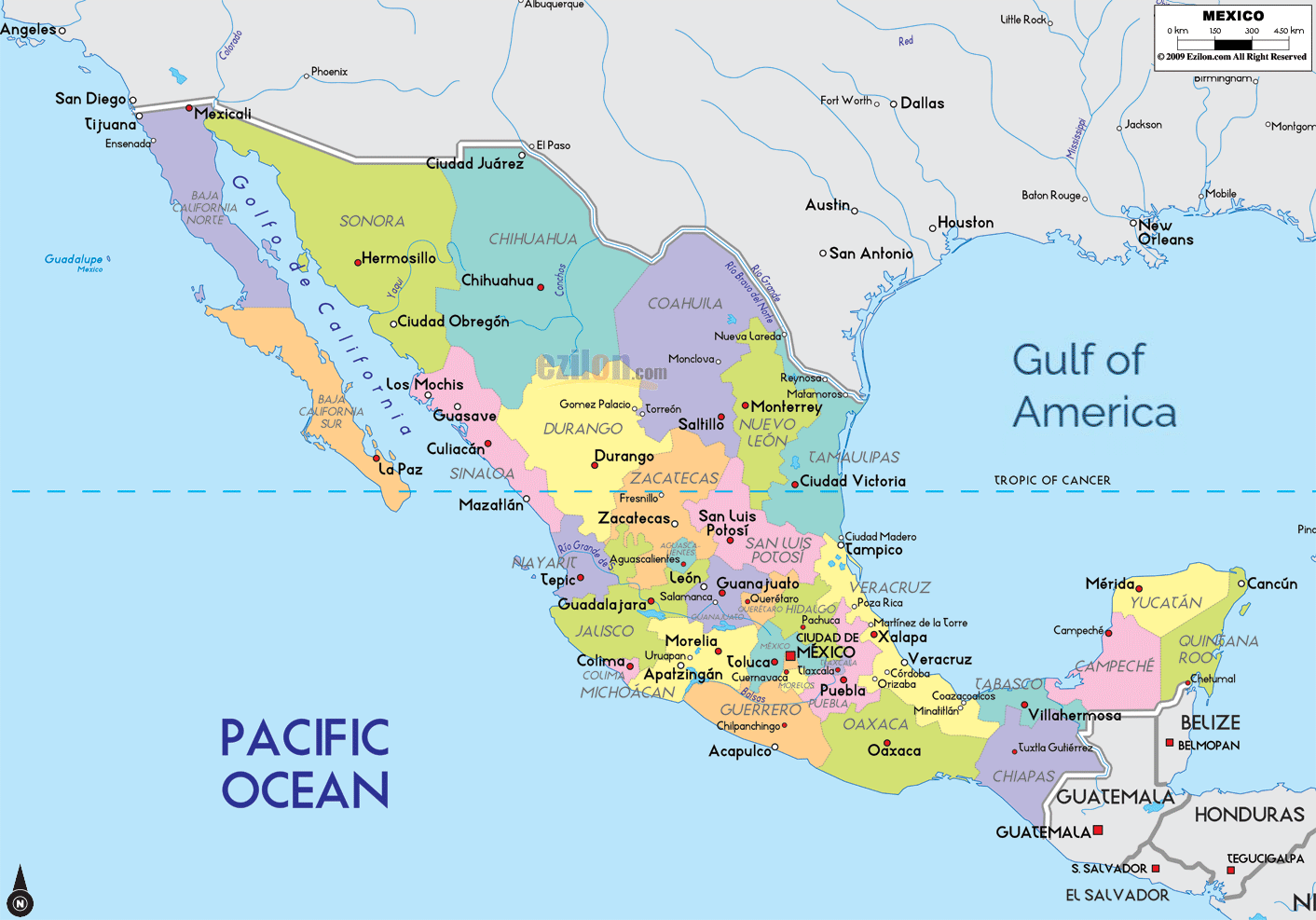
According to realtors at Lake Chapala, Mexico, and the information desk at the Lake Chapala Society in Ajijic, the popular ex-pat retirement destination has received more than double the no. of potential renters, buyers, and information hungry folks from Canada and the U.S. than in years before. (Other popular retirement destinations are also seeing an increase in activity – see no. 3 below).
Among visitors intent on moving are travel aficionados looking for a unique cultural experience, the prospect of meeting stimulating people from all parts of the world, but more importantly, an opportunity to stretch their dollars.
And then there is senior living and healthcare, a subject of interest for most. For “sandwich-generation” boomers who lost savings and/or homes during the American recession of 2007-8, or spent savings for the education of millennial children or grandchildren, many are finding there may be little left for themselves or parents if assisted living or nursing care are ever required.
An added concern is that funding for Medicare and Medicaid in the U.S. are currently being challenged.
Alma, a non-profit home for 40 residents in San Miguel Allende
If the cost of assisted and continuing care in Canada (Canada takes care of its disabled, ill, and older adults through universal care programs but there is also private pay care) or the U.S. is not an option, there are more affordable options in other countries. The closest place to look is Mexico.
Here are guidelines for looking at assisted living and continuing care in Mexico, costing between $600 USD to $3500 USD/month, depending on the value of the American dollar and the Canadian dollar vs. the peso, the location, and the residence you choose:
Take note – in Mexico the terms assisted living and “nursing home”are often one and the same, with exceptions. Care facilities are not known as they are north of the border – assisted living, rehabilitation, nursing home, and hospice. It is often an all-in-one approach. Also, with some exceptions, homes mix physically disabled residents with memory care residents.
Select cities or areas you wish to be in for climate – coastal, desert, mountains. (Coastal tropical places cost a little more because A/C is expensive).
If the future resident does not speak Spanish, seek places with ex-pat communities and English-speaking locals who are often a source of volunteers – Baja California Norte (Ensenada, Rosarito Beach, Tijuana), Cancun, Lake Chapala, Mazatlan, Mexico City, Puerto Vallarta. Or, choose smaller places such as Merida, and San Miguel Allende. Some care homes have all foreigners as residents, others locals and foreigners together. Usually one person on staff speaks English, sometimes more than one.
Do the due diligence. Research places and determine costs. Most assisted living and “nursing homes” catering to foreigners have web sites in English easily found on Google Search.
Consider private pay homes and non-profits, as well as residences run by nuns whether you are Catholic or not. Nuns often (but not always) provide quality care as most are nurses with a mission to serve, plus costs tend to be what Mexicans would pay if price is a consideration. Another level of care is found in government homes, some pleasant others not; some accept foreigners with residency cards. There are differences in every region of the country, and there are no rules.
Note: no two places will be alike – financially, environmentally, socially, and in terms of care. Homes are not regulated with the strict standards one is accustomed to in Canada and the U.S. However, there are places with quality care and high standards.
Conduct site visits. Assess for yourself what might be an acceptable match in terms of environment and people. Would you or your loved one feel comfortable and safe? Do you like the space, the staff? How are you welcomed? Do residents seem cared for or are they alone in “God’s waiting room” without attention and activities? Ask residents what they like best and what they don’t like. How clean is the home? Standards differ from place to place. Arrive at meal time… is there enough assistance for each resident? Is food fresh, nutritious, and nicely presented? Is it food you would or could eat? Does the home prepare meals compatible with health challenges? What about care plans and medication management? What about emergencies? How are these matters handled?
Patio at a private pay “nursing” home, Casa Nostra, at Lake Chapala
Casa de los Abuelos DIF (government) home for seniors, Morelia – these homes are intended for Mexican nationals but on occasion persons with residency visas who pay are accepted, depends on the place and availability
There are no simple answers for selection.
Ideally, we would all have perfect health to our last days and an abundance of funds which would allow us to receive the best possible care wherever we choose to live.
Note: CCRC’s (Continuing Care Retirement Communities, from independent living to demise), now referred to as Life Plan Communities, have not arrived in Mexico, with one exception. There are plans in the works for Life Plan Communities in Baja California, Cancun, and at Lake Chapala from American, Canadian, Mexican, and Spanish developers.
Throughout Mexico, children and grandchildren make a point of spending time with their elders on August 28. They also bring gifts. This year, because the official day is Monday, most festivities and visits were held over the weekend.
Note: The tradition of celebrating Grandparents Day was instituted in 1983 under the presidency of Lazaro Cardenas. During the 1990’s, announcer Edgar Gaytan promoted the special day on a radio program dedicated to older adults. It has become an important event for families.
Arriving at Ohana Assisted Living, San Juan Cosala, Jalisco, Mexico for Grandparents Day Celebration
This year, Ohana Assisted Living in San Juan Cosala at Lake Chapala in the state of Jalisco honored its residents with a grand party that included relatives and friends, staff, folkloric dancers, an extraordinary jazz band with musical choices remembered by the generation of residents, and a beautifully prepared buffet. The residents at Ohana are from Canada, Mexico, and the U.S.
Hosts Ana and Alonzo, both geriatric nurses who live on the lovely campus, warmly greeted all. They produced a memorable event.
Ana and Alonzo, geriatric nurses, owners of Ohana Assisted Living
Fabulous Mexican summer fruit at Ohana Assisted Living, known for its quality meals and treats
Grandparents Day cake at Ohana Assisted Living, Mexico
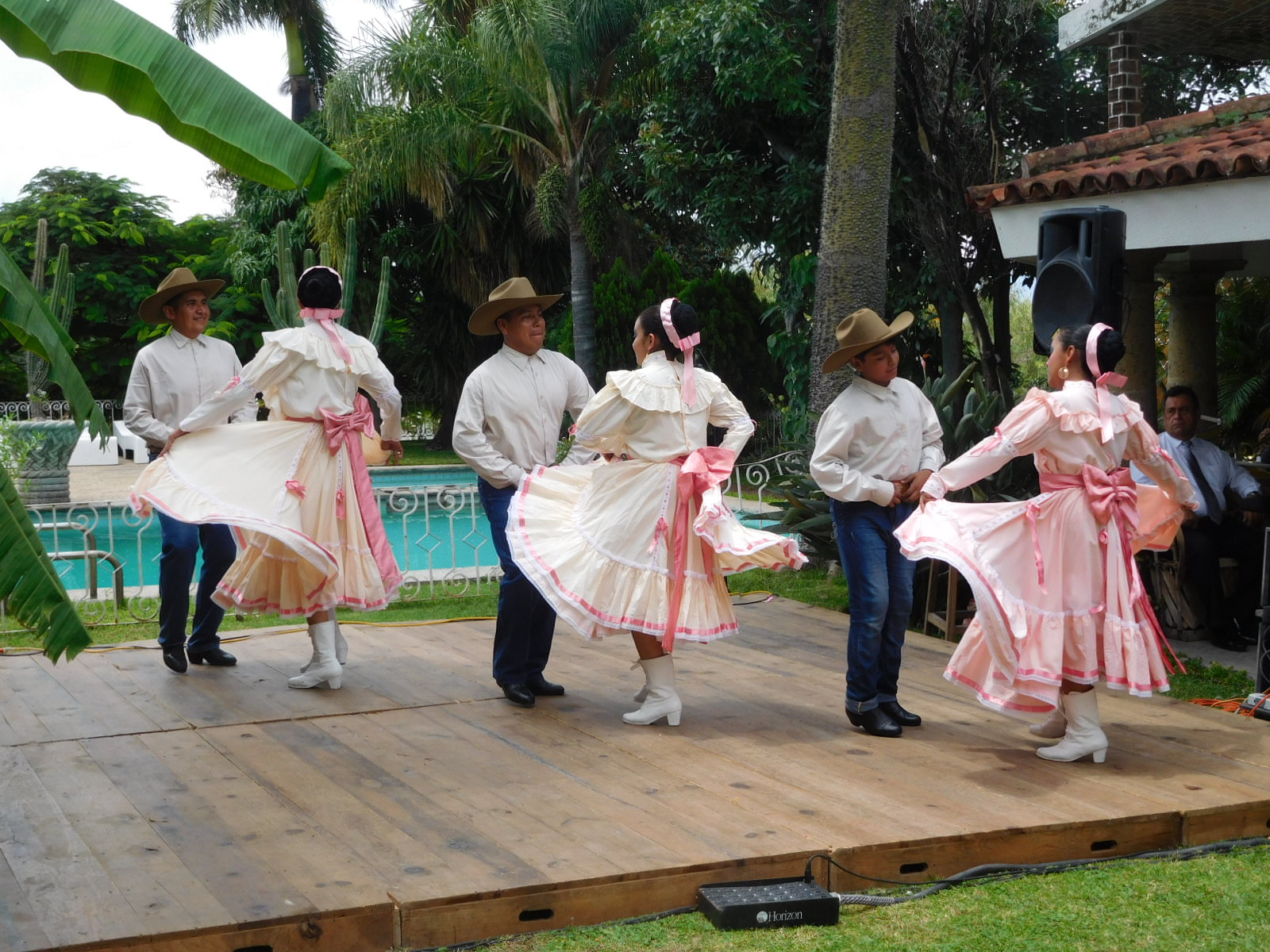
Folkloric dancers near the Ohana Assisted Living pool
The dancers changed costumes three times and by the end of their performances they had gone from pastels to bright and colorful red, white, and black!! Loved the zapadiada dancing. Fun for all.
Grandparents Day Celebration with live jazz band at Ohana Assisted Living, Mexico
Former heavy weight wrestler. salsa teacher, and LA Times writer Ken in rehab after a fall in California, accompanied by adorable caregiversBob, U.S. Air Force retired, with his caregiver who lovingly calls him “joven”, young one because of his bright spirit
The International Day of Older Adults is celebrated, by proclamation of the United Nations, on October 1 every year.
In Mexico this event dovetails with the country’s Senior Day at the end of September. Festivities are held at senior centers, senior homes, and on DIF (government social service) grounds.
For those of you who haven’t been to Mexico, especially Guadalajara, its “tapatio” residents love to sing and dance no matter their age. Being around these folks will automatically lift your spirits. They love to dress up, eat well, and have fun. Most of all, they never give up despite mobility issues or aches and pains.
Tapatio singing seniors
In Mexico there are 7.5 million persons 70 or older. This number is expected to reach 8.5 million in 2020, and 10.2 million by 2030. According to the Mexican government, at 60 you are an older adult. It is unclear why the number of boomers and persons ages 60-70 are not included in the Mexican government statistics (INEGI) reports.
In the U.S. there are 70-80 million adults who will be over 65 by 2020.
This year I attended the Asilo Juan Pablo II senior day festivities (see earlier post September 2016) at http://www.WellnessShepherd.com .
Last year I attended an event at DIF’s Centro de Amistad Internacional (Center of International Friendship) on Calle Eulogio Parra 2539 just off Lopez Mateo in Guadalajara. It was co-hosted by the Office of Older Adults for the State of Jalisco, Mexico and by INAPAM ( the National Institute for Older Adults, est. in 2002). It was held on the first Sunday of October from 10 a.m. to 3 p.m.
Groups of seniors performed dances, ladies were offered free beauty treatments by the Irma de Zuniga make-up academy located on Lopez Cotilla in downtown Guadalajara (www.irmadezuniga.com), there were talks by gerontologists, nutritionists and others experts. Jhre Chacon and his team of healing touch trainees from UNCOA offered massages, Reiki, and other relaxing experiences for the guests. There were also poetry readings and card games.
Tapatio caballeros
older adult folkloric dancers, Guadalajara
healing touch holistic care for older adults, Guadalajara, offered by UNCOA
Queen for a Day make-up gift for older adults, Guadalajara
Ana Maria Luz Garcia, owner of the historic restaurant La Fonda de Arcangel Miguel (www.fondasanmiguelarcangel.com, housed in a colonial convent in the center of Guadalajara), hosted the buffet breakfast/brunch. Garcia is a passionate advocate for healthy living at any age.
Consuelo Manzo Chavez, Director of Older Adults for DIF presided with Alma Solis Montiel, who at the time was the Director of INAPAM but is now the Director General of the Institute for Older Adults for the State of Jalisco.
International Day of Older Adults with Senior Care Advisor Wendy Jane Carrel, DIF Director Consuelo Manzo Chavez, and former INAPAM Director Alma Solis – now Director of the Institute of Older Adults for the state of Jalisco, with unidentified older adult, and human rights attorney Laila Martinez de Santiago
Sweet Zenaida, daughter of Juan Pablo II resident Jose, with precious volunteer Mari who is not only a warm greeter at the home but is part of the outreach to over 30 seniors in the neighborhood
This week Guadalajara, Mexico has seen senior centers, DIF (government social services), non-profits serving older adults, and private sector senior residences celebrating Mexico’s Day of the Older Adult, also referred to as Dia de los Abuelos (Day of the Grandparents). The occasion has been feted every August 28 since 1982.
Guadalajara’s parish of San Bernardo, a social justice block with a church serving 3,000 parishioners, houses a two floor senior home, Asilo Juan Pablo II, where festivities have been in full force. (The diocese also provides a school for Downs Syndrome children, a rehabilitation home for over 50 men, and a palliative care and hospice with 8 beds and outreach to 65 patients, Juntos Contra el Dolor). The Sr. Cura of the Church, Father Engelberto Polino Sanchez is the guardian for the community.
On Saturday, August 27, DIF sponsored a breakfast for the 52 male and female residents. On Sunday, August 28, Father Engelberto celebrated mass. Afterward, the older adults enjoyed a meal of pozole (a stew of vegetables, hominy, and pork) served with jamaica (a hibiscus drink), plus live Mexican music provided by an electric piano and a singer. Mexicans love festivities and the seniors at Asilo Juan Pablo II are no different. They were happy campers.
Below are photos commemorating those in support of older adults, as well as the appreciative seniors who live at Asilo Juan Pablo II. It is a Mexican custom for the older generation not to smile too quickly in photos. An exception, the charming church priests below with their energy of light…
Sr. Cura Engelberto who presided mass for the seniors on Mexican Day of Older Adults pictured with Padre Francisco of Templo de San Bernardo, GuadalajaraReverent seniors, about 30 of whom are wheel chair bound at Asilo Juan Pablo II, Guadalajara, attending mass on Mexico’s Day of Older Adultssenior who is not feeling well with Alicia, an adorable favorite enjoying pozoledisabled senior with super attentive wife who kindly dances with and cheers up other seniorsSeverely disabled man Eliseo who is not a senior, rescued from the street and given a home at Asilo Juan Pablo II. He is popular for his enthusiasmDancing at Day of the Older Adults, Asilo Juan Pablo II, Guadalajara, Mexico
Note: The Juan Pablo II home, a non-profit, is well run. There are challenges with raising funds and providing enough for the residents. The home survives successfully, none the less. Seniors with pensions pay for private or shared rooms. There are indigent seniors who have been rescued. One disabled man around the age of 50, was found in the streets and is living most contentedly at the assisted living, as mentioned in photo above.
The dedicated administrator Bertha C. Gonzalez offers a clean, efficient service with good standards for quality of life in Mexico, up to and including Mexican carino (kindness and care). She hand selects and supervises a team of nursing assistants and nurses, many of whom are sent by various schools to train at the home. Every day there is occupational therapy and some form of physical workout. Every other day there is entertainment, among other activities. Many residents are talented artists, handicrafts experts, and poets. The home is connected to the large church so that those in wheelchairs can attend services easily. Being Catholic is not a requirement for residency. The home is currently full. There is a waiting list.
The senior home has outreach to around 30 elders living in the neighborhood through its volunteer group Asilo en Salida. Mari, featured in the first photo, also goes out with the group. For more information about the activities write to asiloensalida@gmail.com
Contact info:
Asilo Juan Pablo II Pro Dignidad Humana, AC asilojp@prodigy.com.mx
Av. Plan de San Luis #1616 Col. Mezquitan Country tel. 3824-5368
Sr. Cura Engelberto Polino Sanchez, Director General
Bertha C. Gonzalez, Administrator Maria Delores Cortes, social worker
Not long ago I addressed a group of Canadians and Americans at an Open Circle chat at the Lake Chapala Society in Ajijic, Mexico. Most of the attendees were full-time residents with the lay of the land, but curious newcomers attended as well.
The most meaningful part of the presentation? Introducing American and Mexican senior living owners to the audience. After the chat they were able to become acquainted with one another.
In the photo below, four Mexican registered nurse owners are represented. I am the person holding the microphone.
Senior Care Specialist Wendy Jane Carrel introduces owners of Senior Homes at Lake Chapala to Americans and Canadians
If you cannot afford healthcare or retirement in Canada or the U.S., what are your options? Where do you look?
For the last five decades, and especially since the U.S. economic challenges that became apparent in 2007-2008, retirees have been choosing destinations in Asia, Europe, and Latin America.
Despite news about crime and drug cartels, Mexico reigns as the number one choice for most American and Canadians, primarily because of its lower costs, warmer weather, health care choices, and location so close to home.
According to U.S. Consulates in Mexico there is a current count of between 1.2 – 1.4 million Americans living in Baja California, Cancun, Lake Chapala, Mazatlan, Puerto Vallarta, San Miguel Allende, and other areas. (The number also includes Americans who are not retired). According to the Canadian Consulate in Guadalajara and the Canadians Abroad Registry, approximately 10,000 Canadians are registered in high season and 1,500 are registered as retired full time in Mexico. Not all Canadians register.
Choices for senior living in Mexico are not all that dissimilar to those in Canada and the U.S.:
Aging in Place – independent living in your own home or apartment
Aging in Community – co-housing
Assisted Living – if you require care and cannot afford full-time care at home
Nursing Care and Rehabilitation
Lake Chapala
Currently, at Lake Chapala, Mexico there are in the neighborhood of 20,000 retired Americans and Canadians.
North shore Lake Chapala, which includes the communities of Ajijic, Chapala, Jocotepec, San Antonio, and San Juan Cosala (40 minutes drive time from one end of north shore to the other), has several options for senior living with others being planned.
What is different from Canada and the U.S. is the cost of living, especially for health care, often up to two-thirds less.
What is also different is that there are no Life Planning (continuing care) models at Lake Chapala. A project was planned three years ago and has yet to be built. There is one, however, that will open in Mexico City sometime this fall.
Another difference is that in Canada and the U.S. Alzheimer’s and dementia patients are in separate areas on a campus. In most of Mexico, dementia patients are living and sharing the same space with older adults who have mobility issues, not dementia issues, and the care is rarely specialized.
Mexican senior homes are under the purview of the Ministry of Public Health and local fire departments. They are not tightly regulated and inspected as they are in Canada and the U.S.
What is available at Lake Chapala now?
Three co-housing/independent living options – one in Ajijic with three individual apartments and five casitas, a pool, lakeside views, and two meals a day; one in Riberas del Pilar on two levels where residents have their own apartment, are provided with two meals a day, and have access to a library, a gym, and a pool; and one in San Juan Cosala, focusing on health, green living, and sustainability.
At the first two if you become immobile or develop serious health issues you would need to move. At the property in San Juan Cosala (in development) you can invite caregivers to your living quarters.
Three assisted living homes specializing in Alzheimer’s and dementia care – one is run by a geriatrician and a nurse, the other two by nurses with doctors on call. One of these homes plans to add a second home in the near future for a total of four dedicated Alzheimer’s care homes at the lake to meet the growing need.
Six homes combine assisted living, nursing and some rehabilitation.
That number climbs to seven if you include two rooms above the offices of a physician in Ajijic (no rehab), and 9 if you include one owner who has three homes (no rehab).
It climbs to 10 choices with an American-owned recovery care center for plastic surgery (more like a B & B) where you can also rent suites. The recovery center has been in existence for almost 20 years.
The total number of choices reaches 11 if you include a low-income senior home in Chapala which also has Mexican residents.
Four properties have owners who live on site. These properties are either American- or Canadian-owned, or, owned by English-speaking Mexicans who focus on serving the expat community. There usually is one person who speaks English at the senior living options at Lake Chapala.
The above-mentioned places are private pay. Monthly costs for private pay assisted living at Lake Chapala range between $1,000 and $2,000 U.S. per month except for the home in Chapala. (The average U.S. private pay is $3200-$3500, and up to $12,000/month or more for Alzheimer’s care).
Most care homes at the lake have 12 or fewer residents. Service is considered personalized. In many instances there is the quality of “carino,” caregivers treating you like a lovable member of the family.
There are 125 senior living homes in the state of Jalisco, housing 1,723 elders. These numbers include only Mexican citizens. Not included are Americans and Canadians at Lake Chapala or in Puerto Vallarta. There are approximately 758,000 older adults in Jalisco state.
In Guadalajara, an hour from Lake Chapala, there are three models of senior care – private pay, non-profit care primarily with nuns (usually excellent quality), and government care (usually DIF, a social services entity that exists throughout Mexico). Prices range from gratis for the indigent to around $400-$800 U.S. for those with pensions, and up to $3500 U.S. for private pay.
Note: I have met Americans with incomes of $600 or less/month who are living comfortably and safely in Mexican assisted living homes throughout the country.
AMAR, the Mexican Association of Retirement Communities (Asociacion Mexicana de Asistencia en el Retiro), is hosting AMAR’s International Convention 2014 at Rosarita Beach Hotel, Rosarita Beach, Baja California, October 23-25, for North American and Mexican senior housing industry professionals and the public. Rosarito Beach is 20 miles south of San Diego, CA in Mexico.
The event focus, part of a continuing dialogue, is how to attract a portion of North American Baby Boomers over the coming years to senior-friendly, affordable destinations in Mexico with ideal weather, health services, infrastructure, and proximity to the U.S. It is anticipated that of 100 million boomers in Canada and the U.S., 4 million will consider living in Mexico. According to Internet statistics, there are currently 1,400,000 to 1,600,000 U.S. citizens living in Mexico, not all retirees.
Experienced Canadian and U.S. senior living developers, operators, and executives will meet to discuss collaboration possibilities with Mexican developers and investors.
Among the 22 scheduled speakers are Americans Martin Lakatos, VP and developer for California based Front Porch Development Company; Patricia Will, CEO of Belmont Village Senior Living (23 Assisted Living properties across the U.S. and one in development in Mexico City); and Matthew J. Downs of the Center for Medicare Portability. Javier Govi, Founder & CEO of AMAR; Ignacio Bernal of FONATUR (a Mexican government entity which plans and develops top tourist destinations); and Rodrigo Contreras Mejia of PROMEXICO (a Mexican government trust for international trade and investment) will be among the speakers from Mexico.
Subjects will include elements for successful operation of CCRC’s, active senior living, and Alzheimer’s and dementia care with holistic/wellness-based concepts, eco-friendly LEED-certified construction, universal design, and health information technology. Topics will also include the state of MOM and POP projects, aging in place communities where services come to you, and Medicare in Mexico. (Medicare is not yet accessible outside the U.S. unless under rare circumstances. American seniors can purchase Medigap emergency plans C, D, F, G, M, or N with a $250 deductible).
Lic. Javier Govi, Founder & CEO AMAR
When asked about the current state of senior living and its future in Mexico, AMAR’s Javier Govi stated, “We currently cater to the mom and pop market, the parents of baby boomers. We are simultaneously transitioning to meet the needs of boomers who have begun to retire. We have spent years studying this market, looking at the history, and visualizing the future. The important components for boomers will be wellness, fitness, and a holistic approach.”
An adjunct part of the event is the 50+ Expo and Workshops for Healthy Living where the public can learn about senior living options in Mexico.
AMAR Friends Foundation, which helps retirees find independent or assisted living in Mexico, is sponsoring the 50+ Expo. Seminars are designed “to answer questions from banking to moving belongings, and what is involved in obtaining a residential visa,” added Govi. The expo also includes product displays and music. The foundation will soon be providing social service projects for poor elderly Mexicans through its North American volunteers. See http://www.amarfriends.org.
AMAR, founded in 2007, is the first national Mexican non-profit organization committed to educate and collaborate with Mexican government regulatory agencies and business executives in Mexico and North America on the potential of the senior housing industry in Mexico.






















 Wellness Shepherd